
Zero-click SEO measurement should combine search visibility, website visits, verified customer actions and business outcomes. Keep each layer separate. An impression is not a visit, a call-button click is not a completed call, and a brand mention in an AI answer is not a sale. Website traffic still matters; it simply cannot explain the whole customer journey by itself.
For an Indian business, the practical starting point is a small reporting system that joins Google Search Console, GA4, relevant Business Profile activity and a lead or order register. This guide explains the definitions, a step-by-step dashboard structure and a worked example. Sources were checked on 7 October 2026.
What is a zero-click search—and what is it not?
In its strict sense, a zero-click search ends without the user clicking through to a result. Industry studies sometimes use different boundaries, such as no click to an external website. Always read the study’s definition before comparing figures.
“No visit to our website” is a different statement. A person might visit a competitor, call a business from a search interface, refine the query or return later through another channel. Your site’s analytics alone cannot tell you which occurred.
AI summaries, direct answers, knowledge panels and local results can satisfy part of a need before a website visit. They can also help a person decide which website to open. The presence of a feature is evidence about the search layout, not proof that every searcher stopped there.
A useful research example is Pew Research Center’s July 2025 analysis of 900 US adults’ March browsing. Traditional-result clicks occurred on 8% of visits with an AI summary versus 15% without one. This was an observational association, not an India 2026 benchmark or proof that the summary alone caused the difference. The later retrieval of search results is another methodological limitation.
Why can’t you calculate zero-click rate as 100% minus your CTR?
Search Console CTR is your reported clicks divided by your reported impressions, within the selected scope. It does not observe every destination a searcher could choose. If your CTR is 2%, the remaining 98% is not a measured zero-click rate for Google.
The same problem appears when a dashboard divides all GA4 sessions by GSC impressions. The systems count different events, use different scopes and may use different time zones. Consent, tracking and attribution also affect analytics collection. A comparison can support diagnosis, but the quotient should not be labelled a validated search conversion rate.
Use the Search Console definitions of clicks, impressions and position when naming metrics. Average position is a reported average across relevant appearances; it is not a stable promise that every customer saw the same result in the same place.
Which four layers should your SEO dashboard measure?
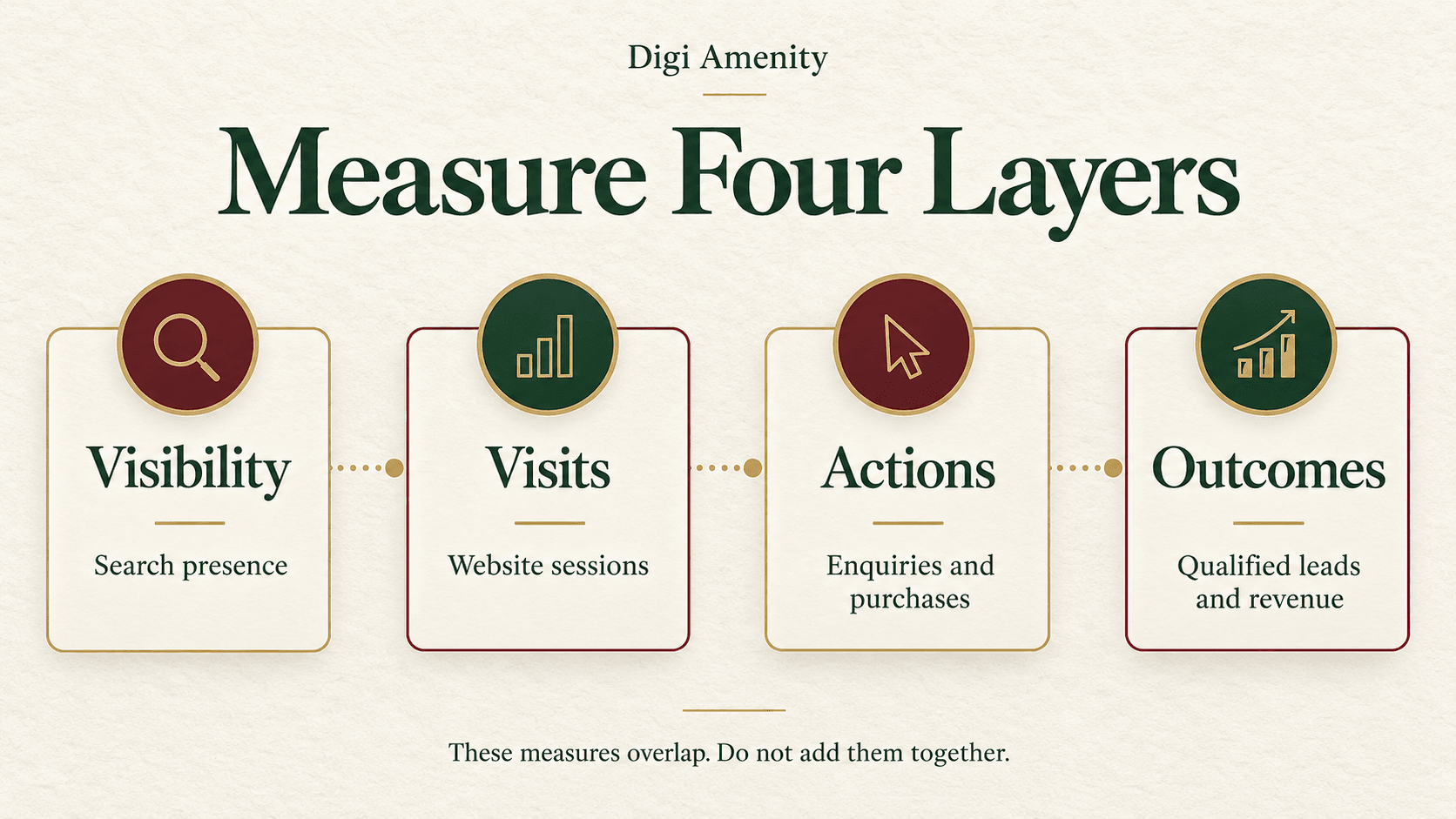
| Layer | Useful measures | Interpretation limit |
|---|---|---|
| Visibility | GSC impressions; AI-feature impressions; documented search observations | Being shown does not establish attention, recall or influence |
| Visits | Relevant organic landing sessions; identifiable AI referrals; engagement | A session is not a unique buyer or a qualified enquiry |
| Actions | Successful enquiry submissions, purchases, calls, bookings | Define precisely whether a measure is a click, completed action or recorded interaction |
| Outcomes | Qualified leads, accepted opportunities, won customers, net order revenue | Attribution is an agreed reporting model, not automatic proof of incremental impact |
Put business outcomes near the top of the report, with visibility and traffic explaining what may have changed. Keep a data-quality note beside every unavailable measure. A blank labelled “CRM source not captured” is more useful than an invented zero.
What changed in Google’s AI reporting in 2026?
Google announced dedicated generative AI performance reports on 3 June 2026 and says they reached websites worldwide on 31 August. AI visibility remains included in overall performance. Do not add the dedicated figure to the overall figure as extra exposure.
The current Search report documentation covers impressions for AI Overviews and AI Mode, with page, country, date and device views. It does not document a corresponding dedicated click, query or conversion breakdown. Search Labs experiments are excluded. A missing report can reflect insufficient impressions; it is not evidence that the site is absent from Google’s index.
There is also an export trap: Google says unavailable symbols can become zeros in downloaded data. Preserve the original state or annotate affected cells before treating those numbers as real observations. This matters when a manager compares “zero AI visibility” with a prior month.
How do you build a zero-click SEO dashboard step by step?
Step 1: Define a business outcome before connecting charts
For lead generation, write the qualification rule with sales. A hypothetical agency might qualify an enquiry only when the service need, contactability and geographic fit are confirmed. That is an example, not a universal lead definition.
For ecommerce, distinguish placed orders, paid orders, cancellations, returns and net revenue. A checkout event is not a paid order. If cash-on-delivery orders matter, report the appropriate fulfilment or collection stage separately so cancelled orders do not inflate success.
Step 2: Validate the event you intend to count
Inspect whether an enquiry event fires after a successful submission or merely when someone presses a button. Check repeat submissions, direct visits to a confirmation page, spam and test activity. Validate the event against the system that actually received the enquiry.
Google’s GA4 key-event tutorial uses a distinct event for the desired action rather than marking every page view as important. Treat the tutorial as an implementation starting point: the business still needs to decide what counts, deduplicate it and confirm the event works on its actual form.
Step 3: Freeze the comparison scope
Choose equal-length, complete periods—for example, two completed 28-day windows. Keep the country, device, search type, page cohort and brand/non-brand classification consistent. Use longer periods when volumes are too small to interpret, and document seasonality.
Maintain a stable list of pages for each cohort: learning guides, comparisons, service pages, categories and product pages. Record newly published or removed URLs separately. Otherwise a larger content inventory can make total impressions rise even while established pages weaken.
Step 4: Export search and AI visibility separately
Save overall Search performance with page-level clicks, impressions, CTR and position. Save the dedicated AI visibility view separately with its available dimensions. Preserve dates, filters and raw exports. Do not infer unavailable AI clicks by subtracting unlike reports.
Use query data to investigate changes in intent, with the understanding that visible query rows are not an exhaustive list of searches. Keep a branded-query definition in writing. A changed spelling rule can change the apparent brand trend without any real change in customer behaviour.
Step 5: Add landing sessions and identifiable referrals
In GA4, inspect landing pages with session-level acquisition dimensions for the question “which visits started here?” Keep first-user acquisition and session acquisition distinct. A person first acquired by paid media can return through organic search later.
Build an AI-referral view from identifiable source values, inspect sample rows and document the rule. Browser or app behaviour can obscure referrals, so this is observed referral traffic rather than all AI-influenced demand. Our UTM tracking guide explains consistent campaign labelling; avoid adding UTMs to internal website links.
Step 6: Reconcile local and offline actions
For a local business, Google Business Profile performance can show call-button and website clicks. Its call metric is a button interaction, not a recording of a completed or qualified conversation. Direction requests also do not establish that someone visited.
Use call handling or booking records where available and authorised. Add an optional “How did you hear about us?” field or sales question, retaining the customer’s actual answer. Do not force an uncertain answer into “SEO.” The Business Profile audit checklist helps check the underlying listing and customer journey.
Step 7: Join the business register without double counting
Give each enquiry or order a stable internal ID. Keep its creation date, source evidence, status and outcome. A single person who submits a form and later calls should not automatically become two qualified leads.
Record a maturity window for outcomes. A B2B lead created yesterday has not had the same opportunity to close as one created two months ago. Compare similarly mature cohorts or clearly label recent outcomes as provisional.
Which formulas are useful?
| Measure | Formula | Required guardrail |
|---|---|---|
| Search CTR | Reported clicks ÷ reported impressions × 100 | Same GSC scope; never label the complement as zero-click rate |
| Session enquiry rate | Sessions with a verified enquiry ÷ eligible landing sessions × 100 | Use sessions in both numerator and denominator; exclude tests consistently |
| Lead qualification rate | Qualified leads ÷ assessed leads × 100 | Report unassessed leads separately; stable qualification rule |
| Win rate | Won customers ÷ qualified leads in a mature cohort × 100 | Same cohort, documented lag and consistent status definition |
| Observed citation coverage | Valid sampled answers citing the domain ÷ valid sampled answers × 100 | Fixed sample protocol; not population-wide market share |
If the denominator is zero or unavailable, return “not calculable” rather than 0%. Do not average page CTR percentages to obtain the site CTR; calculate from the appropriate totals. Likewise, distinguish a percentage-point change from a relative percentage change.
How can fewer clicks still accompany better business results?
Hypothetical illustration—not Digi Amenity or client performance: the same page cohort is compared over two completed 28-day windows, with the same filters and a stable lead definition.
| Measure | Earlier period | Later period |
|---|---|---|
| GSC impressions | 100,000 | 120,000 |
| GSC clicks | 2,000 | 1,800 |
| CTR | 2.0% | 1.5% |
| GA4 eligible landing sessions | 1,800 | 1,600 |
| Sessions with a verified enquiry | 36 | 40 |
| Session enquiry rate | 2.0% | 2.5% |
| Unique qualified leads | 18 | 24 |
Clicks fell 10%, CTR fell 0.5 percentage points, and qualified leads increased by six. This is a reason to investigate the improved business yield—not proof that zero-click exposure created those leads. The offer, page mix, tracking, qualification process or follow-up may have changed.
GSC clicks and GA4 sessions differ in the example deliberately. Do not force them to match by replacing one with the other. If no reliable lead data existed, the conclusion would be “business effect unknown,” even if impressions rose.
How do you decide what to improve?
- Visibility rises; visits fall; qualified outcomes hold: investigate result layout and query mix, retain useful content and test stronger reasons to visit.
- Visibility and position weaken: check indexing, competition, intent and content changes before attributing the decline to AI.
- Visits hold; enquiries fall: inspect forms, mobile experience, offer and lead capture.
- Enquiries hold; qualification falls: inspect audience fit, search intent and misleading promises.
- Qualified leads hold; sales fall: review follow-up, pricing and sales-cycle maturity.
Give a page a useful reason to be visited: a calculator, downloadable checklist, detailed implementation example, product comparison or decision worksheet. Do not hide the basic answer merely to manufacture a click. A clear answer can build trust while the deeper resource completes the task.
A monthly zero-click SEO review worksheet
For each priority page or cohort, record: business purpose; reporting period; comparison period; country/device/search-type filters; overall impressions and clicks; available AI impressions; landing sessions; verified actions; qualified outcomes; missing-data reason; other changes; interpretation; next action; owner; review date.
End the review with one decision: keep, improve, expand or investigate. “Improve” needs a concrete action such as adding a delivery-cost comparison or repairing an enquiry event. “Investigate” is appropriate when the data cannot distinguish a tracking fault from a real decline.
If your SEO report shows impressions but cannot explain qualified enquiries, Digi Amenity can review the search data, landing journey, event definitions and follow-up process together. Discuss the measurement problem through our SEO services.
Download the practical checklist
Download the Zero-Click SEO Review Worksheet (PDF). Use it to record evidence, assign an owner and set the next review date.
Frequently asked questions
Is zero-click SEO replacing traditional SEO?
No. It describes a reporting and content challenge within a broader discovery journey. Technical access, useful pages, relevant visits and conversion paths remain important. Add visibility and off-site action evidence without abandoning traffic or commercial outcomes.
Can Search Console tell me how many users saw my brand without visiting?
It reports impressions under its own counting rules, not a complete count of unique people who noticed or remembered your brand. Use the report for visibility and avoid presenting it as a measured audience-recall or revenue figure.
Can I calculate an AI-specific CTR from the new visibility report?
Not from impressions alone. The documented dedicated report does not supply a matching AI click metric. Mixing overall clicks with AI-only impressions would produce an invalid CTR. Retain the available visibility data and analyse overall traffic separately.
Should branded search growth count as SEO success?
It can be a useful signal, but it can also reflect advertising, publicity, referrals or offline activity. Keep the brand-query definition stable, review other campaigns and present the trend as supporting evidence rather than assigning all credit to SEO.
How should a local business count phone enquiries?
Separate a call-button click, a connected call and a qualified enquiry. Use authorised call or CRM records to confirm later stages where available. If only button clicks are known, label them accurately and leave qualified-call counts unavailable.
What should I do if my analytics data is incomplete?
Record the affected metric, period, reason and owner of the fix. Preserve raw exports and avoid silently filling gaps with zero. Continue decisions supported by reliable evidence while treating the missing business outcome as unknown.
How often should I review SEO performance?
Use a regular monthly business review, with faster checks for technical failures or material changes. Choose complete comparison periods and allow for the sales cycle. Daily movement in a small sample rarely supports a confident strategic decision.
