
AI Max reporting helps you audit which searches triggered your Google Search ads, what message appeared and which landing page received the visit. To make a useful business decision, connect that evidence to qualified enquiries or completed orders. A low reported cost per conversion alone cannot tell you whether the campaign attracted the right customers.
For an Indian business, the practical question is straightforward: did Google match the right customer need to an accurate promise and a page that can fulfil it? This guide explains how to inspect that journey, avoid misleading totals and decide what to keep, improve or investigate.
Documentation checked: 15 October 2026. Google documents a combined reporting view, but the presence of documentation does not confirm access in every Indian advertising account. Check your account before relying on a particular menu or column.
What is AI Max reporting, and what changed?
Google Ads AI Max is a set of features for Search campaigns. It can extend search matching and optimise assets, including text and final URLs. It is not a separate campaign type or another name for Performance Max. Google explains the feature relationships in its AI Max overview.
On 23 September 2026, Google announced reporting that connects searches, creative and destinations. The practical benefit is context: an unusual query may be reasonable when you see the headline and destination together, while a familiar query can still lead to a poor experience.
For example, a business selling annual office-maintenance contracts should distinguish a procurement enquiry from someone looking for a one-off household repair. Both visitors might submit a form. Only one may fit the offer. This is an illustrative example, not a Digi Amenity client result.
Where should you look in Google Ads?
Google’s AI Max reporting guide documents these useful starting points:
| Question | Reporting view | What to inspect |
|---|---|---|
| Which query, message and destination appeared together? | Search terms and ad combinations | Search term, headline, landing page and campaign context |
| Which traffic came through AI Max? | Search terms report | Source column and AI Max match-type filter |
| Where did expanded matching contribute? | Keyword summary | AI Max expanded matches and landing page matches totals |
| Which text did Google create? | Assets | Expanded final URL assets and the Added by field |
| Which pages did automation select? | Landing pages | Selected by field and destination performance |
These views answer different questions. Treat them as ways to inspect overlapping activity, not separate buckets of revenue to add together.
How do you open the combined report?
- Open the relevant Search campaign context and go to the Search terms report under Campaigns.
- Use the report dropdown to look for Search terms and ad combinations. Older references may call it Search terms and landing pages from AI Max.
- Set a fixed date range and record campaign, network and other active filters.
- Inspect the query alongside the headline and landing page, rather than exporting the query alone.
- For a separate AI Max search terms report view, add Source and use the AI Max match-type filter where available.
If the option is absent, record that limitation and work with the available search-term, asset and landing-page views. Do not enable a feature or change a campaign merely to make a report appear. Menu names, permissions and availability should be checked in the actual account.
What should you establish before analysing performance?
Start with the business outcome and the measurement setup. If the campaign counts a WhatsApp-button click as a primary conversion, its conversion count is not automatically a count of conversations, qualified leads or sales.
Write down the conversion actions included in the report, their primary or secondary status, counting settings, attribution settings and expected delay before a lead becomes qualified. Identify duplicates across forms, calls and CRM records. Agree who decides that an enquiry fits the service, location, budget and purchase intent.
Keep a short evidence record: account time zone, date range, currency, campaign IDs, filters, export time and qualification rule. This makes a later comparison reproducible. If the qualification rule changes halfway through a test, record the break instead of presenting the result as a like-for-like improvement.
Our Google Ads Data Strength audit guide covers the broader conversion-data foundation. This article focuses on interpreting query, message and destination evidence once those definitions are clear.
How do you audit a search term without blocking useful demand?
Judge the customer’s likely task, not whether the phrase repeats your chosen keyword. A query can use unfamiliar wording and still describe a profitable need. Conversely, a query containing your service name can refer to jobs, training, free resources or a location you do not serve.
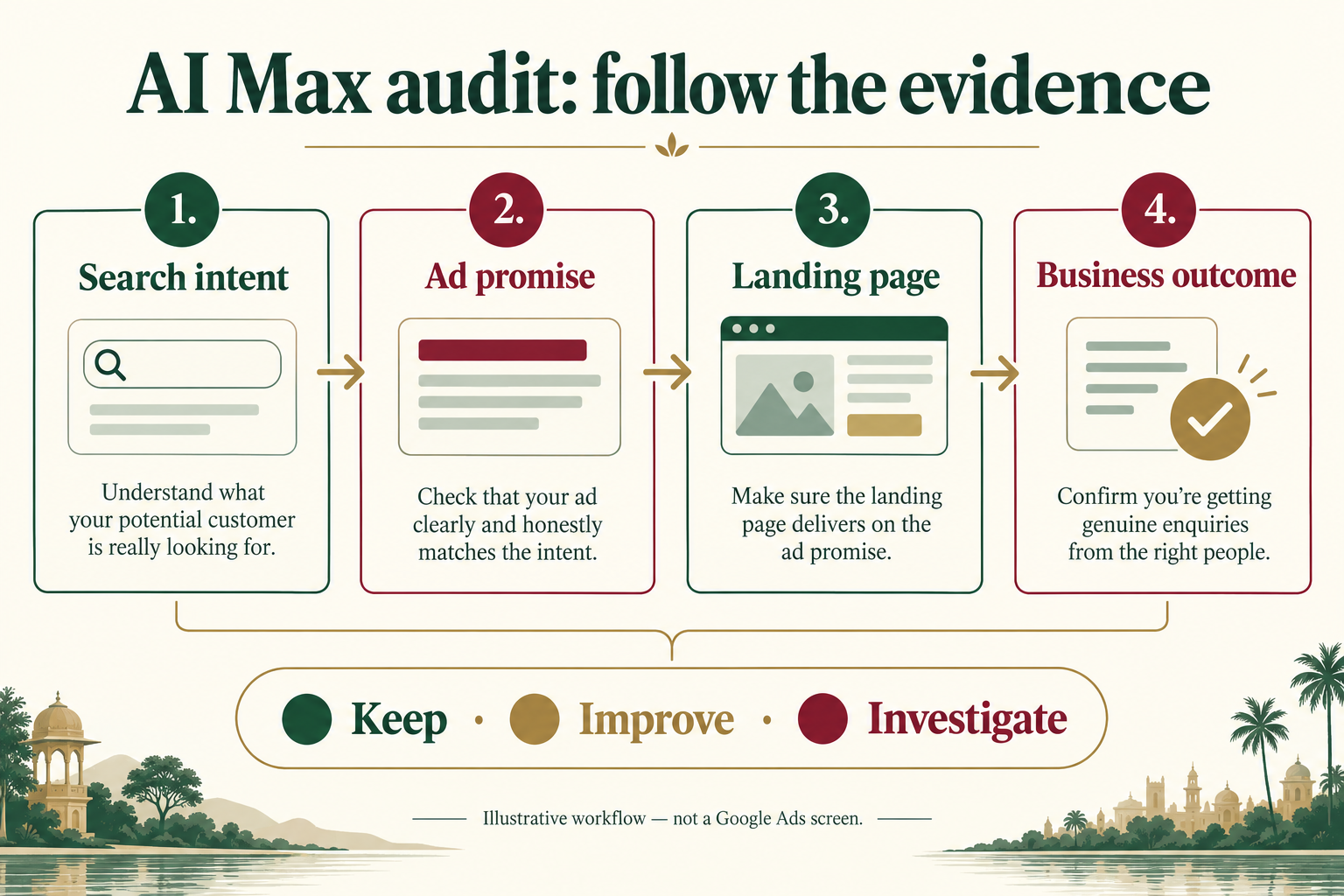
For each meaningful cluster, ask:
- Intent: Is this person buying, researching, looking for support or seeking employment?
- Offer fit: Can the business actually provide the requested service, product variant or delivery location?
- Message: Does the headline make a promise the landing page supports?
- Outcome: Do the resulting enquiries meet the agreed qualification rule?
Use a negative keyword when the search intent itself is unsuitable. Investigate the destination when the intent is useful but the page is wrong. These are different problems: blocking a good query to compensate for a weak page can remove valuable demand.
Do not make a universal rule such as “exclude every query with no conversion after ten clicks”. Ten clicks could represent very different costs, purchase cycles and levels of intent. Set review thresholds using the business’s acceptable acquisition cost, data volume and conversion delay. Record the reasoning behind each exclusion.
How should you check AI Max landing pages and ad promises?
Read the destination as a prospective customer on a phone. Check the offer, location, product availability, price conditions and the next step. Then test the form or checkout path using an appropriate test process. A page that loads successfully can still be commercially wrong.
A hypothetical Mumbai commercial-cleaning advertiser might receive an office-contract query but send the visitor to a general cleaning page dominated by residential offers. The first action should be to inspect the destination choice and page content. Adding “office cleaning” repeatedly to the ad will not repair an unclear service journey.
Pay particular attention to campaign tracking templates. Google warns that incompatible URL handling can interfere with Final URL expansion. Test the actual destination with tracking parameters, not only the clean page URL. Its documentation also says pinned responsive-search-ad assets are not respected when Final URL expansion selects a more relevant URL. Pinning is therefore not a reliable safeguard for mandatory wording in that situation. Review the feature configuration when exact wording is essential. Source: Google’s AI Max configuration guidance.
Keep the correction specific: remove an inaccurate claim, improve the page, apply an appropriate URL exclusion or review the campaign’s expansion settings. Avoid changing all of these together unless an urgent issue requires it, because you will lose the ability to identify what helped.
If the problem is duplicate or missing events rather than destination selection, first review the implementation. Our server-side versus client-side tracking guide explains why changing the collection method alone does not fix event definitions or deduplication.
Which metrics matter for lead generation and e-commerce?
Keep platform reporting and business validation side by side. They may use different attribution and timing rules, so label both rather than forcing them to match.
| Metric | Calculation | Interpretation limit |
|---|---|---|
| Reported cost per conversion | Ad spend ÷ reported conversions | Depends on which conversion actions the account counts |
| Cost per valid enquiry | Ad spend ÷ unique valid enquiries attributed to that cohort | A valid enquiry is not necessarily commercially qualified |
| Qualified-lead rate | Unique qualified leads ÷ unique valid enquiries in the same cohort × 100 | Requires a consistent qualification rule and enough time for follow-up |
| Cost per qualified lead | Ad spend ÷ qualified leads attributed to that cohort | Qualification and attribution must be documented |
| Reported ROAS | Attributed conversion value ÷ ad spend | Revenue-based ROAS is not profit and may precede refunds or cancellations |
If a denominator is zero, the ratio is undefined; do not display a zero cost per qualified lead. If the data have not been collected, label the result unavailable. Do not turn missing evidence into a zero.
Hypothetical example: why the cheaper lead may be less useful
Assume two comparable acquisition cohorts have completed the same follow-up period, use the same attribution rule and contain no duplicate enquiries:
| Measure | Cohort A | Cohort B |
|---|---|---|
| Ad spend | ₹24,000 | ₹30,000 |
| Unique valid enquiries | 40 | 30 |
| Qualified leads | 8 | 15 |
| Cost per valid enquiry | ₹600 | ₹1,000 |
| Qualified-lead rate | 20% | 50% |
| Cost per qualified lead | ₹3,000 | ₹2,000 |
Cohort A looks cheaper at the enquiry stage. Cohort B produces qualified opportunities at a lower cost. This does not prove that AI Max caused the difference: changes in brand traffic, geography, offer, sales follow-up or seasonality could explain it. It shows why a campaign review needs both acquisition and qualification evidence.
For e-commerce, add order value, cancellations, returns and margin by the relevant product group. A high-value order for a low-margin or frequently returned product may contribute less than a smaller retained order. Also check whether the destination sends shoppers to a suitable product, collection or information page. Use consistent order and attribution windows before comparing groups.
Why might the report totals disagree?
Some search terms are withheld because they do not meet reporting privacy thresholds. Google’s API documentation also explains that the combination view and search-term view overlap, and that campaign aggregates can include activity omitted from detailed rows. Do not add the views together or treat a missing query row as proof that the spend did not occur. Source: AI Max reporting API documentation.
The AI Max match-type filter also excludes “Other search terms”, according to Google’s reporting help. A filtered detail export therefore need not reproduce the full campaign total.
Before diagnosing a discrepancy, compare date ranges, time zones, filters, conversion columns, attribution settings and reporting delay. Use a campaign-level report for the overall spend control and detailed views to investigate patterns. Keep the difference visible rather than allocating hidden activity to visible queries without evidence.
An AI Max source label identifies a reporting category. It does not establish incremental revenue, and it does not by itself prove that an ad appeared inside an AI Overview or AI Mode answer. Avoid drawing placement conclusions from a matching label.
When should you intervene, and when should you collect more evidence?
Separate urgent defects from performance optimisation. A broken landing page, unavailable offer or inaccurate claim deserves prompt attention. Low-volume performance fluctuations require more patience.
Google’s reporting guidance recommends allowing at least two weeks after enabling AI Max before routine adjustments. Treat that as a starting point for observation, not a promise that every account has enough evidence after fourteen days. Longer sales cycles and sparse qualified-lead data may require a longer evaluation period.
Our recommended decision sequence is:
- Fix clear defects. Record the issue, affected URL or query cluster, time found and correction.
- Check measurement. Validate the conversion action and qualification process before optimising to a questionable result.
- Separate major segments. Examine brand versus non-brand, relevant service lines and locations without creating so many groups that each contains almost no data.
- Choose one testable change. For example, correct a destination mismatch while keeping the offer and qualification rule stable.
- Set a review date. Allow conversion and follow-up delays to mature, and compare equal-length complete periods with identical filters.
For a causal question such as “does enabling AI Max improve this campaign?”, use a suitable controlled experiment where available. Google has documented AI Max testing capabilities; confirm eligibility in your account. A before-and-after comparison is useful operational evidence, but it cannot isolate the feature when several other conditions changed.
What should your weekly AI Max audit worksheet contain?
Copy this original worksheet into your team’s working document. Keep one row per issue or test, with links to the underlying export and page evidence. Avoid placing personal customer details in a shared marketing worksheet.
| Field | What to record |
|---|---|
| Scope | Review date, account time zone, campaign, period and filters |
| Search intent | Query or cluster, likely customer task and offer fit |
| Ad promise | Observed headline and any claim requiring correction |
| Destination | Observed URL, mobile experience and tested enquiry or checkout path |
| Outcome | Reported conversions, unique enquiries or orders, qualification definition and reporting lag |
| Evidence gaps | Hidden queries, unavailable combination view, small sample or unmatched CRM records |
| Decision | Keep, improve or investigate, with a reason tied to evidence |
| Next action | Specific change or check, named owner, baseline and remeasurement date |
Illustrative worksheet entry: “Office-maintenance queries reach a page headed ‘Home repairs’. Improve: verify the selected URL and correct the destination or page message. Owner: paid-search manager and web lead. Baseline: same campaign filters and mature enquiry cohort. Review after the agreed follow-up window.” This is a proposed workflow, not a tested result.
Digi Amenity’s approach is to review the whole customer journey before recommending a budget increase. If AI Max produces more conversions but the sales team sees few suitable enquiries, our Google Ads team can review the query mix, ad claims, landing pages, conversion definitions and lead follow-up together.
Frequently asked questions
Is AI Max reporting the same as Performance Max reporting?
No. AI Max is a feature set for Search campaigns. Performance Max is a different campaign type. Begin with the correct campaign context so that controls and reporting definitions are not mixed.
Is the search terms and ad combinations report available to every Indian advertiser?
Google’s current help documentation describes the report. That does not verify availability in every Indian account. Check the report dropdown, permissions and campaign context, and record missing access rather than assuming universal rollout.
Can I see every search term that generated AI Max spend?
No. Detailed query reporting is subject to privacy thresholds. Keep campaign totals as the overall control and recognise that visible query rows are incomplete. Do not infer a hidden query’s intent from the remaining rows.
Should I exclude every search term with no conversions?
No. First check relevance, spend, conversion delay and measurement quality. Exclude clearly unsuitable intent with a documented reason. A relevant term with little mature data may need investigation rather than immediate removal.
Can headline pinning guarantee the message when Final URL expansion runs?
Google says pinned assets are not respected when Final URL expansion chooses a more relevant destination. If exact wording is essential, review the relevant configuration and observed ads. Do not rely on pinning alone in that situation.
How often should a business review AI Max?
A weekly evidence review is a practical operating cadence, not a Google requirement. Check urgent defects promptly and avoid changing campaigns every week merely because the meeting is weekly. Routine optimisation needs sufficient mature data.
Does a higher reported ROAS prove AI Max increased profit?
No. Reported ROAS depends on attributed conversion value and spend. Profit also depends on costs, margins, returns and other factors. To assess incremental impact, use an appropriate experiment and a consistent business-outcome definition.
