

To improve Meta ads lead quality, first find where enquiries stop progressing: contactability, service relevance, qualification or conversion. Match the ad’s promise to the offer, ask a few useful qualifying questions, route leads promptly and measure qualified outcomes. A lower cost per form submission is only useful when the business can turn those submissions into worthwhile opportunities.
For a Mumbai business, poor fit may mean the wrong service area, a residential enquiry for a commercial service, an unsuitable project size or a misunderstood offer. Those problems need different fixes. Calling every unanswered enquiry a “fake lead” makes the diagnosis less reliable.
This guide focuses on the connection between creative, form design, CRM records and follow-up. It complements the broader campaign setup discussion rather than suggesting that one audience setting solves every lead-quality issue.
What does a quality lead mean for your business?
Define the decision before opening Ads Manager. A qualified lead should meet specific business criteria that the receiving team can apply consistently. For example, a commercial cleaning company might require an office premises within its service area, a relevant scope and a person involved in choosing a supplier.
Keep stages separate. A valid number does not prove buying intent; a relevant enquiry is not yet a sale. Use “unknown” when the team has not established the answer rather than forcing a negative classification.
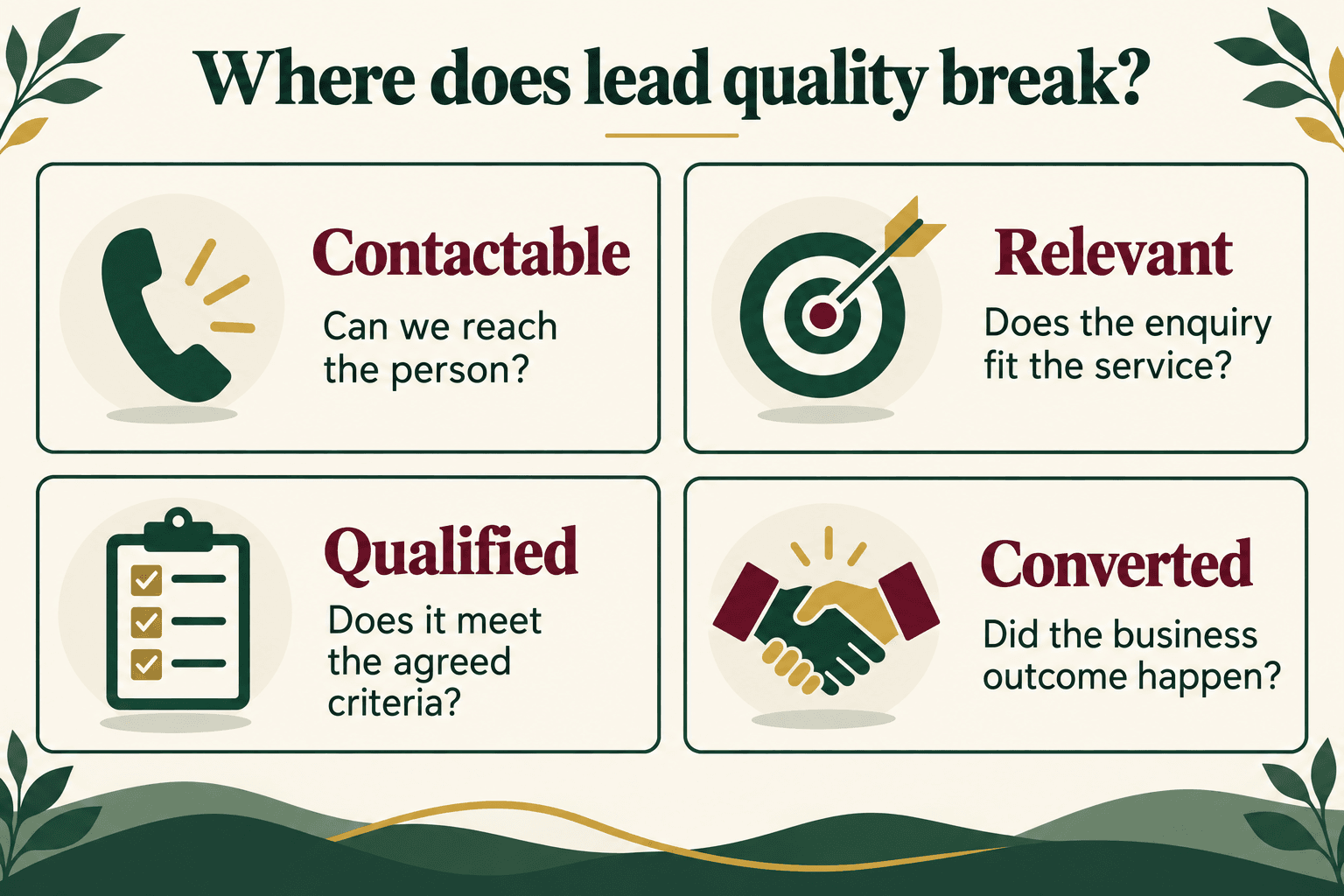
| Stage | Evidence to record | What to investigate |
|---|---|---|
| Contactable | Valid contact details and a documented contact outcome | Incorrect details, unsuitable contact method, delivery failures or follow-up timing |
| Relevant | Service, location and need match the offer | Ambiguous creative, broad promise or missing service boundaries |
| Qualified | Agreed criteria confirmed, with a reason and date | Wrong project scope, eligibility questions or inconsistent sales assessment |
| Converted | Agreed business outcome, such as a booked paid service | Proposal, pricing, availability, trust, response process or offer competitiveness |
Record duplicate, invalid, outside service scope, not ready, lost to competitor and unanswered as distinct outcomes where relevant. “Not ready” can still describe a genuine future customer. Never manufacture favourable statuses to make an advertising report look better.
Should you change the ad before changing the audience?
Check what a reasonable person would expect from the ad. “Free consultation” can attract people seeking advice when the business wants a paid project. A commercial service shown with a residential image can invite the wrong requests even if the geographic setting is correct.
State the actual service, who it suits, relevant service limits and what happens after submission. Include a genuine starting price or minimum scope only when it is accurate and commercially appropriate. Do not invent a low price to generate clicks or hide important conditions until the sales call.
For Mumbai campaigns, distinguish the serviceable area from the entire metropolitan region. A location setting cannot communicate that a team handles only office premises or cannot fulfil a distant booking. Put essential boundaries in the creative or form as well.
Test an audience change when the evidence points there. If a customer-based audience is available and suitable, compare it with alternatives using downstream outcomes. Avoid declaring broad targeting or a narrow interest stack universally superior.
How can instant forms improve Meta ads lead quality?
Meta’s official form-type guidance describes Higher intent forms as adding contact-field context and a review screen. That review step gives people an opportunity to confirm details. It is not proof that every submission is qualified.
Do not assume Higher intent automatically means phone verification. Treat verification as a separate capability to check in the available setup. Meta describes verification tools on its lead-generation product page, but the relevant options and suitability should be checked in your account.
Ask questions that change the next action. For a hypothetical office-cleaning campaign, “Which area is the premises in?”, “Is this an office or another property type?” and “When do you need service?” are more operationally useful than a long list of questions the team never uses.
Explain why you ask. Keep answer choices understandable and include an appropriate alternative when the list is incomplete. More friction may reduce accidental submissions, but it can also discourage suitable people. Assess both qualified volume and cost.
Meta’s lead-ad best practices recommend useful qualifying questions and testing form length against outcomes. Start with the minimum information needed to route and assess the enquiry, then test a specific addition.
When is a website form better than an instant form?
A website can explain a complex service, show examples and help visitors assess fit before submitting. It also adds loading time and navigation steps. An instant form can reduce those steps but may require clearer context within the ad and form.
Choose based on the decision the customer needs to make. A straightforward callback may suit an instant form; a technical project enquiry may benefit from a detailed page. Neither destination guarantees quality. Test the landing page on mobile and confirm that records reach the receiving team before comparing destinations.
For website campaigns, use consistent UTM tracking alongside your conversion measurement. UTMs describe the link’s campaign context; they do not confirm that the resulting enquiry is qualified. Keep personal details out of URL parameters.
What changed for Meta’s qualified-lead performance goal?
Checked on 27 September 2026: Meta’s performance-goal documentation says that, from April 2026, the qualified-leads goal is unavailable for new campaigns without a Conversions API integration. It says the requirement affects existing campaigns from August 2026.
That makes the integration and the quality of the supplied outcome data important setup checks. Confirm the exact goal and eligibility shown in your Ads Manager account rather than following an older tutorial’s labels. An integration alone does not create reliable qualification data.
Map a CRM stage to a real, consistently applied business decision. Keep the original lead reference, outcome date and reason so the team can trace what was sent. Have the implementation owner validate event delivery and duplicate handling using the applicable platform documentation before relying on those signals.
If your team does not yet record outcomes consistently, begin there. A simpler campaign measured honestly is easier to improve than a sophisticated setup trained on arbitrary sales labels. Connecting a CRM does not remove the need for staff training and quality checks.
How should Mumbai teams measure qualified lead cost?
Calculate qualified lead cost as advertising spend divided by the number of leads meeting the agreed criteria. Also show the number of submissions, the proportion assessed, qualified volume and later business outcomes. Report spend separately from agency, software or sales costs unless the metric explicitly includes them.
Hypothetical comparison, not a client result or benchmark: two office-cleaning campaigns each spend ₹12,000. Campaign A generates 120 submissions, of which 12 qualify. Campaign B generates 60 submissions, of which 18 qualify. Raw lead cost is ₹100 versus ₹200; qualified lead cost is ₹1,000 versus approximately ₹667.
Campaign B looks more efficient on that defined measure, but check the comparison before reallocating budget. Were both groups given the same time to receive follow-up? Were the criteria and contact attempts comparable? Were all leads assessed? Did the qualified enquiries progress into viable quotes and customers?
Compare cohorts with the same age since submission. A batch from yesterday has had less time to progress than one from two weeks ago. Report unassessed leads as pending, not failed, and avoid sweeping decisions from a handful of outcomes.
The same discipline can support your Google Ads lead-quality analysis, while recognising that the channels capture different kinds of intent.
What should you test first?
- Audit the records: inspect a recent sample across successful, unsuitable and unanswered enquiries. Identify missing outcome data before assuming a targeting fault.
- Choose one diagnosis: for example, too many residential enquiries for an office-only service.
- Make one focused change: clarify commercial premises in the creative and align the form. Record the date and hypothesis.
- Check the receiving process: confirm routing, owner, contact expectations and the treatment of duplicates.
- Compare mature outcomes: evaluate qualified volume and cost with equivalent follow-up windows, then examine quotes and sales as they become available.
A useful test log contains the problem, change, affected campaign, start date, qualification definition, spend, assessed leads, qualified leads and decision. Keep other major changes limited enough that the result remains interpretable. Low volume may require more observation; no fixed seven-day promise applies to every business.
Frequently asked questions
Why do Facebook lead ads bring low-quality leads?
Possible causes include an unclear offer, incorrect expectations, weak qualification, unsuitable service coverage or a broken follow-up process. First separate invalid details from genuine enquiries that are unsuitable, unanswered or not ready. The appropriate fix depends on that distinction.
Are Higher intent forms always better?
No. Their review step can help people confirm their submission, but added friction can also reduce volume. Test against an appropriate alternative and compare qualified outcomes, not just form completion or raw cost per lead.
Does Higher intent automatically include OTP verification?
Do not assume that. Meta’s form-type documentation describes a review screen and contact-field context. Check any verification option separately in your available setup, and remember that verified contact details still do not prove commercial fit.
Do I need Conversions API for the qualified-leads goal?
Meta’s current documentation states that the integration is required under its April and August 2026 changes for new and existing campaigns respectively. Check account eligibility and implementation details, and validate the business meaning of the outcomes sent.
Should I add budget questions to every form?
Only when the answer helps qualify or route the enquiry and people can answer meaningfully. For an unfamiliar service, a clear scope question may be more useful. Test whether the question improves qualified volume and sales efficiency without excluding suitable prospects unnecessarily.
What is a good cost per qualified lead in Mumbai?
There is no useful universal number across services. Work backward from customer value, margin, the share of qualified enquiries that become customers and your selling costs. Use your own consistently defined outcomes; a competitor’s reported CPL may refer only to submissions.
Should unanswered leads be marked invalid?
No. Keep them in an unanswered or pending category under a documented contact process. Invalid means evidence supports that classification. Treating every unanswered contact as fake can hide delays, communication preferences or a weak follow-up workflow.
If your Meta campaigns produce enquiries but few suitable opportunities, Digi Amenity can review the offer, form, routing and outcome measurement through its Meta Ads services before you increase the budget.
