
Updated: 3 October 2026
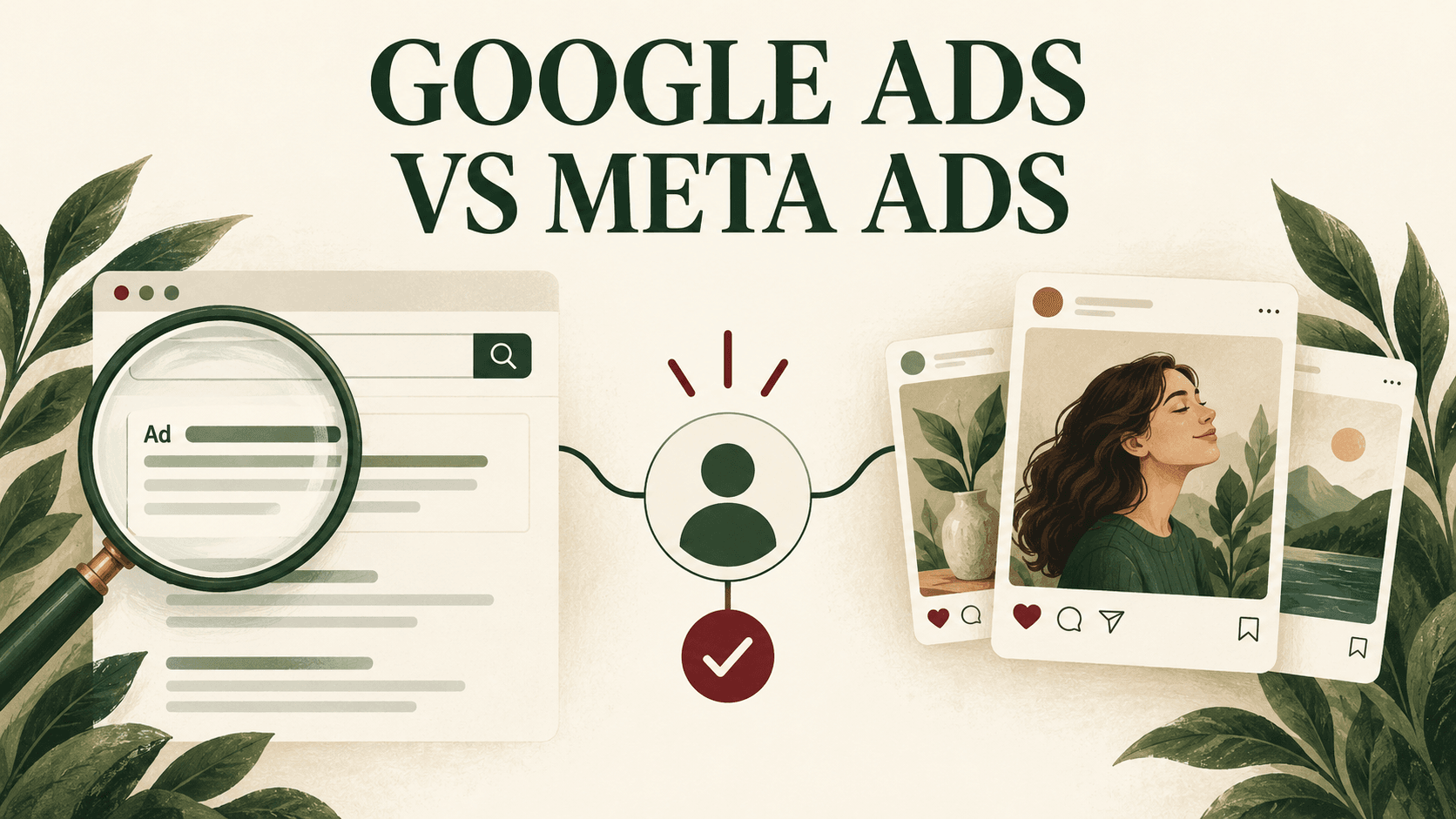
Google Ads vs Meta Ads lead generation is a decision about how you reach a suitable prospect. Google Search ads can capture existing demand when someone searches for a solution. Meta ads on Facebook and Instagram can introduce an offer while someone browses. Both can generate valuable leads, and both can waste budget.
Choose based on customer intent, the offer, creative resources and the economics of turning an enquiry into a customer. This comparison focuses on Google Search and Meta lead campaigns; Google also offers video, display and other campaign formats with different behaviour.
The practical comparison
| Factor | Google Search ads | Meta ads |
|---|---|---|
| Typical starting intent | A person is actively searching for a topic, service or provider | A person discovers an offer while using Facebook or Instagram |
| Delivery inputs | Keywords, search context, location, bids, assets and campaign settings | Creative, conversion signals, audience inputs, location and campaign settings |
| Creative needs | Relevant text assets and a page matching the search | Strong visual/video concepts and copy that introduces the offer |
| Lead destinations | Website forms, calls or other eligible lead paths | Website forms, instant forms or eligible messaging/lead paths |
| Potential advantage | Capture a specific need at the point of search | Explain and demonstrate an offer to people who were not already searching |
| Main risk | Expensive or irrelevant searches; weak page; poor tracking | Low-intent submissions; weak offer/creative; poor follow-up |
| Useful success measure | Qualified lead cost and customer acquisition cost | Qualified lead cost and customer acquisition cost |
When Google Ads is a good starting point
Consider Search when people already look for the service you sell and your landing page can fulfil that need. Examples include a repair service, a specialist B2B provider or a business with clearly defined appointment demand.
Group keywords around related intentions. Someone searching “how to clean an AC filter” may want a tutorial, while “AC repair near me” may want a technician. Whether an informational search belongs in a paid campaign depends on the offer and economics.
Use location settings that reflect your service coverage, inspect search terms and add relevant negative keywords. A top ad position or high click-through rate does not prove that the campaign is profitable. Follow our Google Ads India setup guide for a practical workflow.
When Meta Ads is a good starting point
Consider Meta when the offer benefits from a visual demonstration, story or explanation, and you can develop several credible creative concepts. A new product, workshop or clearly packaged service may attract interest even when the audience is not already searching for its exact name.
The ad must communicate who the offer is for, the benefit, important terms and the next step. A low-friction form can increase enquiry volume, but qualification questions and a clear follow-up process help establish whether those enquiries are useful.
Campaign options and automation vary by account. Avoid a strategy based on obsolete objective names or manual audience controls that are no longer available. Read our Facebook Ads mistakes guide before launching.
Which platform produces better-quality leads?
Neither always does. Search intent can be strong, but broad queries, a misleading ad or poor service fit can still produce unsuitable leads. Meta can introduce valuable prospects, but an unclear or overly easy offer can attract submissions from people who have little buying intent.
Agree on a qualification definition before comparing results: service need, location, budget or timeline where relevant, contactability and a meaningful next step. Record duplicate and spam leads separately. Then compare qualified opportunities and customers after allowing for sales lag.
Compare costs using CAC, not a universal CPL benchmark
Costs vary by auction, location, sector, offer, creative, season and conversion definition. A national “Google CPL” or “Meta CPL” figure is not a dependable forecast for your business. Use your own test results and commercial limits.
Illustrative example, not an industry benchmark or client result:
| Measure | Google Search test | Meta test |
|---|---|---|
| Media spend | ₹20,000 | ₹20,000 |
| Raw leads | 40 | 100 |
| Qualified leads | 24 | 20 |
| New customers | 6 | 4 |
| Raw CPL | ₹500 | ₹200 |
| Qualified CPL | About ₹833 | ₹1,000 |
| Media-only CAC | About ₹3,333 | ₹5,000 |
Meta looks cheaper at the form-submission level in this example, while Google looks cheaper at the customer level. The reverse can happen in another business. Include agency fees, creative costs and sales effort when calculating fully loaded acquisition cost.
Allowable qualified CPL = allowable CAC × qualified-lead-to-customer rate. If the business can spend ₹2,000 to acquire a customer and closes 20% of qualified leads, ₹400 is the corresponding qualified-lead allowance. Set the CAC from contribution margin, cash flow and reliable customer value—not turnover alone.
Tracking and lead handling for both platforms
- Test website forms, calls or messaging paths from the actual ad destination.
- Use consistent campaign parameters and capture the source in the lead record.
- Configure relevant conversion events and separate primary business outcomes from diagnostic actions.
- Where appropriate and consent-compliant, connect qualified or completed outcomes from the CRM back to the platform.
- Deduplicate events and reconcile leads with customer records.
- Record response time, contactability, qualification and close outcome.
Meta’s lead generation guide discusses lead workflows and CRM feedback. The guide is an official resource, but use your current account interface for available settings. Google and Meta attribution totals can overlap and should not simply be added together as unique sales.
Can you use Google and Meta together?
Yes, when the budget and team can support meaningful tests. Meta can introduce an offer, while Search captures people looking for it later. Useful website content and a CRM can connect the journey.
Audiences do not automatically transfer from one platform to the other. Retargeting requires appropriate tagging or eligible audience data, user permissions, platform compliance and sufficient audience availability. Cross-platform behaviour also makes attribution uncertain.
A practical test plan
- Choose one comparable offer: the same service, coverage and qualification rules.
- Set a spending limit and success measure: qualified CPL, CAC and business contribution.
- Give each platform suitable assets: intent-matched search ads and landing pages; clear visual Meta concepts.
- Fix obvious faults promptly: broken forms, wrong geography, spam and misleading claims.
- Allow for the buying cycle: do not judge a long B2B sale after a few days of form submissions.
- Review the next decision: continue, improve, reallocate or stop based on evidence.
There is no universal budget split. A narrow Search campaign may be the better first test for an urgent service; a visual discovery campaign may be the better first test for an unfamiliar offer. Use our marketing funnel template to connect acquisition with evaluation and follow-up.
Discuss a lead generation plan with Digi Amenity based on your offer, website and sales process.
Frequently asked questions
Is Meta always cheaper than Google Ads?
No. Raw lead costs may differ, but qualified lead cost and customer acquisition cost depend on the offer, audience, creative, search demand and sales process.
Are Google leads always better quality?
No. Search intent can help, but irrelevant queries and weak landing pages can attract poor-fit enquiries. Measure qualification and customer outcomes on both platforms.
Should a small business use both platforms immediately?
Only if the budget, tracking and team can support useful tests. Starting with one strong channel often produces clearer learning than spreading a small budget too thin.
Are instant forms better than website forms?
Instant forms reduce friction; website forms offer more context and control. Test qualification, contactability and customer outcomes rather than selecting on submission volume alone.
How do I avoid counting the same customer twice?
Use unique lead/customer records, deduplicate events and reconcile platform reports with your CRM or orders. Attribution claims from two platforms may refer to the same sale.
