
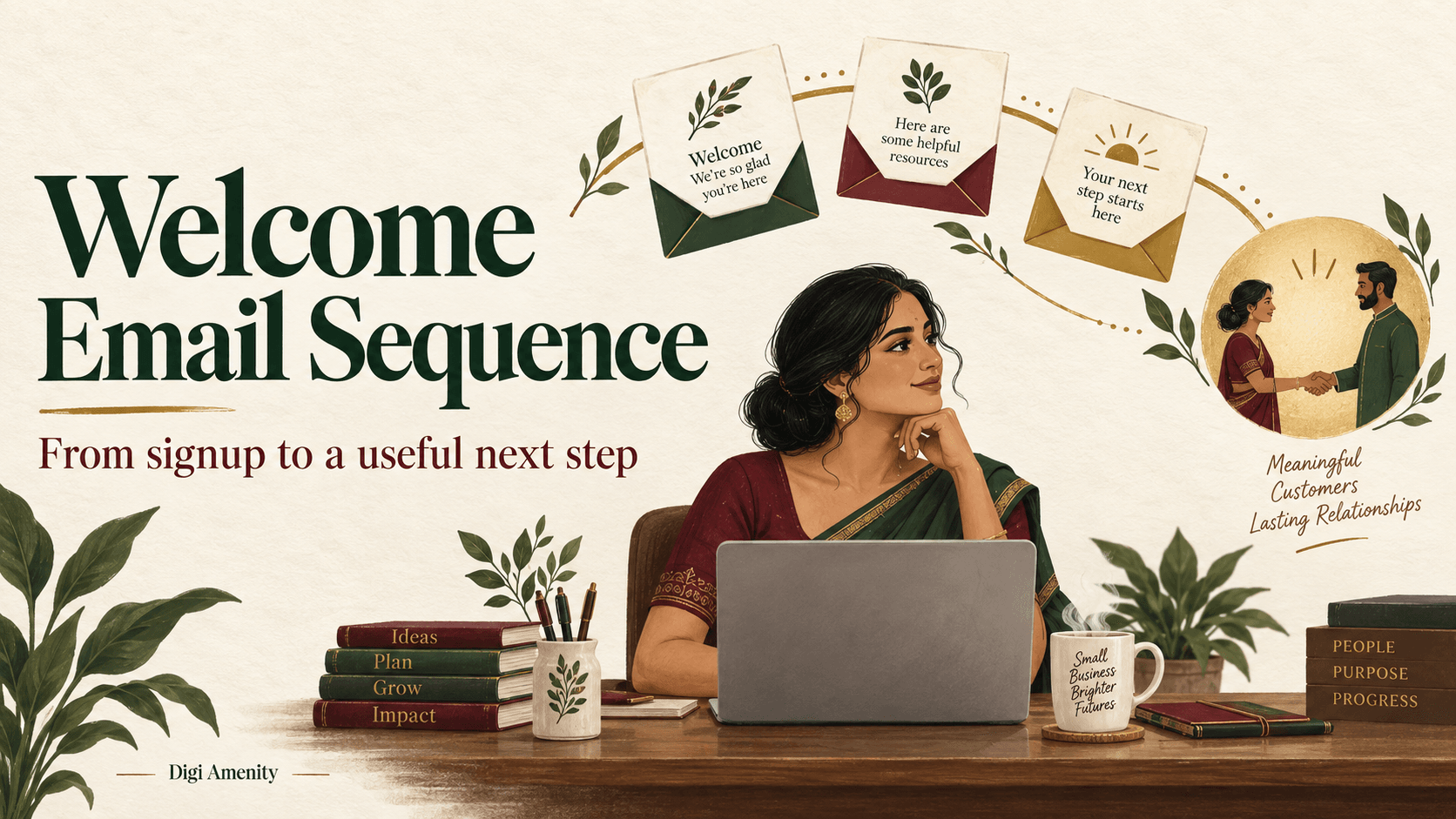
A welcome email sequence is an automated set of messages that helps a new subscriber take a useful next step. Start by delivering what the signup form promised, explain what they will receive next, and offer relevant guidance before asking for a purchase or enquiry. For a small business, a focused four-email plan is a sensible starting experiment. The right length depends on the subscriber’s intent and your sales cycle.
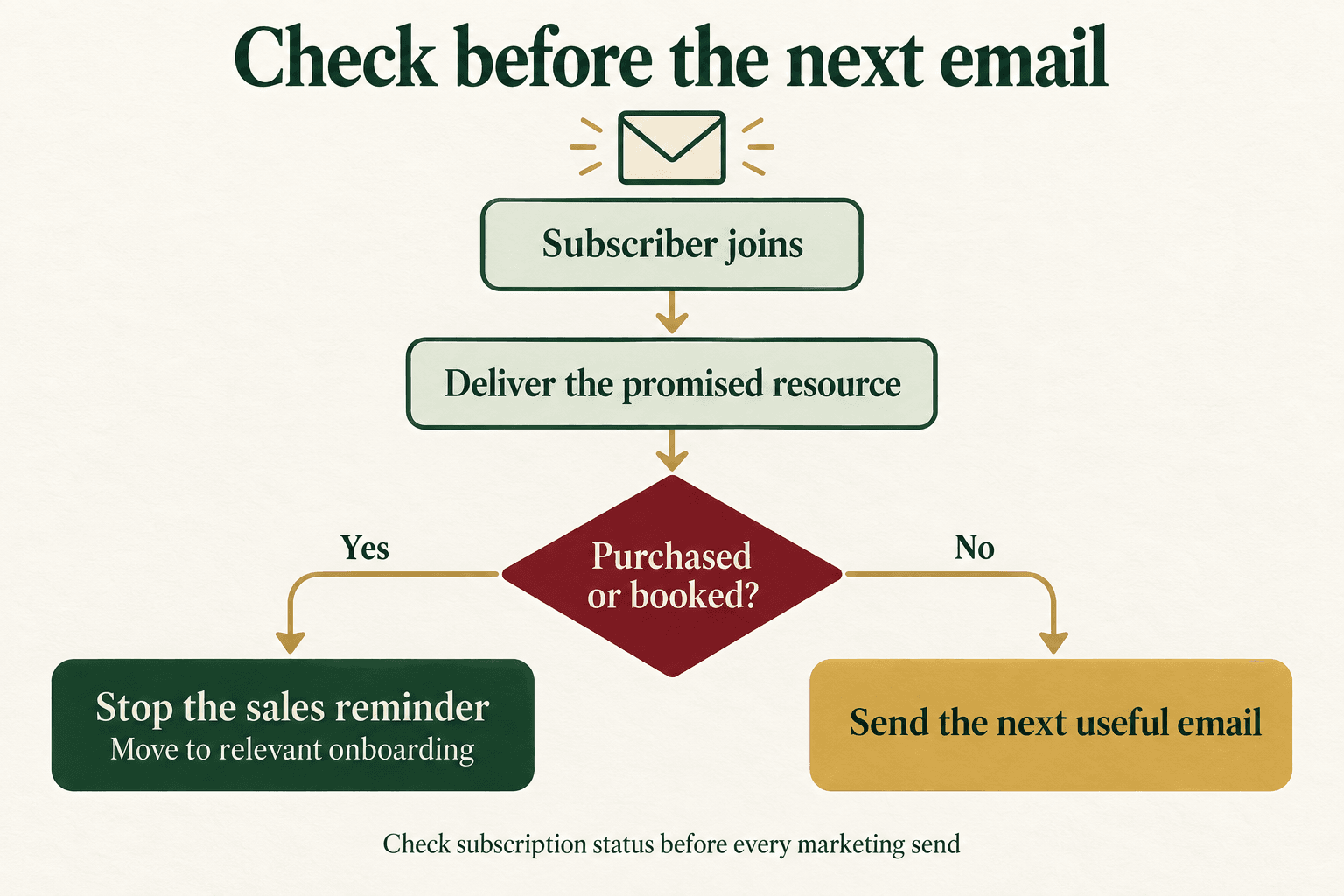
The important decision is not whether to send email three on Tuesday. It is whether the person still needs that message. A customer who has already bought should not receive a reminder to make their first purchase; someone who has booked a consultation should not keep receiving booking requests.
This guide combines original welcome email examples with the automation rules and launch tests needed to make them work. The examples are hypothetical, not Digi Amenity client results.
Who should enter your welcome email sequence?
Write down the signup promise before writing the emails. A newsletter signup, a product purchase and a request for a quotation represent different needs. A service enquiry also needs an operational response from your team; a marketing sequence should not delay that response.
| Entry point | First useful message | Next step to measure |
|---|---|---|
| Subscriber requests a buying guide | Deliver the guide and explain what follows | Relevant product or service-page visit |
| Subscriber joins for an offer | Provide the promised offer with clear conditions | First completed purchase |
| New customer places an order | Keep order information clear; offer relevant getting-started help separately | Successful product use or support resolution |
| Prospect requests a service quote | Acknowledge the request and explain the actual response process | Qualified conversation or booked consultation |
Only add people to marketing automation when their subscription status and permission support it. Do not treat a purchase, business card or quotation request as automatic permission for an unrelated newsletter. Keep necessary order and service communications distinct from promotional sends.
What should a four-email welcome series contain?
Use one primary action per message. A short introduction can build trust, but the useful resource or promised offer should not be buried beneath a company history. Use a recognisable sender name, a monitored reply address, descriptive subject lines, readable text and a clear unsubscribe option.
Illustrative timing: send the first message promptly after the relevant subscription confirmation, then test follow-ups around days two, five and eight. These are starting intervals, not proven best times for every business. A short buying cycle may need fewer messages; a complex service may need more space and human follow-up.
Email 1 — Fulfil the promise. Give the subscriber what they requested and set a realistic expectation for future messages.
Subject: Your room-planning checklist is ready
Preview: Start with the three measurements on page one.Thanks for joining [Brand]. Here is the room-planning checklist you requested. Before choosing anything, measure the available floor space, doorway and intended placement area.
Over the next week, we will send three short notes on sizing, materials and choosing your next step.
Main action: Open the checklist
Email 2 — Help them make one decision. Address a problem connected to the signup. For a product business, this could be sizing or compatibility. For a service, explain what information is needed before a useful recommendation is possible.
Subject: Will it fit? Check this before choosing
Preview: Compare the product dimensions with your usable space.A product can fit the room and still block a walkway. Use the dimensions on the product page to mark its footprint with removable tape. Leave the access space your household needs before deciding on a size.
Main action: Read the sizing guide
Email 3 — Resolve a real objection. Use an accurate demonstration, comparison or verified customer example. If evidence is unavailable, explain the buying decision directly. Do not invent testimonials, bestseller status or performance numbers.
Subject: Compare materials before you shortlist
Preview: Look at care needs as well as appearance.Before comparing prices, check the material, care instructions and intended use on each product page. Save the options that fit your space and maintenance preferences. If a specification is missing, ask before ordering.
Main action: Compare the product details
Email 4 — Offer an appropriate next step. This could be a purchase, a reply or a consultation. Mention an offer deadline only when it exists and is enforced. A discount is not required.
Subject: Need help choosing your next step?
Preview: Tell us which detail is holding up your decision.If you are still comparing options, reply with the product you are considering and the question you need answered. We can point you to the relevant specifications and support information.
Main action: Reply with your question
These copy samples need your real resources, policies and product details before use. For a service business, replace the product journey with resource delivery, a preparation checklist, an explanation of scope and a booking invitation. Once the person books, send useful preparation information instead of another sales invitation.
How do you build welcome email automation that stays relevant?
Map the workflow on paper first: entry condition → first message → delay → eligibility check → next message. Choose software that supports the required forms, contact fields, events and exclusions. A visually attractive email editor alone does not establish whether your purchase or booking data arrives reliably.
- Connect the correct form to the correct list or workflow. Test the actual website form, including mobile and footer forms. If you use double opt-in, the marketing welcome message should follow the required confirmation step.
- Record the signup context. Retain the requested resource or interest so the first email matches the promise. Collect only information needed for the experience.
- Choose the conversion signal. Use a completed order or confirmed booking, rather than a product-page view or a click on a booking button.
- Recheck before the next sales message. If the conversion has happened, stop that reminder or move the contact to relevant onboarding. Keep genuinely useful educational messages only where they still make sense.
- Coordinate other sends. Decide how welcome messages interact with newsletters, sale announcements and checkout reminders. Avoid stacking competing offers; preserve necessary transactional messages.
- Define re-entry deliberately. A second form submission should not automatically replay the same introduction. Check the platform’s actual re-entry behaviour before promising a new resource delivery.
For example, Klaviyo’s welcome-series documentation describes list-based entry, subscription confirmation and purchase-based conditional splits. Its documented list-triggered flow sends to a person only once. Treat that as a platform-specific rule, not a rule for every email tool.
Digi Amenity’s practical view: an email problem can originate outside the inbox. If the form adds contacts to the wrong list, the product page omits dimensions, the booking event never reaches the email tool or replies go unanswered, rewriting the subject line will not repair the full journey.
What should you test before switching the sequence on?
Run these tests with controlled test contacts and inspect the recipient/activity log. A successful test email proves the design can send; it does not prove the workflow selects the right people.
| Test | Expected result |
|---|---|
| New eligible signup | Correct resource arrives once; links and mobile layout work |
| Confirmation still pending | No premature marketing sequence where confirmation is required |
| Same address signs up twice | No duplicate introduction; requested resource remains obtainable |
| Purchase or booking occurs before follow-up | Irrelevant sales reminder is skipped; appropriate onboarding remains |
| Order or booking sync is delayed | Delay is visible in event logs; timing/filter design is adjusted before launch |
| Contact unsubscribes mid-sequence | Remaining marketing messages are suppressed |
| Name or interest field is missing | Readable fallback text; no raw merge tags or empty greeting |
| A campaign is scheduled during onboarding | Messages follow your chosen priority and frequency rules |
For Indian audiences, check currency, offer conditions, service coverage and any stated response hours. Show IST explicitly where a time matters. Do not promise nationwide delivery or same-day callbacks unless your operations can support them. If replies need a salesperson, assign an owner and make the handoff visible.
Also verify sender authentication and list hygiene with the email deliverability checklist. Keep the promised resource accessible without forcing subscribers to complete the same signup again.
How should you measure and improve the sequence?
Decide what success means before launching. For a retailer, measure completed first orders from eligible new subscribers. For a service business, measure qualified conversations or confirmed bookings and validate them in the CRM or booking system. A click on a contact button is an intermediate action, not automatically a qualified lead.
Track delivered messages, useful clicks, completed outcomes, bounces, unsubscribes and complaints where available. Apple Mail Privacy Protection can make opens unreliable. Automated security activity can also inflate clicks, so use available bot filtering and reconcile downstream outcomes rather than treating every click as a person.
Keep your denominators clear. Per-message click rate uses that message’s delivered recipients. For your own sequence conversion report, define a consistent cohort of eligible entrants and a fixed observation window. Do not add the recipients of four emails and call that four times as many subscribers.
Use consistent campaign tags to connect email links with website behaviour. The UTM tracking guide and templates can help organise that measurement. Keep personal data out of URL parameters and document differences between analytics and email-platform attribution.
- Few deliveries: inspect contact eligibility, authentication, bounce reasons and the workflow queue before rewriting copy.
- Deliveries but weak useful clicks: check whether the message fulfils the signup promise and offers one clear next action.
- Clicks but few outcomes: inspect mobile landing pages, product details, pricing, form errors and reply handling.
- Frequent opt-outs: review signup expectations, competing sends, relevance and frequency before adding more emails.
Test one meaningful change at a time and let each comparison group finish the same observation window. Small lists may not support a confident winner quickly; use test logs and customer questions to guide improvements without declaring a statistically reliable uplift from a handful of orders.
Frequently asked questions
How many emails should a welcome sequence have?
Start with the fewest messages needed to fulfil the signup promise and support a decision. Four is an illustrative plan here, not a requirement. Combine weak or repetitive emails, and add a message only when it resolves a distinct question.
When should the first welcome email arrive?
Send it promptly after the relevant eligible signup or confirmation step. If the subscriber expects a resource, unnecessary delay makes the experience less useful. Test actual delivery through your live form rather than assuming that an automation marked active works.
Should every welcome email include a discount?
No. Product guidance, useful resources and clear support can provide value without discounting. If an incentive was promised at signup, honour its real terms and avoid repeatedly sending first-purchase offers to people who already bought.
Can a service business use an email onboarding sequence?
Yes, but distinguish prospect education from onboarding a confirmed client. A prospect may need scope and preparation guidance; a client may need a document checklist and next steps. Keep a real enquiry’s human response separate from the marketing schedule.
What happens when someone buys halfway through?
Check whether the remaining messages still fit. Suppress obsolete sales reminders and route the person toward useful onboarding. Verify that the order event reaches your email platform before its next eligibility check, particularly if integrations sync with a delay.
Can different lead magnets share one welcome series?
Yes, when the audience and next step are sufficiently similar. Deliver the correct requested resource first, then use shared guidance. Separate the path when the signup promises or interests differ, and test repeat signups so people do not receive duplicate introductions.
What is a good welcome email conversion rate?
There is no single useful target for every business. Define the conversion, audience, observation window and attribution method, then establish your own baseline. Compare equivalent cohorts and check lead or order quality rather than importing another vendor’s aggregate benchmark.
Need help connecting signup, email and follow-up?
If new subscribers receive generic emails or continue getting sales reminders after they convert, Digi Amenity can review the forms, welcome copy, event tracking and follow-up rules together. Explore our email marketing services to plan a sequence around your customers’ actual next steps.
