

Updated: 3 October 2026
The future of performance marketing is being shaped by AI-assisted advertising, changing customer journeys and a stronger need to connect platform reports to real business outcomes. In 2026, the advantage is not simply launching more campaigns. It is giving those campaigns a clear goal, trustworthy data and creative that helps the right customer act.
This guide separates current developments from predictions and explains what an Indian business can do now. Features differ by account, market and campaign type, so check your live platform controls before making a rollout-dependent plan.
What is performance marketing?
Performance marketing is a measurable approach to acquisition and growth: you track actions such as enquiries, purchases or app installs and optimise toward their value. It includes paid search, paid social, affiliate programmes and other measurable channels.
It does not always mean “pay only when you get a sale”. Google and Meta campaigns can incur click or impression costs even when no customer buys. The performance discipline comes from measuring outcomes and controlling economics, rather than a promise of risk-free advertising.
Six developments to plan for in 2026
1. AI handles more delivery decisions
Google announced upgrades from older Search features to AI Max in 2026. Its upgrade announcement is a current example of this shift. Review account notices, generated text and landing-page controls when adopting expanded automation.
Automated bidding, audience expansion and asset variations reduce some manual tasks. The marketer’s job moves toward defining conversion goals, setting boundaries and judging results. An algorithm optimising for every form submission can become very good at finding people who submit forms but never buy.
Action: audit primary conversion events. Separate meaningful leads or purchases from page views and button clicks. Review search terms, locations, landing destinations, creative claims and brand suitability where the platform exposes those controls.
2. Creative becomes a structured experiment
Automation does not remove the need for a persuasive offer. Test different customer problems, demonstrations, proof and calls to action. Several colour changes to the same ad are not the same as testing distinct concepts.
For a service business, compare a problem-and-solution video with a walkthrough of the process. For a product, compare a demonstration with an objection-handling explanation. Use captions, legible mobile layouts and placement-appropriate crops. Refresh based on performance and fatigue signals, rather than an arbitrary calendar.
3. First-party customer data improves feedback
A CRM can connect enquiries to qualified opportunities and completed sales. With suitable consent and platform requirements, conversion integrations can send useful outcomes back to ad systems. Server-side or API tracking can improve resilience, but it does not recover every missing event or remove privacy obligations.
Action: define a qualified lead, record the reason for rejection and reconcile platform events with your lead database. Deduplicate browser and server events when both report the same action. Keep test events and spam out of the optimisation goal.
4. Privacy planning needs accurate assumptions
Do not base your strategy on the claim that Chrome has eliminated all third-party cookies. Google’s April 2025 announcement maintained user choice rather than introducing the previously proposed standalone prompt. Browser restrictions and user choices still limit measurement.
Action: explain data collection, respect consent choices and build useful customer relationships. Compare analytics, platform attribution and business records without expecting identical totals.
5. Discovery spreads across formats
Customers may find an offer through a search result, AI response, short video, creator or recommendation, then convert through a different channel. Google’s 2026 marketing predictions are a useful planning input, but a forecast is not proof that a specific channel will work for your business.
Build content from real customer questions and keep product or service details consistent across touchpoints. Give search campaigns useful landing pages and social campaigns creative that explains the offer without assuming prior knowledge.
6. Profit and incrementality challenge easy ROAS stories
A platform can take credit for a sale that another platform also reports. Retargeting can reach customers who were already planning to buy. Reported return on ad spend is therefore useful but incomplete.
Action: review blended acquisition cost, new-customer mix, contribution margin and repeat purchases. Where volumes and business conditions permit, use holdout, geographic or conversion-lift experiments to estimate what advertising added. Small businesses can start with careful tests, recognising seasonality and other changes as confounders.
Metrics that connect campaigns to the business
| Metric | Calculation or meaning | What it helps you decide |
|---|---|---|
| Cost per qualified lead | Ad spend ÷ leads meeting your agreed criteria | Whether the campaign brings suitable prospects |
| Customer acquisition cost (CAC) | Defined acquisition costs ÷ new customers | Whether acquisition fits margin and cash flow |
| ROAS | Attributed revenue ÷ ad spend | Revenue efficiency within an attribution model |
| Contribution after marketing | Revenue minus direct costs, returns and defined marketing costs | Whether growth leaves money to operate the business |
| Incremental conversions | Estimated additional conversions versus a suitable control | Whether the campaign caused added demand |
Always label the date range, attribution window and cost scope. Media-only CAC and fully loaded CAC answer different questions.
Example: a cheap lead can produce an expensive customer
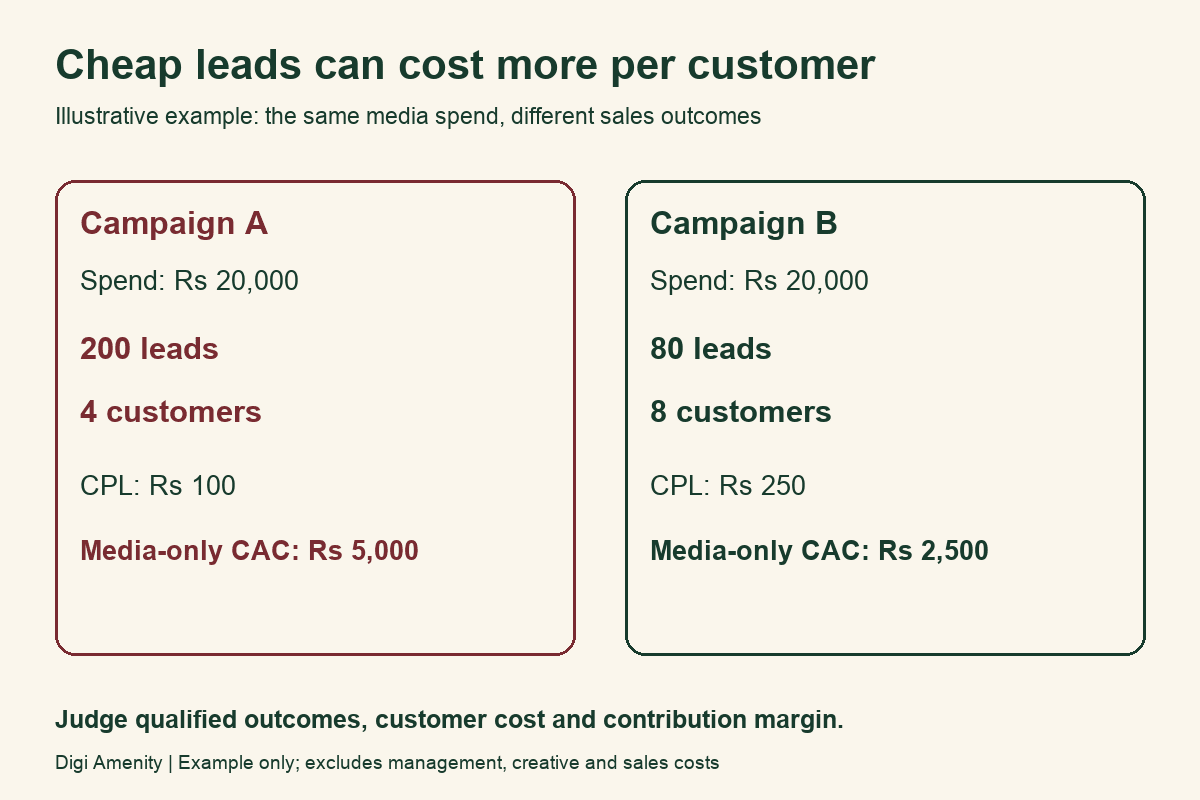
Illustrative example, not a client result: Campaign A spends ₹20,000 and produces 200 leads, with four customers. Campaign B spends the same amount and produces 80 leads, with eight customers. A has a ₹100 CPL and a ₹5,000 media-only CAC. B has a ₹250 CPL and a ₹2,500 media-only CAC.
If sales quality and contribution per customer are comparable, B may be the better campaign despite a higher lead cost. Check sales lag, refunds, staff time and whether those customers were new before moving the budget.
A 90-day performance marketing action plan
| Period | Priority | Deliverable |
|---|---|---|
| Days 1–30 | Measurement and offer | Tested conversion events, documented lead criteria, CRM stages, budget limits and a clear landing page |
| Days 31–60 | Controlled experiments | A small set of distinct creative concepts or keyword groups, with one main variable per test and a predefined success metric |
| Days 61–90 | Economics and scale | Reconciled customer outcomes, a margin-aware report and a decision to scale, revise or stop each test |
Avoid dividing budget by a universal 60/40 formula. Allocation should reflect current demand, lead quality, conversion lag, creative resources and fulfilment capacity. See our Google Ads vs Meta Ads guide for a channel decision framework.
What a useful agency report should show
- Spend, management fees and the exact conversions being counted.
- Lead quality, customer outcomes and any delay in sales reporting.
- Creative or audience tests, the result and the next decision.
- Tracking gaps and attribution assumptions.
- Budget changes tied to business capacity and margins.
Talk to Digi Amenity about a performance marketing plan built around your offer, data quality and customer economics. If Meta campaigns are already running, use our Facebook Ads mistakes checklist to identify avoidable waste.
Frequently asked questions
Will AI replace performance marketers?
AI can automate parts of bidding, delivery and production. People still need to choose goals, verify data, develop offers, approve creative and connect results to the business.
Is performance marketing the same as pay-per-sale advertising?
No. Campaigns often charge for clicks or impressions. Performance marketing describes the use of measurable outcomes to guide optimisation; it does not eliminate advertising risk.
Are third-party cookies completely gone in Chrome?
No. Google maintained user choice in its April 2025 announcement. Tracking restrictions and individual browser settings still affect measurement, so use consent-aware first-party records.
Which matters more: CPL or CAC?
CPL helps assess enquiry cost. CAC connects acquisition to customers. Review both, alongside lead quality, margin and the time between enquiry and sale.
How often should creative be changed?
Review results regularly and refresh when fatigue, declining qualified outcomes or a new offer justifies it. There is no fixed replacement interval that works for every audience and campaign.
