

ChatGPT Ads are sponsored placements that businesses can buy through OpenAI Ads Manager. India is listed as an available advertiser market as checked on 5 October 2026. Start by confirming your business eligibility, choosing a measurable outcome, preparing a relevant landing page and setting a controlled test budget. Advertising does not purchase influence over ChatGPT’s answers.
This guide explains the setup process, cost controls and measurement decisions for Indian businesses. It is based on current official documentation, not a claim that Digi Amenity has run the example campaigns. Features and account eligibility can change; check the linked documentation and your account before launch.
Are ChatGPT Ads available in India?
Yes. OpenAI announced the India expansion on 31 August 2026, and its current Ads Manager availability table lists India. The legal entity being billed must be based in a supported country. Availability does not mean every business category, advertisement or account is automatically approved.
For an Indian company, use its real business and billing information. An agency managing an overseas advertiser should establish which legal entity owns the advertising account and pays the invoices before creating anything. Do not choose another country simply to access an unavailable setting.
What are you buying—and who can see it?
Ads can appear beneath a ChatGPT response, clearly marked as sponsored. Eligible Free and Go users may see them; Plus, Pro, Business, Enterprise and Edu accounts are ad-free. OpenAI says advertisers cannot change the model’s answers and do not receive users’ private conversations. Source: ads eligibility, placement and privacy.
Keep three activities separate in your marketing plan: buying a sponsored placement, using ChatGPT to draft marketing material, and earning organic visibility in AI-generated answers. They have different inputs and measurement. Paying for ads is not a shortcut to organic citations or Google rankings.
A useful fit question is: What buying decision could a customer be working through when our offer would help? A product with a clear use case and a page that answers practical objections is easier to build a test around than an undefined “brand awareness” ambition.
How do you set up ChatGPT Ads step by step?
-
Define the outcome and the owner. Write down one business result: a completed order, a valid enquiry or another meaningful action. Assign an owner for landing-page changes, tracking, ad review and sales follow-up. A button click and a qualified lead must not share the same success definition.
-
Create the advertiser account. Start at OpenAI’s advertiser website. Use a work-controlled login, enter the account, public brand and legal billing names, and confirm country, currency and time zone carefully: these settings cannot be changed after account creation through the standard setup. Complete required verification, add the brand logo, configure billing and invite team members with appropriate roles. Keep one account per advertiser and avoid shared passwords. Account setup reference.
-
Choose the campaign objective and billing basis. Views campaigns buy impressions; Clicks campaigns buy valid clicks. Conversion optimization focuses delivery on a supported outcome but still bills for clicks or impressions, depending on the selected option. It is not a pay-per-sale arrangement. For conversion optimization, tracking and a supported standard event are prerequisites; custom events are not currently supported as its optimization goal. Decide before creation because the objective and selected conversion goal cannot simply be edited into a different one. Conversion objective requirements.
-
Set budget, dates and actual service geography. Select the countries and other supported locations that match where you can fulfil orders or deliver services. Some new self-serve accounts initially have home-country restrictions. Location options vary by campaign type and country. Do not assume a Mumbai-only option exists merely because India is supported. If the first-campaign flow hides scheduling, do not publish just to reveal it: delivery could begin before your intended start. Campaign settings reference.
-
Organise ad groups around distinct customer needs. Keep related offers together and use names that explain the hypothesis, such as
IN_storage_small_rooms. Context hints describe the product, audience and situations in which it is useful. They are additional context, not exact-match keywords, exclusions or guaranteed delivery rules. Use location and scheduling controls for those restrictions. Official context-hint guidance. -
Create distinct ads and matching destinations. Write a specific title, supporting description and relevant image. Each variation should test a different reason to buy rather than changing punctuation. Link to the closest useful product, collection or service page. Add consistent UTM parameters directly to the destination URL, check the mobile journey and ensure the page can be reached by the relevant OpenAI crawlers. Review the current creative limits and policy checks in the account. Ad and landing-page guidance.
-
Validate tracking before spending. Create the required data source, implement the Pixel and/or Conversions API, map the intended event and verify a permitted test action. The next section provides the operational checks. Do not label a tracking installation successful merely because its code is present.
-
Review, submit and confirm delivery. Check the offer, links, spend controls, event, account verification and billing together. After approval, inspect the serving status. “Not serving” can reflect review, billing or account issues; open the status explanation before changing bids. Record launch settings and the time each material change is made. Official launch quickstart.
Hypothetical creative example: an Indian furniture retailer sells compact desks. One ad group could address people furnishing small rooms. A context hint might describe “compact desks for people creating a home workspace with limited floor space.” One ad could emphasise verified dimensions; another could show storage. Both pages should display actual measurements, delivery coverage, price and return terms. This is an illustrative planning exercise, not a tested campaign or a promise that the hint will match particular conversations.
How much do ChatGPT Ads cost, and which limits matter?
There is no defensible universal CPC, CPL or ROAS target for every Indian advertiser. OpenAI’s advertiser FAQ says established performance benchmarks are not yet available across industries and campaign types. Build a target from your own margins and sales outcomes.
The official campaign table currently lists a ₹725 minimum daily budget for INR-billed accounts, checked on 5 October 2026. That is a campaign setting, not a recommended test size or a guaranteed cost per result. Recheck the table and account before budgeting. Current campaign minimums.
| Control | What it means | Business implication |
|---|---|---|
| Daily campaign budget | An average, not an absolute same-day cap; a day can reach twice the selected amount, with a seven-times allowance over the applicable week and proration rules. | Allow cash-flow headroom; see the daily-budget rules. |
| Campaign-total budget | The maximum media budget across that campaign. | Useful when an experiment needs a fixed total allocation; include all campaigns in your overall plan. |
| Card payment threshold | A trigger for collecting accrued charges. | It does not stop spend at that amount. |
Billing documentation also explains postpay charging and that account-wide limits are restricted to eligible invoice accounts. Do not assume a self-serve card account has that safeguard. Allow separately for applicable taxes, production and implementation costs. Pausing may not stop delivery instantly; monitor the final billed spend rather than treating an early dashboard value as a final invoice.
Digi Amenity’s recommendation for a first test is to approve a total learning budget and loss tolerance in writing. Choose the campaign control that fits it, keep the number of simultaneous experiments manageable and define the evidence required before increasing spend. This is a planning recommendation, not OpenAI’s minimum or a performance forecast.
How should ChatGPT Ads conversion tracking be checked?
OpenAI supports browser Pixel and server-side Conversions API measurement. Its click reference, oppref, can connect eligible clicks to later events. Preserve it through redirects; when sending the same outcome through browser and server, use the same event ID for deduplication. Share conversion data only with the required disclosures and permissions. Conversion measurement reference.
- Write an event contract. Specify the trigger, event name, value, currency, unique ID and system responsible. An enquiry event should follow a successful submission, not an attempt that fails validation.
- Implement in a controlled environment. Use the current official integration instructions. The Pixel reference covers initialization, measurement consent, standard events and debugging. The consent default requires attention; connect measurement to your actual consent process rather than assuming a banner automatically controls it.
- Test success and failure paths. Check a permitted test order or enquiry, validation errors, page refresh, repeated clicks and redirects. Verify one real outcome produces one intended event and that value/currency remain correct.
- Reconcile with your own records. Compare events with orders or CRM records before optimisation. Keep test records clearly labelled. Never put customer phone numbers, emails or private form values in UTM parameters.
- Record attribution settings. Save the report’s date basis, time zone and available click/view windows. Inspect what each column includes in your account. Documentation and beta reporting options evolve; do not combine click-through and view-through figures into an unlabeled total.
Analytics totals can differ because of attribution, consent, time zones, event configuration and modelling. Investigate those causes before assuming either system is wrong. If the landing page itself loses visitors, our web development services address the form, mobile UX and technical journey that the campaign depends on.
Which metrics should e-commerce and lead-generation businesses use?
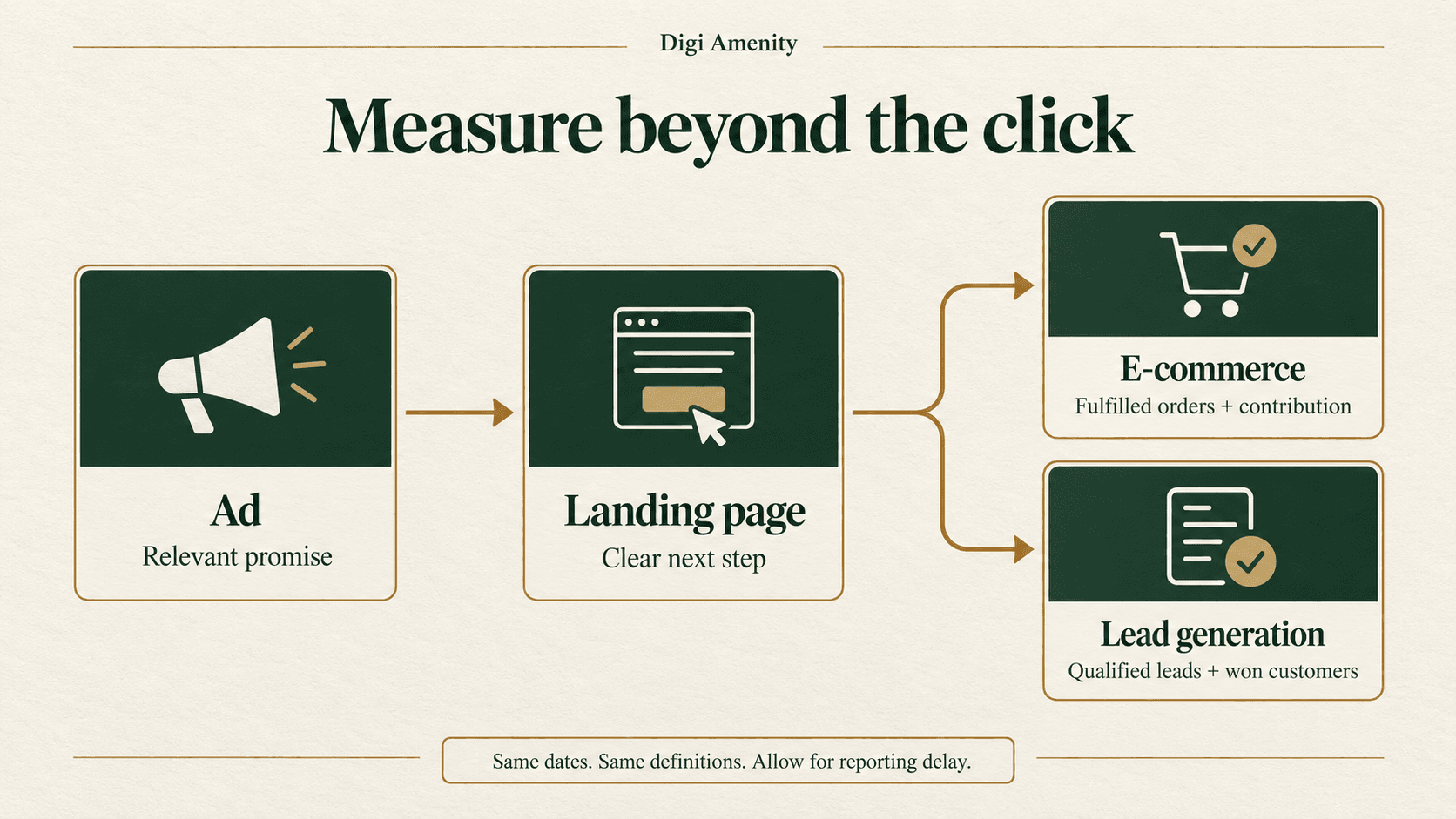
Start with delivery and cost: impressions, clicks, spend, CTR, average CPC and average CPM. In Ads Manager, use the reporting table’s menu and Edit columns to select relevant metrics and available conversion events, then save the view. Review campaign, ad-group and ad levels. Export the same date range for each review. OpenAI’s reporting guide explains column options, attribution settings and data freshness. Attributed conversions can take 24–48 hours to populate, so same-day conclusions can be premature.
| Business | Outcome scorecard | What needs another system? |
|---|---|---|
| E-commerce | Attributed purchases, purchase value, CPA and ROAS; compare with fulfilled orders, net revenue and contribution after advertising. | Returns, cancellations, fulfilment costs and new-versus-existing customers from store/order records. |
| Lead generation | Valid leads, qualification rate, cost per qualified lead, bookings, won customers and acquisition cost. | CRM stages, duplicate/spam checks, response timing and actual won revenue. |
Use explicit formulas: CPA = spend ÷ attributed purchases; ROAS = attributed purchase revenue ÷ spend; cost per qualified lead = spend ÷ qualified leads; qualification rate = qualified leads ÷ assessed unique leads. Define the cohort and allow its sales cycle to mature. Leave a ratio blank when its denominator is zero. These are business calculations, not a claim that every field is native to Ads Manager.
Hypothetical e-commerce example: a pilot spends ₹15,000 and records 30 attributed orders worth ₹60,000: CPA is ₹500 and reported ROAS is 4.0. If the matched order cohort produces only ₹12,000 contribution before advertising after product, shipping, payment and return costs, it produces minus ₹3,000 after media spend, before other overhead. A positive revenue ratio did not establish profitability.
Hypothetical lead-generation example: ₹12,000 generates 40 unique assessed enquiries, 12 qualified leads and three won customers. Raw CPL is ₹300, qualified CPL ₹1,000 and customer acquisition cost ₹4,000. Whether that is acceptable depends on customer contribution and sales effort. Use the same matured cohort; do not divide this week’s spend by customers won from last month’s leads. Our lead-quality guide explains why enquiry volume and business value must be reviewed separately.
What changes for Shopify stores with larger catalogues?
Where available, the manual feed workflow is Tools → Feeds → Create Feed, then import and validate products, create a Product feed campaign, and choose the feed and product filters in the ad group. Assign someone to keep prices, stock and links current. New feed campaigns currently use country-level geographic targeting. Ads eligibility through this feed does not mean products enter organic ChatGPT answers. Product-feed instructions.
For a small first experiment, a carefully selected product set is easier to audit than an entire catalogue. Group by a useful buying need and commercial constraints—such as deliverability and contribution—not just the number of products available. Confirm the actual integration and checkout event path before assuming a Shopify connection handles every tracking requirement.
What should your pilot checklist contain?
Copy this planning worksheet into your campaign brief. It is an original decision aid, not a platform requirement.
- Business owner, billing entity, account country, currency and time zone confirmed.
- Offer, eligible service area and one primary business outcome documented.
- Landing-page mobile journey, form/checkout and offer claims checked.
- Event trigger, unique ID, consent behaviour and duplicate handling validated.
- Total test allocation, campaign budget type and loss tolerance approved.
- Each creative has a named hypothesis, destination and consistent tracking label.
- Dashboard dates, attribution basis and CRM/order cohort definitions recorded.
- Lead follow-up or fulfilment owner assigned before launch.
- Review date allows reporting delay and the normal buying cycle.
- Decision logged as continue, revise, pause or insufficient evidence, with a reason.
Decision record: hypothesis → spend and exposure → verified outcome → limitation → next action → owner → next review date.
Pause for a broken destination, incorrect offer or demonstrably faulty conversion signal. If clicks arrive but outcomes do not, check message-to-page fit and the buying journey before producing more ads. If results are sparse, label the evidence insufficient; a single sale does not establish a winner. Expand only when acceptable economics repeat across enough comparable observations for the decision at hand.
What if the campaign is not delivering or reports disagree?
Check the specific serving-status explanation, verification, ad review, billing, active dates, geographic eligibility and remaining budget first. For tracking problems, compare the selected campaign event with the event actually received. For apparently good traffic and poor sales, investigate the offer, page, fulfilment or follow-up. Raising a bid cannot fix a failed form.
Keep proven acquisition channels funded according to their own economics while evaluating the new channel. Do not add attributed revenue across platforms and call the sum incremental revenue: multiple systems can claim the same order. A credible channel comparison needs consistent definitions and, where practical, a controlled incrementality design.
If you are considering ChatGPT Ads, Digi Amenity can review the offer, landing-page journey, conversion definitions and test economics alongside your Google Ads strategy before you commit more budget.
Frequently asked questions
Do I need ChatGPT Plus to advertise?
Advertiser access is managed through Ads Manager and its eligibility requirements. A consumer subscription is not proof of advertiser approval. Start with the official advertiser signup and current country list; distinguish the account buying ads from the audience eligible to see them.
Can I buy a recommendation inside ChatGPT’s answer?
No. OpenAI states that sponsored placements are separate from answers and advertisers cannot shape or rank the response. Evaluate paid performance and organic AI visibility separately; an ad purchase is not an organic placement guarantee.
Is ₹725 enough to prove whether ChatGPT Ads work?
₹725 is the documented INR daily campaign minimum at this article’s check date, not a research sample requirement. The evidence needed depends on actual click costs, conversion frequency and the sales cycle. Set a total learning budget you can afford, and allow an inconclusive result.
Does conversion optimization mean I only pay when someone buys?
No. The objective guides delivery toward a selected supported event; billing remains tied to clicks or impressions. Review the billing choice and tracking prerequisites before launch. An optimization goal is not a guaranteed acquisition price.
Can context hints replace geographic targeting or negative keywords?
No. They describe relevant business context and do not enforce delivery restrictions. Use the controls actually available for your campaign, and verify location eligibility. Do not place “only Mumbai” in a hint and assume it establishes a geographic boundary.
Should a service business optimise for enquiries or qualified leads?
Choose a supported, reliably measured outcome with useful signal. Track qualification and won customers in the CRM even when the platform’s selected event is an earlier enquiry. An inexpensive form submission is not automatically a useful prospect; assess fit, duplicates and follow-up.
Why do Ads Manager and store or CRM totals differ?
They may use different attribution windows, time zones, event definitions and reporting delays. Store records can also include refunds or cancellations outside the advertising report’s scope. Reconcile a consistent cohort and separate attributed results from all business outcomes before drawing conclusions.
