

The NMC guidelines for doctors on social media allow responsible health education and specified factual communication, while restricting patient solicitation, self-promotion, misleading claims, promotional testimonials and misuse of patient information. The current starting point is the National Medical Commission’s notice dated 6 October 2026 on ethical advertising and public communication. It applies with immediate effect and addresses hospitals, medical institutions and Registered Medical Practitioners (RMPs).
For a doctor, clinic owner or communication team, the practical question is: does this post help someone understand health or find accurate information, or does its wording, imagery and distribution promote a particular practice? An unpaid Instagram post can still be promotional. Patient consent and an “AI-generated” label do not automatically make prohibited content permissible.
Checked against the official notice on 13 October 2026. This guide explains the document for communication planning; it does not determine the legal status of a specific campaign. Obtain appropriate medical-ethics or legal advice for disputed cases and check subsequent NMC or State Medical Council directions before acting.
Download the doctor social media review checklist (PDF) to record the purpose, evidence, privacy review and approval for each asset.
Which official NMC document should you read in 2026?
Read the NMC’s Guidelines on Ethical Advertising and Public Communication by Hospitals/Medical Institutions and Registered Medical Practitioners, issued through notice R-13014/01/2024-Ethics on 6 October 2026. The notice and its annexure together form a 13-page document.
Articles based only on earlier social-media guidance may miss these current provisions. A page labelled “latest” is not enough: inspect the underlying notice date, issuing body and operative text. In particular, the 2026 document contains detailed provisions on digital patient acquisition, AI content, institutional communication and third-party responsibility.
Clauses 2 and 4 explain that these guidelines operate alongside the NMC Act, the applicable 2002 professional-conduct regulations and other relevant laws. They do not authorize something another applicable law prohibits. For institutions, the relevant clinical-establishment or state legislation also matters; do not assume one state-law framework applies identically across India.
Who is covered: an individual doctor, a clinic or a hospital?
The document defines an RMP through registration under the NMC Act in the National or State Medical Register. Its definition of a hospital or medical institution refers to clinical establishments under applicable legislation. These are related but different categories.
Do not automatically apply the individual-RMP provisions to every person described as a healthcare professional. A dentist or practitioner regulated under a different professional system needs the rules of the relevant regulator checked as well. Equally, operating through a hospital brand does not remove restrictions on promoting an individual RMP.
Clause 4.4 addresses content produced through an agency, influencer or platform. Responsibility is not removed where the doctor or institution authorized, commissioned, sponsored, adopted or knowingly permitted the communication. The competent authority determines the consequences on the facts.
Practical first step: record the account owner, the person featured, the institution involved and the reviewer responsible. A hospital’s factual facilities announcement and a surgeon’s personal promotional Reel should not pass through an identical checklist without this scope assessment.
What counts as advertising on social media?
Clause 3.2 uses a broad concept of advertising: direct or indirect promotion of services, reputation, skills, qualifications, achievements or facilities. The medium list includes websites, blogs, messaging services such as WhatsApp and Telegram, social platforms, podcasts, influencer activity, sponsored content and promotional interviews. Search-engine and AI-assisted communication can also fall within scope when promotional in character.
Ordinary public information without a promotional character or an intention of commercial benefit is distinguished from advertising. That distinction requires looking at the whole communication, not just whether money was paid to distribute it.
- Purpose: is the content explaining a health issue or trying to obtain patients for a named practitioner?
- Presentation: do the thumbnail, music, captions or before-and-after sequence imply a superior outcome?
- Destination: does a supposedly educational post lead into a promotional booking funnel?
- Distribution: do repetition, targeting or third-party endorsements change the character of otherwise factual information?
These four questions are an editorial screening method, not four separate statutory tests. Clause 8.3 specifically cautions that the form, medium or frequency of institutional communication must not turn factual information into solicitation.
What can doctors and hospitals communicate publicly?
The guidelines leave room for useful information. The conditions attached to each category matter as much as the category itself.
| Communication | Relevant boundary | Practical approach |
|---|---|---|
| General health education | Clause 5.1 permits awareness, public-health, academic and educational content without promoting personal practice, soliciting patients or promotional monetization. | Explain a question accurately, include material limitations and remove practice-promotion elements. |
| Formal practice announcement | Clauses 8.2(ii) and 9.3 cover specified announcements, including starting practice, address changes, absence, resumption and charges; they must remain factual, limited and non-promotional. | Communicate the actual change without adding superiority or urgency claims. |
| Hospital facilities information | Clause 8.3 permits objective, verifiable institutional information under its conditions. | State location, departments, emergency services, facilities or applicable charges accurately; avoid outcome promises and individual-doctor promotion. |
| Hospital doctor directory | Clause 9.1 distinguishes factual professional listings from paid promotion. | Use recognized qualifications, specialty, registration details and availability for patient information. |
For example, announcing that an institution has a particular diagnostic facility is different from claiming that its equipment guarantees an accurate diagnosis or makes it superior. The equipment explanation in clause 3.2 does not authorize those additional claims.
A useful internal distinction is “information needed to understand or access an existing service” versus “persuasion designed to select us over another provider.” It is a review aid, not a blanket legal safe harbour.
Which credentials should appear in electronic posts?
Explanations III and IV to clause 3.2 address transparency in electronic posts. RMP communication should disclose the practitioner’s name, qualifications, registration status and State Medical Register or National Medical Register number. Clinical-establishment posts should disclose the relevant RMP names and corresponding professional details described in the provision.
Verify these facts against the appropriate records. A designer should never invent a registration number, convert a course certificate into a recognized specialist qualification or silently shorten a qualification in a way that changes its meaning.
A working editorial template is: [Name] | [verified qualification] | [registration status] | [SMR/NMR number]. Use actual verified information before release. Keeping it readable in a caption or end card is a practical implementation choice; this guide is not claiming that NMC mandates one particular font size, placement or graphic template.
Check that the website biography and social post agree. Our website development work can support clear profile layouts and maintainable information fields, but the practitioner remains responsible for the truth and appropriateness of the credentials supplied.
Can doctors post patient testimonials, reviews or before-and-after photographs?
For professional promotion on social media, explanation V to clause 3.2 says an RMP should not request or share patient reviews, testimonials, recommendations or endorsements. It also prohibits fake, paid or misleading review and rating practices by RMPs and institutions. Clause 8.1 addresses using patients, celebrities, employees or influencers for prohibited testimonials and endorsements.
A signed patient consent form does not override these restrictions. Clause 6.2 makes that distinction explicit. Consent is one question; whether the particular use is permitted is another.
Clause 8.1(v) restricts promotional cases, surgical results, before-and-after imagery, celebrity-patient publicity and personal success stories. Its strictly scientific or educational qualification must be read together with consent, anonymization and the other privacy provisions. It is not a permission slip to rename a promotional transformation video “patient education.”
Clause 7.4 addresses patient information that can be publicly identified. Removing a name alone may be inadequate: a face, voice, distinctive anomaly, visible record, date or surrounding story may make someone recognizable. Where a disclosure is otherwise lawful and consent is required, clause 6 calls for specific, informed, voluntary, documented and verifiable consent.
For review purposes, separate three decisions: Is the use permitted? Is the person identifiable? Is the required consent valid for this exact use? A “yes” to the third does not repair a “no” to the first.
Which claims, offers and endorsements need particular attention?
Clause 8.1 covers exaggerated achievements, cure guarantees, unrealistic expectations, concealed risks and unproven therapies. Avoid creating an impression that every patient will obtain the same result or that an intervention has no meaningful limitation.
Superiority claims and awards require more than an attractive badge. Clause 8.1(ix) requires objectively verifiable claims with transparent, independently checkable methodology and relevant award information where needed to prevent misleading impressions. The use must also be otherwise lawful. Evidence for an award does not cancel the separate restrictions on an RMP’s self-promotion.
Product endorsements are another trap. Clause 8.1(iv) restricts use of professional status to endorse drugs, devices, health or commercial products whether payment is received or not. A disclosure that a post is sponsored does not make an otherwise prohibited endorsement acceptable.
Fees should be distinguished from inducements. Clause 8.1(x) restricts discounts, coupons, gifts, referral benefits, free procedures and similar tactics where they encourage unnecessary care or amount to solicitation. Lawful price information must be factual, transparent and non-misleading. Do not interpret this as either permission for every “package” advertisement or a ban on every factual disclosure of consultation charges.
What do the NMC rules say about AI-generated content?
Clause 7.2 deserves a direct reading. Its opening prohibits AI-generated promotional campaigns furthering commercial interests. It then requires AI-origin marking for AI-generated promotional content that conforms to the guidelines, applicable regulations and laws. Those adjacent provisions create an interpretive question; this guide cannot resolve it by treating an AI label as universal permission.
The clause also addresses misleading AI-assisted claims, fabricated or manipulated patient material, synthetic endorsements presented as actual people, appropriate disclosure of materially artificial content and patient information used as AI input.
- Do not manufacture a “patient” praising a doctor, even if the voice and face are synthetic.
- Do not alter a clinical result to make treatment appear more effective.
- Do not send identifiable patient records to a general-purpose AI service simply to generate captions.
- Have a qualified human verify health explanations, qualifications and depicted information.
- Escalate proposed AI promotional campaigns for appropriate advice; disclosure alone does not settle permissibility.
The operational distinction is between a tool producing a draft and a responsible person approving a lawful communication. An accurate caption can still be part of a prohibited promotional use. Conversely, this notice should not be paraphrased as a blanket ban on every possible use of AI in a medical organization.
Can a doctor use an agency, SEO service or healthcare platform?
The contract and the work both need scrutiny. Clause 8.1(ii) restricts self-promotion and third-party marketing of an RMP’s medical services. Clauses 8.1(vii) and (viii) address commissions, referral or lead-generation fees and payment linked to obtaining or referring individual patients. Clause 4.4 prevents an agency arrangement from automatically removing responsibility.
Do not assume that replacing a per-patient payment with a monthly retainer makes prohibited promotional activity permissible. A retainer changes the payment arrangement; the purpose and content still need review. Equally, these provisions should not be reduced to “a doctor cannot receive any outside technical or editorial support.” The precise scope of an engagement needs competent assessment.
For a factual website or directory, distinguish maintaining accurate information from buying professional prominence. Clause 9.4 addresses paid rankings and transparent healthcare-platform listings. The restrictions on misleading algorithmic manipulation do not justify claiming that every technical SEO task is prohibited.
Work such as fixing broken information links or making an approved factual page readable is conceptually different from selling a doctor a “top specialist” position. When planning technical SEO and website information improvements, document exactly what is being changed and why. Do not promise patient acquisition or legal clearance through a channel label.
For reviews, distinguish an independent third-party comment from requesting, purchasing or republishing praise for promotion. An unsolicited review’s existence is not permission to convert it into an advertising creative. Do not disclose a person’s patient status or treatment details when responding publicly.
How would a Mumbai clinic audit its existing content?
Hypothetical example: a Mumbai clinic has Instagram posts, a hospital-style website directory and a freelancer who prepares weekly creatives. The following is a proposed screening exercise, not an account of work performed for a client or a legal finding about a real post.
| Asset found | Review issue | Concrete next action |
|---|---|---|
| Reel combining patient praise with a booking prompt | Promotional testimonial; consent alone is insufficient. | Hold further distribution, preserve the record and route to the responsible medical/legal reviewer against clauses 3.2, 6.2 and 8.1. |
| General health explainer without practice promotion | Potential educational communication; clinical accuracy still matters. | Verify the explanation, limitations, credentials and full presentation before approving the specific version. |
| Directory showing an old qualification or registration detail | Factual accuracy and transparency. | Obtain verified details and correct the controlled profile through an approved change. |
| AI voice presented as a satisfied patient | Synthetic endorsement purporting to be a real person. | Stop the proposed creative; retain the decision and check other variants from the same template. |
| Agency invoice charging for each patient acquired | Acquisition-linked payment and underlying promotional activity. | Escalate the contract and deliverables together; do not merely rename the fee. |
The audit unit should be the complete asset: image or video, caption, thumbnail, link, targeting, placement and commercial arrangement. Reviewing just the caption can miss the feature that creates the problem.
What should your approval workflow and downloadable checklist include?
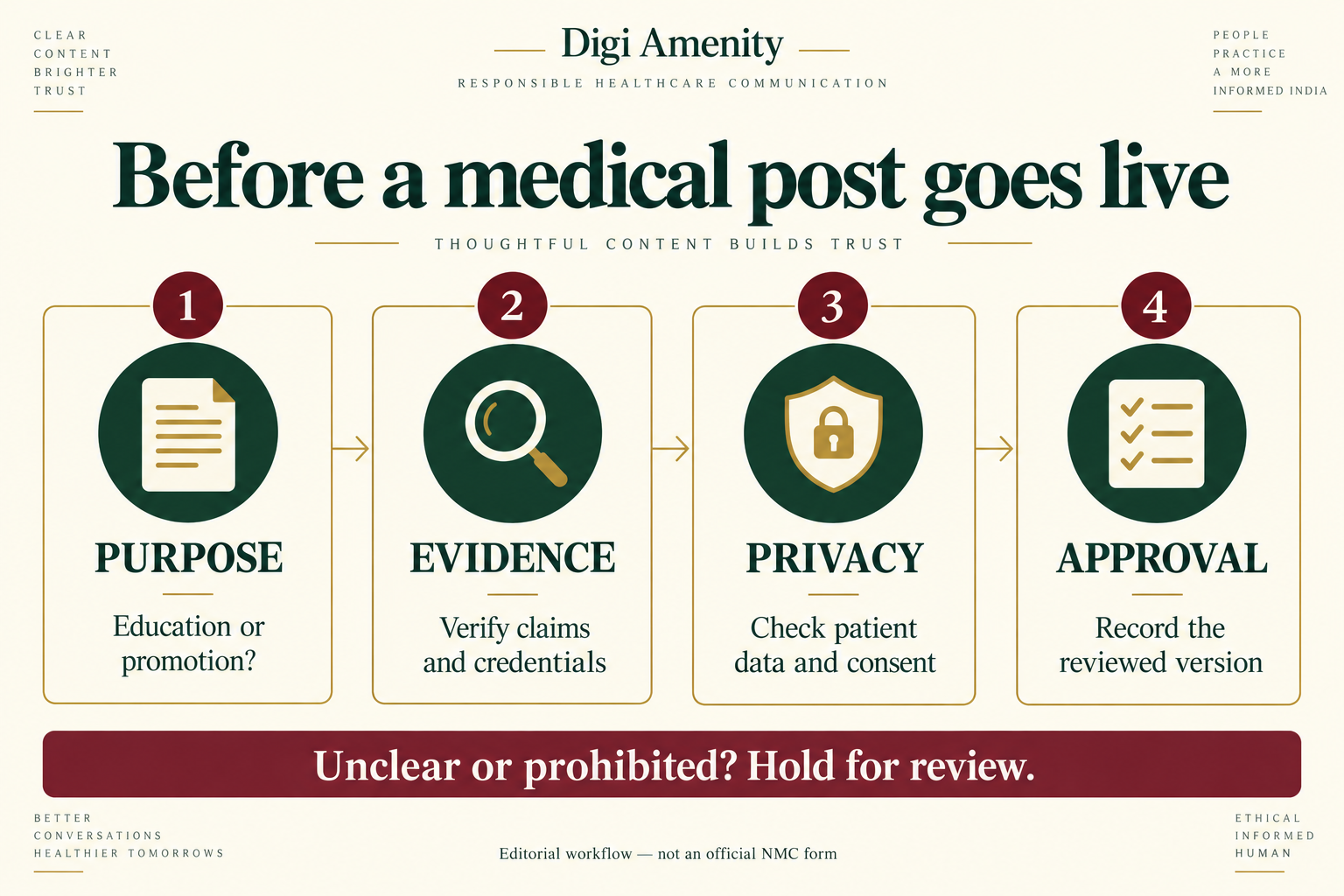
Use four review gates: purpose, evidence, privacy and approval. These are Digi Amenity’s proposed operational controls, not an NMC-mandated software process.
- Inventory: list owned profiles, website pages, scheduled posts, paid placements, messaging templates and agency-produced assets. Assign an owner and record the URL or file version.
- Purpose: identify the communication category and provider type. Hold unclear promotion instead of approving it because a competitor does the same thing.
- Evidence: check qualifications, registration, dates, medical statements, prices, awards and any implied outcome. Remove unsupported claims.
- Privacy: look for identifiable patients, records, images, voices and AI inputs. Verify lawful use and required consent separately.
- Approval: record the actual reviewed version, named reviewer, date, decision, conditions and next review trigger.
- After release: monitor unauthorized edits, reposting, comments and stale information. Preserve a correction trail and reassess when guidance changes.
Download the printable NMC social media review checklist and approval record (PDF). It includes a screening list, a decision record and escalation prompts. A completed worksheet is not a legal certificate; unresolved questions remain on hold.
Measure the communication process honestly: proportion of assets with evidence records, time to correct inaccurate information, unresolved privacy issues and completion of scheduled reviews. Views, bookings or engagement alone cannot establish that a communication is ethical.
What can happen if the guidelines are violated?
Clause 10.1 describes graded action that the relevant State Medical Council may contemplate, subject to applicable law and the competent authority’s powers. It lists a warning and mandatory ethics training for a first violation; censure and a monetary penalty for a second; suspension for three to six months for a third; six to twelve months for serious violations; and removal from the register for one to three years for repeated violations.
These are not automatic outcomes for every complaint. The document does not supply a fixed rupee amount for the monetary penalty. Clauses 10.2 and 10.3 provide for a show-cause notice, an opportunity to explain and a reasoned order. Institutions’ enforcement framework also depends on applicable clinical-establishment or state law.
Clause 11 describes appeals, including the statutory route to the Ethics and Medical Registration Board and a further appeal under the NMC Act, with the stated 60-day periods. Anyone facing a notice should obtain advice on the actual order, applicable powers and deadline rather than calculate a response from a blog summary.
Frequently asked questions
Are doctors banned from using Instagram, YouTube or LinkedIn?
No blanket platform ban is stated in this notice. The rules concern the purpose and nature of communication. Educational and specified factual communication have conditions; a practice-promotional post can still breach the rules even when published organically.
Can a doctor share a patient’s thank-you message after getting consent?
Consent alone is insufficient. An RMP requesting or sharing patient praise for professional promotion on social media runs into the testimonial provisions. Assess the proposed use, privacy and consent separately rather than treating a signed form as approval to advertise.
Can hospitals announce a new department or piece of equipment?
Factual institutional information is contemplated, subject to the guidelines. Verify that the facility actually exists and describe it objectively. Do not add guaranteed accuracy, cure promises, unjustified superiority or promotional portrayal of an individual doctor. Presentation and frequency also matter.
Can a doctor display a professional photograph?
Clause 9.2 addresses photographs where their use constitutes self-advertisement, solicitation or promotional publicity. It should not be simplified into a claim that every photograph in every context is banned. Review the placement, purpose and surrounding claims against the full provisions.
Does an AI-generated label make a healthcare advertisement acceptable?
No. Clause 7.2 begins with a prohibition on AI promotional campaigns furthering commercial interests and also contains conditional marking requirements. Labelling cannot override prohibited purpose, fabricated endorsements or misleading claims. Obtain appropriate interpretation for a proposed campaign.
Can consultation fees appear on a website or in an announcement?
The document allows specified factual charge announcements and lawful transparent fee information. That differs from offers or inducements that amount to solicitation or encourage unnecessary care. Review the whole presentation, including deadlines, rewards and booking pressure.
Do these rules apply only to paid advertisements?
No. The definition encompasses direct or indirect promotion through several media. Unpaid posts, messaging broadcasts, influencer arrangements and promotional interviews can fall within scope. Paying nothing for reach does not decide whether the communication is advertising.
What should an agency do before posting for a doctor?
Confirm the regulatory scope and authorized purpose, review the contract and payment structure, collect verified credentials and evidence, check privacy and obtain approval for the exact version. An agency should not promise legal certification or assume the doctor’s approval cures an otherwise prohibited activity.
How can Digi Amenity support a clearer content-review process?
If your clinic’s website and social accounts contain mixed educational posts, testimonials and promotional creatives, Digi Amenity can help organize the asset inventory, evidence records and publishing workflow alongside your designated medical-ethics or legal reviewer. Explore our social media content planning support to discuss that operational review. Individual content permission and legal interpretation need the appropriate professional review.
Primary source: NMC notice of 6 October 2026 and its attached guidelines, especially clauses 3–9 for communication and clauses 10–11 for process. Refer to the NMC website for subsequent notices. The cover and workflow graphic are AI-generated editorial illustrations; neither depicts an actual patient nor represents an official government form.
