
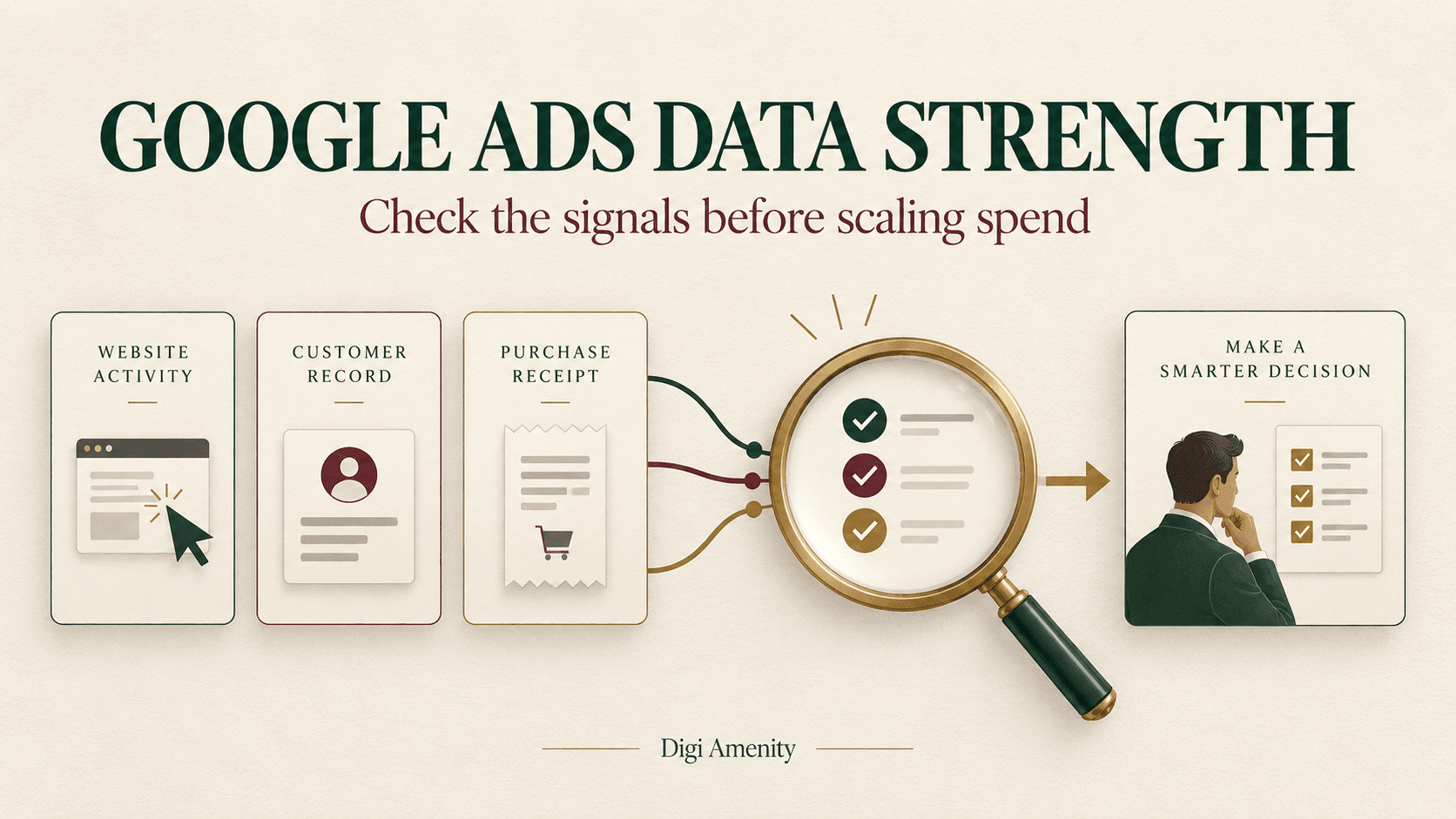
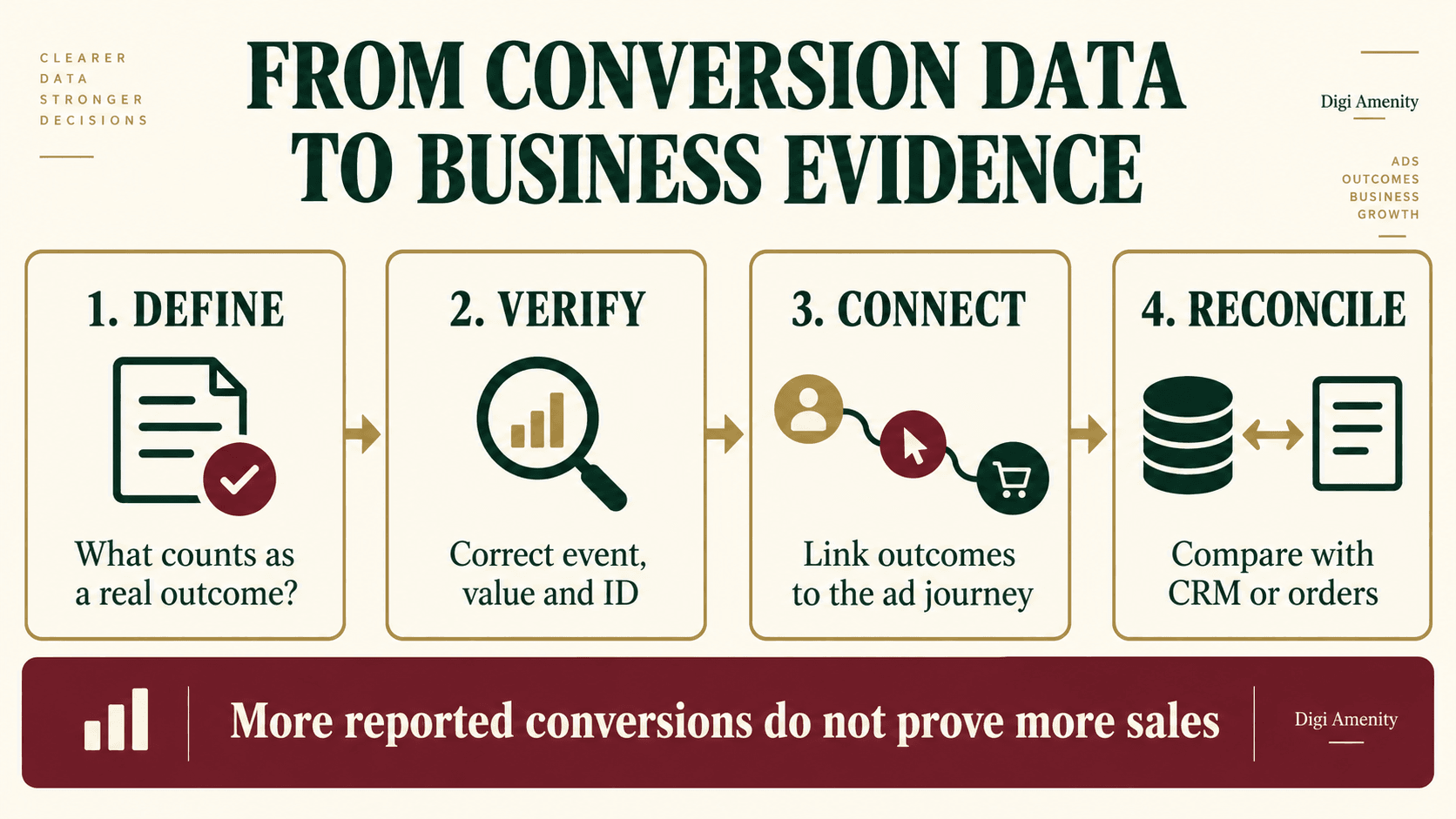
Google Ads Data Strength means building reliable first-party measurement so advertising decisions use meaningful customer outcomes. Start by defining a real purchase or qualified lead, checking that it is recorded correctly, connecting later outcomes from your CRM or order system, and comparing the advertising report with business records. Adding more events is useful only when those events describe something worth optimising.
For an Indian service business, a WhatsApp-button click and a booked consultation are different outcomes. For an online store, an order placed and a cash-on-delivery order successfully fulfilled may have very different commercial value. A measurement setup needs to preserve those differences.
Platform documentation checked on 12 October 2026. Menu labels, connectors and new reporting features can vary by account. Examples below are hypothetical, not Digi Amenity client results.
What does Google Ads Data Strength actually cover?
Google’s framework brings together connected data sources, useful customer and transaction signals, their use in advertising, and evidence of business impact. Its Data Strength guidance connects website tagging, Analytics, offline data, conversion values and measurement experiments.
The practical question for a business owner is: “Can the advertising system distinguish the outcomes we want from activity that merely looks successful?” An enquiry form that fires before submission can produce misleading numbers even when every integration is connected. A correct event with no sales follow-up can still leave a large gap in the picture.
| Term | What it helps you assess | Business check to keep beside it |
|---|---|---|
| Data Strength | The first-party measurement foundation | Are the recorded outcomes accurate and useful? |
| Google Ads Data Manager | Connections and activation of external first-party data | Does the right record reach the intended destination? |
| Enhanced conversions | Conversion measurement using supported first-party customer information | Is the underlying event valid and the data use appropriate? |
| Ad Strength | Feedback about ad assets | Does the message produce relevant, profitable demand? |
| Business performance | Qualified enquiries, customers, fulfilled orders and contribution | Do the outcomes justify the total cost? |
Ad Strength is a different diagnostic from Data Strength. Do not use a creative rating to certify your tracking or treat a connection status as proof of profitability.
What changed in 2026, and what should Indian advertisers verify?
On 10 September 2026, Google announced a Data Strength Uplift metric intended to show additional conversions recovered through first-party measurement. The announcement also described Data Manager and Meridian developments. This is a dated platform announcement, not evidence that every account has every feature today. See Google’s measurement announcement.
Recovered conversions and incremental sales answer different questions. If an order already happened but was previously unreported, recovering its attribution improves visibility. It does not establish that the tracking change caused another customer to buy. Demonstrating incremental demand requires an appropriate experiment or other causal measurement design.
There is also a setup change worth checking before following an old tutorial. Google’s enhanced-conversion settings update describes a unified on/off setting from June 2026 and changes to offline-upload API access. Existing integrations should be reviewed against that migration guidance. Do not build a new upload process from an old Google Ads API example without checking the supported Data Manager API route.
For an Indian account, confirm feature visibility, connector support, permissions, currency, time zone and customer-data requirements in that account. This guide does not establish an India-wide launch date for the new uplift card. Missing a new card does not prevent you from auditing event definitions and CRM outcomes now.
What should you prepare before changing the setup?
Create a one-page data contract: a shared description of what each event means, who owns it and how it will be checked. Marketing, the website developer and the person responsible for sales or orders should agree on it.
- Outcome: the exact business action, such as a successfully submitted service enquiry or a paid purchase.
- Trigger: the evidence that the action completed. A button press alone may not prove a successful submission.
- Identifier: a stable lead or order reference that can be used for reconciliation without exposing personal information in ordinary reports.
- Value: what the amount represents, including the treatment of discounts, taxes, delivery charges and cancellations.
- Timing: when the outcome happened, when it was uploaded and how long later-stage outcomes normally take.
- Owner: the person who fixes errors and the person who approves a change to the definition.
A useful contract has a testable statement. “Track leads correctly” is too vague. “Record one successful enquiry, retain its reference in the CRM, and exclude a failed submission” gives the team something concrete to verify.
How do you audit Google Ads Data Strength step by step?
1. List the actions each campaign actually uses
Open Goals → Conversions → Summary and inspect the relevant goals and actions. Record the source, action optimisation setting, value rule and campaign usage. Google’s primary and secondary action documentation explains that primary actions contribute to bidding when their standard goal is used. Secondary actions normally support observation, but a secondary action inside a custom goal can still be used for bidding.
That exception matters during an audit. Do not stop after finding the word “secondary”. Inspect the campaign’s selected goals. Also look for two separate actions that both represent the same purchase or enquiry. A native Ads conversion and an Analytics import can create confusing totals when both are used without a deliberate measurement design.
2. Validate the event before adding another connection
Use approved test transactions or a staging process to check success, failure, repeat submission and page reloads. Keep test records clearly labelled and out of business outcome reporting. Inspect the event in the appropriate tag-debugging tools and compare it with the backend record.
For purchases, verify a dynamic, unique transaction ID. Google describes deduplication for the same conversion action and transaction ID; a constant ID reused across different orders can cause undercounting. Matching IDs should also remain consistent across supported routes for the same outcome. See transaction ID guidance. Do not assume an ID automatically deduplicates every separate conversion action in the account.
If events are absent or firing at the wrong moment, work through the Google Ads conversion-tracking troubleshooting guide before making bidding decisions from those numbers.
3. Separate data delivery from business meaning
Google tag gateway changes how Google tagging is served through first-party infrastructure. Enhanced conversions supplement conversion measurement with supported first-party information. These solve different parts of the measurement problem. Neither can decide whether a sales team has correctly marked an enquiry as qualified. See Google’s tag gateway explanation and enhanced-conversion overview.
Choose an implementation because it resolves a documented gap. Write down the failing check, the proposed change and the expected evidence afterwards. Avoid adding a second plugin or server route simply because a dashboard number looks low; first inspect what the existing route already sends.
4. Connect the relevant outcome source
Google Ads Data Manager provides a way to connect and activate first-party data. Google’s documented entry is Tools → Data manager. A connection, a data source and a destination are separate concepts: access to a CRM does not by itself prove that the correct conversion action receives its records.
Select the supported source and intended use case, review the fields, then trace a permitted sample record through the flow. Confirm identifiers, timestamps, value, currency and the intended event stage. Keep the sample small enough to diagnose an error before it affects a large batch. Permission to connect a system should be limited to the data needed for the agreed purpose.
5. Check customer-data handling and consent
Enhanced conversions use hashed first-party customer information for measurement. Hashing is not the same as removing every privacy obligation. Review the applicable Google customer-data policies and your own responsibilities before enabling collection or uploads.
Consent mode communicates consent choices to supported tags; it does not obtain consent on your behalf. Keep personal information out of page URLs, ordinary event labels and shared reporting sheets. A developer should test permitted and denied states where applicable, rather than assuming a first-party delivery route overrides the visitor’s choices.
6. Read diagnostics and reconcile actual records
Inspect import errors, warnings, freshness and the last successful run. Google notes that its data-source diagnostics are rolling out gradually. If a new diagnostic view is absent, document that limitation and inspect the evidence available in the current connection and conversion reports.
Reconcile at two levels. First, ask whether eligible records were processed correctly. Then ask whether the reported business outcome agrees with your CRM or order definitions. Successfully processed records are not automatically matched ad conversions, and ad-attributed conversions will not necessarily equal all orders from every channel.
7. Change optimisation only after the new signal is dependable
Do not switch several goals, budgets and bidding targets simultaneously if you want to understand the result. Save the previous settings, document the change and allow for the actual conversion delay. Google’s conversion-goal change guidance describes an adaptation period, typically measured in conversion cycles. A long sales cycle needs a different review window from a same-day purchase.
Choose a meaningful outcome that arrives reliably enough to support a sensible decision. A very late closed sale may be commercially valuable but operationally difficult to evaluate quickly. A consistently defined qualified lead can be a useful intermediate outcome, provided the qualification rule has a real relationship to sales.
What should a lead-generation business send back?
Write down the distinction between a submitted enquiry, a qualified lead and a converted customer. For example, a qualification rule might require a relevant service request, a serviceable location and a reachable contact. The exact rule belongs to the business; a sales representative’s personal preference should not silently change it.
Google provides separate qualified-lead and converted-lead goal categories. Its Data Manager setup guide for enhanced conversions for leads covers connecting CRM/file sources, selecting a conversion goal and mapping source fields. Use the current instructions shown for your connector, rather than treating this article as a screen-for-screen installation manual.
Hypothetical example: a service business spends ₹30,000 and records 100 enquiries. After the agreed follow-up window, 25 meet its qualification rule and five become customers. Raw CPL is ₹300; cost per qualified lead is ₹1,200; acquisition cost is ₹6,000. These calculations use the same advertising cohort and outcome window. They do not prove profitability without customer value and delivery costs.
If the dashboard later recovers attribution for ten enquiries that already existed, a lower reported CPL alone does not establish improved sales performance. Keep the CRM totals beside the platform report. Diagnose the offer, location targeting, response time and qualification process using the lead-quality review guide when raw lead volume and sales outcomes disagree.
How does the audit differ for e-commerce?
Start with the order lifecycle. Decide how your management report treats paid orders, cancelled orders, refunds, cash on delivery and return-to-origin costs. Preserve the platform’s purchase definition and show later commercial adjustments explicitly; silently changing definitions makes historical comparisons unreliable.
Hypothetical example: an online store has ₹40,000 ad spend and ₹2,00,000 of attributed order value, giving a reported revenue ROAS of 5. After the business reconciles cancellations and refunds for that same mature cohort, retained revenue is ₹1,50,000. Its corresponding management ratio is 3.75. Neither number is profit: product, fulfilment, payment and service costs still matter.
Audit mobile checkout, payment success and payment failure separately. Confirm that a browser refresh does not create another order in your management reconciliation. Check whether discounts and currency values are consistent between the event and the order. If a technical release changes measurement, annotate its date before interpreting a sudden improvement in ROAS.
Which metrics belong in a Data Strength dashboard?
Keep measurement health and commercial results in separate groups on the same report. The following are recommended management calculations, not claims that Google provides each one as a built-in metric.
| Metric | Definition | Interpretation limit |
|---|---|---|
| Processing acceptance rate | Accepted records ÷ submitted records ×100, where the source reports these counts | Acceptance does not prove matching or incremental sales. |
| Outcome-field completeness | Eligible records with the agreed required fields ÷ eligible records ×100 | Complete fields can still contain incorrect values. |
| Upload delay | Time between outcome occurrence and successful processing | Report a distribution or median, not only the fastest record. |
| Qualified-lead rate | Qualified leads ÷ valid enquiries in the same mature cohort ×100 | Keep qualification criteria and exclusions stable. |
| Cost per qualified lead | Spend attributed to the cohort ÷ qualified leads | Do not divide this week’s spend by older leads closing this week. |
| Revenue ROAS | Attributed revenue ÷ advertising spend | Revenue basis and attribution differ from profit. |
| Business reconciliation difference | Difference between aligned platform and backend measures | Investigate scope, attribution, consent and timing before labelling a gap an error. |
If a denominator is zero, display “not applicable” rather than an invented percentage. If a source is unavailable, leave the result blank with a reason. Record the date range, currency, attribution basis, included actions and data freshness beside the report. Never add a platform’s aggregate uplift value to another conversion total without understanding the overlap.
How should you respond when the numbers disagree?
- Ads conversions rise while CRM customers stay flat: inspect recovered attribution, duplicate actions and outcome definitions before increasing spend.
- CRM outcomes exist but imports fail: check connection health, permissions, required fields, timestamps and the documented upload route.
- Imports succeed but reported conversions remain low: investigate eligibility, matching, attribution and processing delay; do not repeatedly resend records without deduplication controls.
- Raw CPL falls but qualified CPL rises: review traffic intent, offer wording, form friction and follow-up. Better event delivery cannot repair an unsuitable offer.
- ROAS changes immediately after a tracking release: compare order-level evidence and the measurement definition before treating the change as a campaign improvement.
What is the complete pre-scaling checklist?
Copy this checklist into your audit record and add an owner, evidence link and review date to each item. A tick should mean the check passed, not merely that someone opened the setting.
- Business outcome and exclusion rules are written down.
- Campaign goals, primary/secondary actions and custom-goal exceptions are inspected.
- Duplicate representations of the same outcome have a deliberate treatment.
- Successful, failed and repeated actions have been tested through an approved process.
- Transaction or order identifiers are stable, unique and free of personal information.
- Values, currency, timestamps and reporting time zones are documented.
- Customer-data terms, permissions and applicable consent behaviour are reviewed.
- Tagging and any gateway/enhanced-conversion route have a named technical owner.
- CRM or order fields map to the correct destination and business stage.
- Existing API integrations have been checked against current migration guidance.
- Import failures, warnings and data freshness are monitored.
- A sample has been reconciled with backend records.
- Lead and order cohorts allow sufficient time for later outcomes.
- Reporting recovery is separated from evidence of incremental demand.
- Change history, baseline, rollback plan and next review date are saved.
A sensible first-month plan is to agree definitions and inspect goals in week one, repair collection in week two, validate permitted offline feedback in week three, and review mature evidence in week four. This is a planning example, not a deadline promise. A long sales cycle may require a longer observation window.
Frequently asked questions
Is Google Ads Data Strength the same as Ad Strength?
No. Data Strength concerns measurement foundations and first-party signals. Ad Strength gives feedback about creative assets. Review both where useful, but judge business success through appropriately measured qualified leads, customers and commercial outcomes.
Does a higher Data Strength uplift percentage mean more sales?
It can indicate recovered conversion measurement. An already completed sale becoming visible is different from a new sale caused by advertising. Keep reporting recovery separate from incremental-demand tests and backend commercial results.
Do we need an expensive CRM to begin?
You need consistent outcome records, ownership and a supported data route. Start by documenting your stages and maintaining accurate records. Evaluate the supported connector, access controls and total operating cost before buying a CRM or integration solely for this project.
Can we use WhatsApp clicks as qualified leads?
A click shows an attempt to open a conversation, not proof of qualification. Keep it labelled as that interaction. Record an actual enquiry and subsequent qualification separately when your approved systems and process can reliably establish them.
Should every conversion action become primary?
No. Choose actions that reflect the campaign’s intended objective and inspect campaign goal usage. Remember that custom goals can use secondary actions for bidding. Making every interaction a target can obscure which outcomes the campaign is meant to generate.
Why does an older enhanced-conversions tutorial look different?
Google has documented unified settings and changes to supported offline-upload routes in 2026. Check the current settings documentation and your actual account. Preserve working integrations while your developer validates migration requirements; do not recreate conversion actions merely to resemble an old screenshot.
How soon should we decide whether the work helped?
Validate implementation first, then wait for sufficient mature outcomes using consistent definitions. Review data delivery, attribution and business results separately. A before-and-after comparison with changed budgets, offers or seasonality cannot isolate the effect of a tracking change.
If Google Ads reports conversions but your sales or order records tell a different story, Digi Amenity can review the event definitions, tracking, CRM feedback and landing-page journey before you increase spend. Explore our Google Ads review and management services.
