
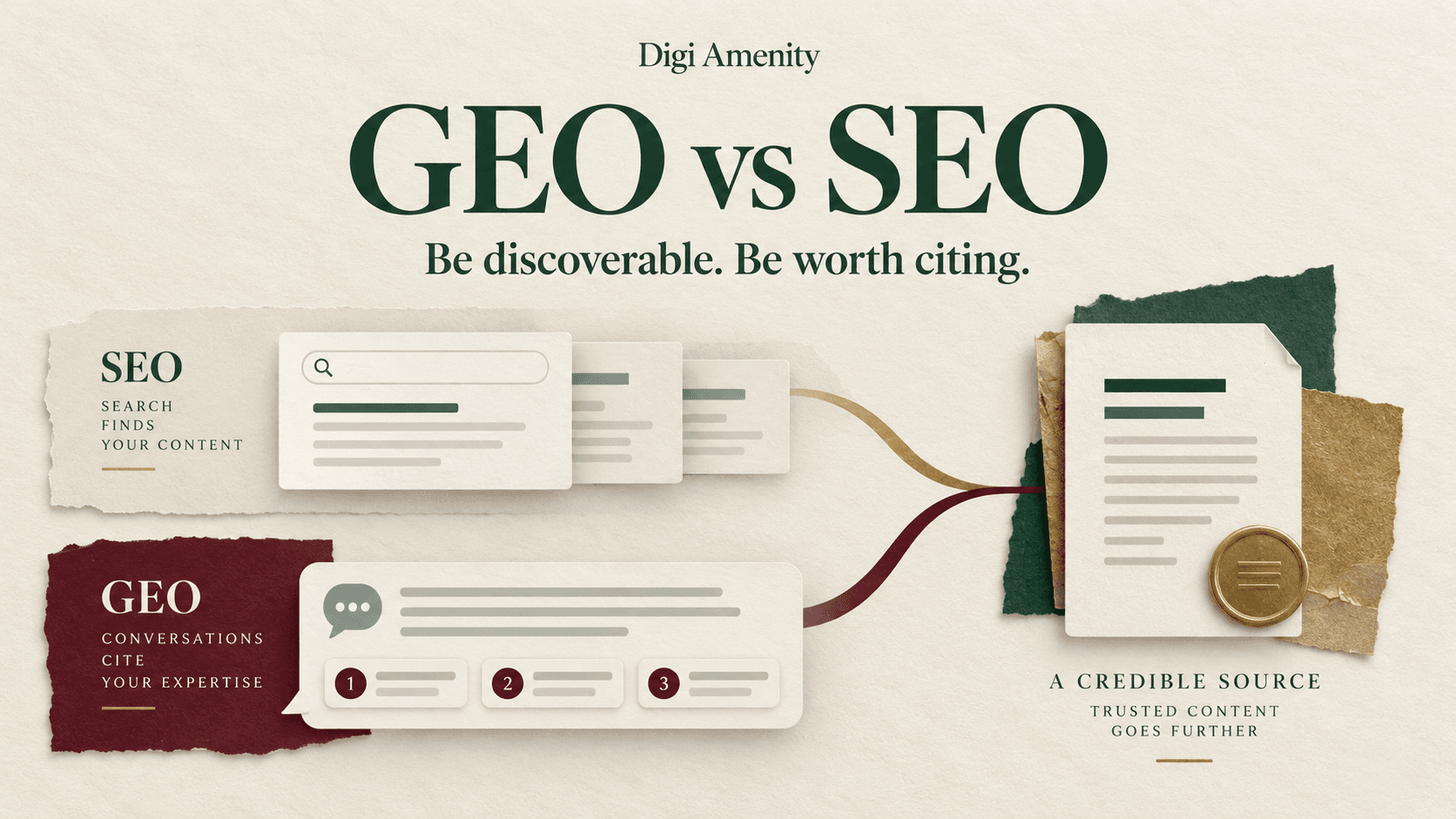
GEO vs SEO is a question of scope, not a choice between two competing foundations. SEO improves discovery through search; generative engine optimization focuses attention on how a brand or its information appears in generated answers. Both benefit from accessible pages, accurate information and useful evidence. Earning a citation in ChatGPT, Gemini or Perplexity is possible, but no format, file or agency can guarantee it.
For Indian business owners, the practical approach is to improve what customers can verify, check the relevant platform’s access controls and measure mentions, citations, visits and outcomes separately. This guide provides a platform comparison, content brief and repeatable observation method. Product documentation was checked on 7 October 2026.
What do SEO, GEO and AEO mean?
SEO stands for search engine optimization. It covers the work that helps search engines discover and understand useful pages and helps visitors complete a task after arriving.
GEO stands for generative engine optimization. Marketers use it to describe work intended to improve visibility and accurate representation in AI-generated answers. The term does not identify one common ranking algorithm shared by every AI platform.
AEO, or answer engine optimization, is another overlapping label, often used for direct-answer experiences. These labels can help organise work, but buying three differently named services does not automatically create three distinct sets of necessary website changes.
Google’s current guide treats optimisation for generative Search as SEO and warns against inauthentic mentions. It says no special schema is required for these features. Clear content organisation should serve the reader rather than a supposed universal “AI-friendly” word count.
What is different about discovery inside an AI answer?
| Dimension | Conventional search observation | Generated-answer observation |
|---|---|---|
| Visible result | A page listing, rich result or other search element | A response that may combine information and cite sources |
| Unit to inspect | Query, result URL and observed position | Prompt, product/mode, response, cited URL and claim |
| Content question | Does the page satisfy the intended task? | Is the information accurate, attributable and useful in this answer? |
| Measurement | Search performance, visits and business actions | Sampled mentions/citations, available platform reporting, identifiable referrals and actions |
| Shared risk | Visibility without a useful customer journey | Visibility without a useful customer journey |
Not every generated response searches the live web. Some answers may be produced without current retrieval, and product settings affect the experience. A brand mentioned without a link is different from a cited source; a citation can support a narrow fact without recommending the business.
That distinction changes the content brief. Ask what the brand can explain or substantiate better than a generic summary. A transparent shipping-area table, a documented specification or a useful implementation worksheet gives a source a purpose. Repeating “we are the best” gives readers little to verify.
How should you approach ChatGPT, Gemini and Perplexity separately?
ChatGPT: distinguish search access from model training
OpenAI’s crawler documentation separates OAI-SearchBot, which supports search discovery, from GPTBot, which relates to model training. ChatGPT-User handles some user-triggered visits and is not the control for automatic search inclusion. A decision about training access should therefore not be mistaken for a complete search-visibility configuration.
Have the site owner and developer inspect the intended public pages, robots rules and relevant firewall behaviour. Verify requests using official guidance rather than trusting a user-agent name alone. Enabling access does not oblige ChatGPT to select or cite a page.
Gemini: keep the app separate from Google Search
Google’s crawler documentation explains Google-Extended as a control relating to specified AI uses, including training and grounding in relevant products. It is not a conventional Google Search ranking control. For AI Overviews and AI Mode, review the separate Search generative AI setting and its inheritance.
Record “Gemini app,” “Google AI Mode” or “AI Overview” explicitly in an observation sheet. A screenshot from one does not verify visibility in the others. Do not infer the Gemini app’s entire source-selection process from a Google ranking screenshot.
Perplexity: check the documented search crawler
Perplexity documents PerplexityBot for surfacing and linking websites in search, and says it is not used for foundation-model training. It separately describes Perplexity-User for user-requested access. Its guidance includes official IP ranges and firewall considerations.
A developer should diagnose an actual access failure before changing firewall rules. Keep protections in place and make narrowly justified changes for verified traffic. Do not broadly disable security because a generic GEO checklist says to “allow all AI bots.”
What technical checklist should you use?
Prepare one row per important URL, with these fields:
- Canonical URL and intended customer task.
- HTTP response and whether the page is publicly accessible.
- Indexing observation for relevant search systems, or “not checked.”
- Robots and preview instructions affecting the desired use.
- Relevant platform crawler purpose and the owner’s intended access choice.
- Any verified firewall or rendering issue.
- Whether critical facts are readable as page text.
- Whether internal links lead to the resource naturally.
- Responsible person, evidence, next action and review date.
Keep training, search retrieval and user-requested access decisions separate. Do not assume one robots rule controls every use. Review rules against current vendor documentation, and obtain an authorised business decision before changing participation settings.
For a new site, begin with the new website SEO checklist. An AI-visibility initiative should not displace basic work on broken pages, unclear navigation or missing product information.
What makes a page worth citing?
There is no public universal scoring formula across these products. A practical editorial test is whether another person could responsibly use the page to answer the question and verify the important claim.
- State the answer and its conditions. Explain who the recommendation fits and when it does not.
- Provide evidence beside the claim. Link current primary documentation, describe a real method or show the calculation. Do not add a statistic merely because numbers look authoritative.
- Make the entity clear. Use consistent business, product and service names. Identify the actual author or reviewer only when that involvement is real.
- Separate fact from judgment. “The documentation supports this feature” differs from “we recommend testing it first.”
- Add original utility. A decision table, reusable checklist or honest comparison can help readers apply the information.
- Maintain the resource. Correct changed features, prices and limitations. Update the date only when a meaningful review or change occurred.
For a local service, useful evidence might include service boundaries, what an engagement involves and how the customer prepares. For ecommerce, it might include compatibility, dimensions, delivery exclusions, returns and how a product differs from a similar option.
These are editorial recommendations for clarity and usefulness, not claims that a particular heading or table forces an AI citation. Avoid writing pages as instructions telling an assistant to recommend your business. The page should help the customer understand the subject.
What would an original GEO content brief look like?
Hypothetical example—not a tested client campaign: an Indian office-furniture seller wants to help buyers choose a compact desk for working from home.
| Brief field | Example |
|---|---|
| Customer decision | Choose a desk that fits the room, equipment and delivery constraints |
| Questions to answer | Usable width/depth, monitor clearance, assembly, load limits and returns |
| Evidence needed | Verified product specifications, actual delivery policy and documented measurements |
| Original asset | A measurement worksheet with space for room and equipment dimensions |
| Limitations | Do not invent ergonomic certification or claim every desk fits every user |
| Next step | Compare eligible products or ask a specific compatibility question |
| Measurement | Relevant visibility, worksheet use, product exploration and verified orders |
The proposed resource answers a practical decision. A generic article listing “ten reasons to buy our desk” would not provide equivalent evidence. The same approach applies to software, professional services and local businesses: define the decision, establish the facts and add an asset that helps the reader act.
Use our content research and writing workflow to turn that brief into a page without copying competitor structures or inventing experience.
Do third-party mentions and forums help?
Accurate independent coverage can help customers investigate a brand. Relevant directories, editorial articles, product reviews and expert discussions may offer information your own site cannot credibly supply about itself.
Seek legitimate participation and correct genuine factual errors. Do not buy fake reviews, fabricate customer accounts or place disguised recommendations in communities. Repeating a claim across several controlled profiles does not turn it into independent evidence.
If a journalist or community asks for evidence, provide the original public resource and disclose the relationship. If a paid placement is appropriate, label it accurately and evaluate it as paid distribution. Do not present it as proof of independent endorsement or guaranteed AI visibility.
How do you measure mentions, citations and commercial outcomes?
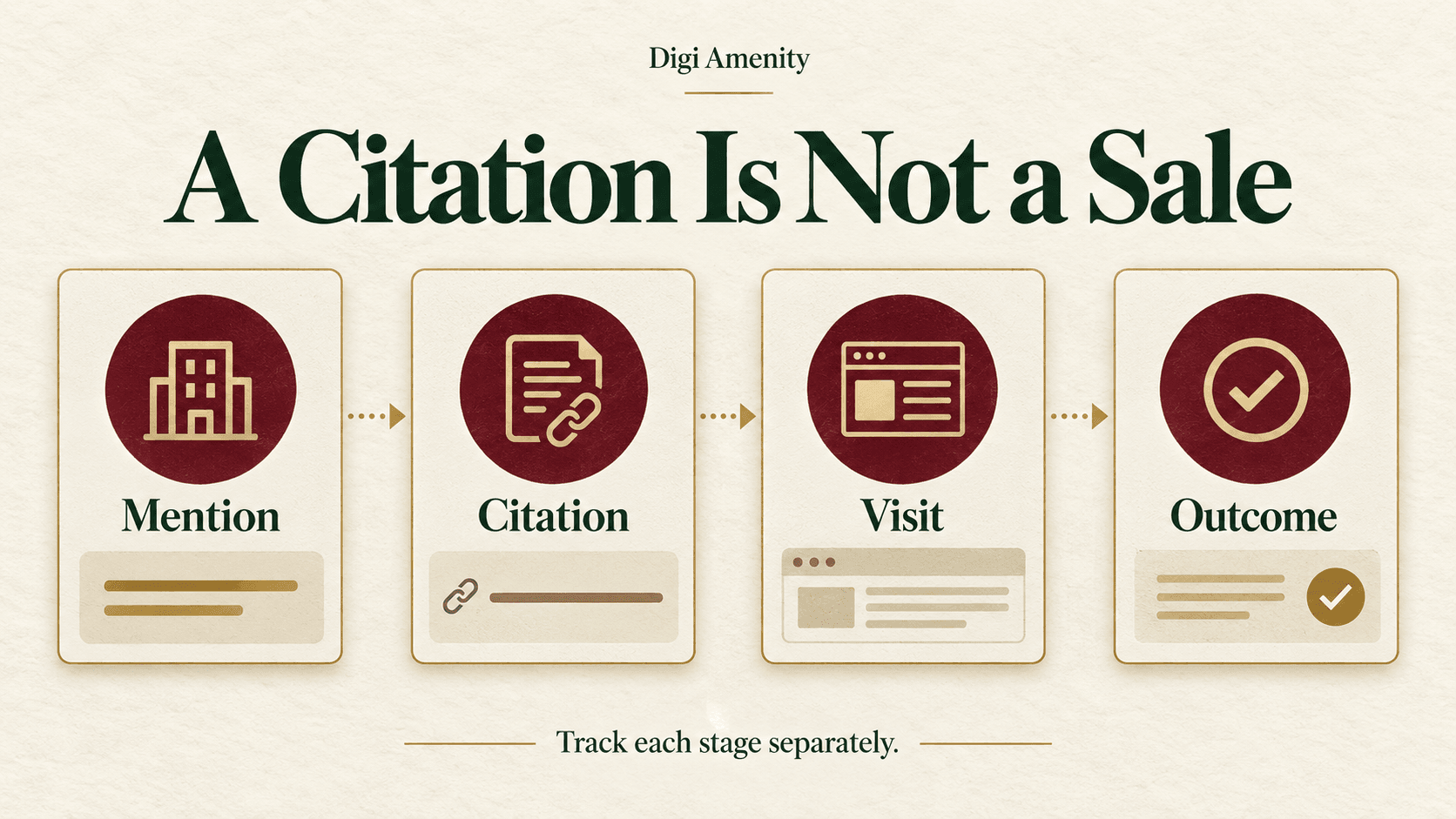
Use precise definitions:
- Mention: the response names the brand. Record whether the statement is accurate and what context surrounds it.
- Citation: the response links to a source. Record the destination and the claim it supports; a third-party page mentioning you is not a citation to your domain.
- Recommendation: the answer suggests choosing the brand for a use case. Keep this separate from a neutral mention.
- Visit: an identifiable session reaches the website. Referral data captures only what the system can observe.
- Outcome: a verified enquiry, qualified lead or order occurs under a documented definition.
OpenAI’s publisher guidance says ChatGPT adds utm_source=chatgpt.com to referral URLs. Inspect actual analytics data rather than assuming every AI-related visit will be identifiable. The absence of a referral tag does not prove the person never used an assistant.
For Google’s Search AI features, use the available Search Console visibility reporting alongside wider search and business data. That report is not a dashboard for ChatGPT, Perplexity or the Gemini app. Do not combine incompatible platform measures into a single “AI market share” percentage.
How do you build a repeatable AI visibility sample?
A small prompt panel can be useful for qualitative learning. It is an observation protocol, not a representative survey of all users.
- Choose real customer tasks. Include learning, comparison and suitability questions. Keep branded and unbranded questions separate.
- Freeze the prompts. Record exact wording, language, intended geography and the reason each belongs in the panel.
- Record the environment. Note product, mode, account context, web-search availability and date. Do not assume the same prompt is a comparable test across unlike modes.
- Use a consistent session method. For example, start a fresh conversation for each observation and document that choice.
- Capture the evidence. Save the response, cited URLs, brand statements and any factual errors locally.
- Repeat on a planned cadence. Preserve unfavourable answers and failed observations. Do not rerun until a desired answer appears and discard the rest.
- Review changes cautiously. A changed answer may reflect product variation, source changes or sampling noise, not your latest content edit.
Hypothetical calculation: a scheduled panel has 30 observations, but three fail. Of 27 valid answers, nine cite the business’s domain. Report “9 of 27 valid answers cited the domain; coverage 27 of 30 scheduled observations.” The observed citation rate is 33.3% for that panel. It is not 33.3% of all AI answers or market demand.
If you change the prompt list, start a new series or retain a stable subset for comparison. Keep an “unknown” state when a response cannot be assessed. A brand name alone should not be counted as a domain citation.
What should a 60-day implementation plan prioritise?
Days 1–14: document the customer tasks, audit technical access and establish the source/claim baseline. Choose a small set of commercially relevant pages rather than rewriting the entire site.
Days 15–30: improve missing facts, comparisons and original practical assets. Align product or service information across the website and legitimate business profiles.
Days 31–45: review published resources, fix inconsistencies and make them discoverable through useful internal links and appropriate distribution. Participate in relevant communities only under their rules.
Days 46–60: compare the fixed observation panel, available visibility data, identifiable visits and qualified outcomes. Decide what to keep, improve, expand or investigate. The schedule organises work; it does not promise a citation within 60 days.
GEO and SEO review checklist
- One customer decision and an appropriate page are identified.
- Important pages are accessible and indexing observations are recorded honestly.
- Search, training and user-triggered access controls are distinguished.
- Facts, dates, names and product details have current evidence.
- At least one practical asset adds value beyond a summary.
- Hypothetical examples and untested ideas are labelled.
- Third-party activity is relevant, transparent and compliant with local rules.
- Mention, citation, recommendation, visit and outcome are separate measures.
- Prompt-panel wording, conditions, failures and denominators are retained.
- No ranking, citation or revenue guarantee appears in the plan.
If your brand information is hard to verify or scattered across inconsistent pages, Digi Amenity can review the technical access, content evidence and customer journey before recommending AI-visibility work. Discuss the priority pages through our SEO services.
Download the practical checklist
Download the GEO and SEO Evidence Checklist (PDF). Use it to record evidence, assign an owner and set the next review date.
Frequently asked questions
Does GEO replace SEO?
No. Search access, useful content, site organisation and credible information remain foundational. GEO is a useful label for additional attention to generated answers, platform differences and citation measurement; it does not remove the need for ordinary SEO.
Can a small business get cited in ChatGPT or Perplexity?
It can be a useful source when its information fits the question and is accessible, but inclusion is not assured. Focus on a specific area where the business can provide accurate details or a useful resource rather than competing through unsupported broad claims.
Do I need to allow model training to appear in search answers?
Do not treat training and search as the same permission. Vendor documentation distinguishes relevant crawler purposes. Review each platform’s current controls and the owner’s intended participation choices rather than applying one blanket setting.
Does adding llms.txt guarantee AI citations?
No. Google explicitly says it does not use llms.txt for Search visibility. Other systems may have their own uses or documentation, but the file is not a universal admission ticket. Prioritise accessible, useful pages and current platform guidance.
Can we guarantee a citation by using a particular content structure?
No. Headings, tables and concise explanations can improve usability, but selection depends on the question and the system. Avoid fixed word-count recipes and promises that a formatting change will force a platform to cite you.
What is the difference between a brand mention and a citation?
A mention names the brand; a citation links to a source. A citation can point to another website discussing your brand, so record the actual destination. Neither observation proves the reader visited your site or bought something.
How should we judge a GEO agency’s report?
Ask for the exact prompts, platforms, dates, sample sizes, failures and cited URLs, plus the work completed on your pages. Expect separate traffic and business-outcome evidence. Treat unexplained visibility scores or guaranteed placements as insufficient evidence.
