
The best payment gateways in India depend on your business model, payment mix and website platform. For an Indian online store, start by comparing Razorpay, Cashfree, PayU and PhonePe. Add CCAvenue, Paytm, Easebuzz, Instamojo or Pine Labs when their collection tools, pricing structure or checkout features match a specific requirement. Choose two candidates, obtain written commercial terms and test the complete payment-to-order journey before committing.
A low transaction rate is useful only when customers can finish paying, your website records the correct order and your finance team can reconcile the money. This guide compares nine options and explains how to make that decision for a Shopify store, WooCommerce website, service business or subscription product.
Pricing and availability checked on 6 October 2026. Published rates are a comparison starting point; taxes, merchant category, approved payment methods and negotiated terms can change your quote. The recommendations below are editorial assessments of documented features, not a live performance test or an endorsement of a universal winner.
Which payment gateways in India should you compare?
The order below is not a ranking. The “consider when” column helps you decide which providers deserve a closer look. Fees shown exclude applicable taxes unless stated otherwise; specialist payment methods and additional products may have different charges.
On mobile, swipe the table sideways to see all columns.
| Gateway | Public pricing snapshot | Consider when | Question to resolve |
|---|---|---|---|
| Razorpay | Standard pricing FAQ: 2% + GST; pricing banner advertises a first-90-days offer. | You want website/app integration plus payment links and related collection tools. | Which modes, limits and add-ons does your quote include? |
| Cashfree | Standard offer-expiry rate: 1.95% + taxes; eligible new merchants have a capped introductory offer. | You need checkout, collection and reconciliation capabilities together. | What remains chargeable during the promotion? |
| PayU | 2% for specified domestic methods; 3% for specified premium, EMI and international transactions. | Your customers need several payment and affordability options. | What is your approved UPI and payment-method rate card? |
| PhonePe PG | Standard plan displays “Free” during an offer; 1.99% is struck through. | You are comparing domestic checkout options and introductory economics. | When does your offer end and what replaces it? |
| CCAvenue | 2% standard online platform fee; merchant-category differences and add-ons apply. | You need a detailed payment-method and value-added-services comparison. | Are plugin and annual software charges included? |
| Paytm Payment Gateway | 1.99% standard platform fee plus applicable GST; enterprise quotes available. | You want website/app checkout and settlement reporting. | Which methods and settlement options are approved for you? |
| Easebuzz | Custom pricing on the official pricing page. | Your collection workflow includes reminders, invoicing or split payments. | What are the product-specific charges and activation requirements? |
| Instamojo | Payment links show 2% + ₹3 per transaction; other products/plans differ. | You want to collect through links or a simple selling setup. | How does the fixed fee affect small orders? |
| Pine Labs Online | Custom pricing. | Affordability, loyalty redemption or multiple payment methods within a purchase matter. | Which checkout features work on your platform? |
Razorpay: evaluate the full collection setup
Razorpay documents Shopify and WooCommerce integrations, APIs and no-code collection options. That makes it a reasonable shortlist candidate when a business needs both a store checkout and occasional payment links. Its gateway overview explains the integration routes.
The pricing page shows a 90-day introductory banner alongside standard pricing information. Treat that banner as an offer to verify, not a permanent rate. Request eligibility, exclusions and post-offer pricing in writing. Test the exact plugin or checkout you intend to use; a broad product catalogue does not establish that every feature is included in your account.
Cashfree: inspect the promotion cap and exclusions
Cashfree’s current festive-offer terms describe zero platform fees on the first cumulative ₹20 lakh of eligible volume for qualifying new merchants. The page advertises an end date of 31 March 2027. It is not a recurring monthly allowance. Onboarding and activation conditions apply, and premium cards, EMI, subscriptions and international transactions are among the exclusions. Standard fees apply after the allowance or campaign ends.
Its product overview includes plugins, APIs, webhooks and payment links. For evaluation, ask the team to demonstrate an order, a refund and the corresponding settlement report. Keep the promotion calculation separate from your long-term operating-cost comparison.
PayU: price the methods your customers actually use
PayU’s published rate card distinguishes domestic Visa/Mastercard, net banking, BNPL and wallets from Diners, American Express, EMI and international transactions. UPI pricing needs its own confirmation rather than an assumption that the headline domestic rate covers everything.
Consider PayU when payment choice is a material buying requirement. For example, a hypothetical furniture store should ask about supported EMI flows, who funds an offer and how cancellations affect charges. An EMI logo on a checkout is not enough to establish the economics of selling that product.
PhonePe PG: compare the offer and the ongoing contract
The PhonePe pricing page advertises a limited-period free plan and Shopify/WooCommerce integration. The inspected page does not establish a universal offer end date for every merchant. Obtain the duration, eligible methods, volume conditions and later charges before budgeting.
Check the customer journey across the UPI apps and devices your audience uses. A customer’s preferred UPI app and the merchant’s gateway are different choices; selecting a provider should not be reduced to which consumer app is most familiar.
CCAvenue: look beyond the standard platform fee
CCAvenue’s rate card separates standard online processing, premium methods and additional services. It also lists a 0.20% additional Shopify plugin usage charge plus GST. That provider charge is separate from Shopify’s own transaction fee. The page refers to annual software upgradation charges; confirm your amount and applicability rather than importing an old figure from a comparison blog.
Request a consolidated quote that lists every required service. This is especially useful when your checkout includes recurring billing, international cards or other features beyond a basic domestic payment.
Paytm: assess checkout and settlement operations together
Paytm Payments’ standard pricing lists a 1.99% platform fee and no setup or annual maintenance charge. Its gateway page describes plugins, APIs and settlement options.
Ask for a settlement report sample and the escalation route for a successful debit with an unresolved order. Check the contracting entity and gateway product directly; do not substitute information about a different Paytm-branded service when reviewing the payment agreement.
Easebuzz: compare the collection workflow, not an assumed flat rate
Easebuzz’s pricing page uses custom pricing and describes collection reminders, invoicing and split-payment tools. A business collecting course fees or distributing marketplace proceeds should evaluate those workflows specifically.
Do not assume every product is enabled by opening a basic gateway account. Ask which services are approved, how each is priced and how refunds affect split settlements. Where public pages and older product descriptions differ, make the written product confirmation part of the selection process.
Instamojo: calculate the impact of the per-payment charge
Instamojo’s pricing page distinguishes payment links, store plans and other selling tools. Payment links list 2% + ₹3 per transaction, with taxes additional. Compare the exact product you need rather than treating every Instamojo plan as the same gateway package.
Hypothetical arithmetic: at that percentage-plus-fixed structure, a ₹100 payment incurs ₹5 before tax, while a ₹1,000 payment incurs ₹23 before tax. That is a 5% versus 2.3% effective pre-tax fee. Small-ticket sellers should therefore model order count as well as total sales value.
Pine Labs Online: investigate affordability and loyalty needs
Pine Labs’ online gateway page describes multi-mode payments, loyalty-point redemption, EMI/Pay Later options and platform integrations. Public pricing is customised.
Shortlist it when those capabilities address a real checkout requirement, such as a high-value purchase where payment flexibility matters. Ask which combinations work on your platform, how a partial refund is allocated and whether your development team must add custom integration work.
How should you compare payment gateway charges in India?
Use the same expected sales mix for every quote. Comparing one provider’s UPI promotion with another provider’s international-card rate produces a misleading result.
Monthly payment cost = method-wise processing/platform fees + fixed transaction charges + recurring service charges + applicable taxes + platform/plugin fees + optional services.
Then assess refunds, dispute losses and working-capital needs separately. A refundable reserve affects cash availability; it should not automatically be treated as a permanent fee. Equally, GST charged on a fee is a cash outflow, while its eventual accounting treatment may depend on your business. Have your finance team use the appropriate treatment.
What does a worked cost comparison look like?
Hypothetical example, not a vendor quote: a store processes ₹5,00,000 in successful eligible payments over 500 orders. Provider A quotes 2% with no fixed per-order charge. Provider B quotes 1.8% plus ₹3 per successful order. Assume 18% GST on these fees and no other charges.
On mobile, swipe the table sideways to see all columns.
| Calculation | Provider A | Provider B |
|---|---|---|
| Percentage fee | ₹10,000 | ₹9,000 |
| Fixed payment fees | ₹0 | ₹1,500 |
| Total before GST | ₹10,000 | ₹10,500 |
| GST in this example | ₹1,800 | ₹1,890 |
| Total fee cash outflow | ₹11,800 | ₹12,390 |
The lower percentage costs ₹590 more in this scenario. This does not establish that one real provider is cheaper: add your actual payment mix, refund policy, plugin charges and negotiated terms. Both scenarios assume the same successful payment volume; no conversion uplift has been invented.
Does zero UPI MDR mean zero gateway cost?
No. A bank-to-bank UPI transaction charge and a hosted gateway’s platform/service fee are different line items. Razorpay explicitly distinguishes them in its pricing FAQ. Ask for separate treatment of ordinary bank-account UPI, RuPay credit card on UPI and other supported funding sources. A “zero MDR” label alone is not an all-in quote.
Which charges are easy to overlook?
- Whether original processing fees are retained when an order is refunded.
- Charges for instant refunds, accelerated settlements, mandates, messages or split payments.
- International-card pricing, currency conversion and documentation charges.
- Dispute administration, rolling reserves, minimum commitments and annual software fees.
- Shopify transaction fees, gateway plugin fees and third-party checkout app subscriptions.
Request a sample invoice and settlement statement. They show how commercial terms become actual deductions.
Which option fits your business model?
Small service business: start with approved payment links if you do not need a full cart. Compare Razorpay, Instamojo, PhonePe or another provider offering the collection flow you need. Keep invoices, customer references and refund records connected.
D2C ecommerce: shortlist two compatible providers from Razorpay, Cashfree, PayU, PhonePe, Paytm or CCAvenue. Prioritise mobile checkout, payment-method mix, refund handling and accurate order updates. Add Pine Labs when affordability or loyalty features justify the evaluation.
Subscriptions: compare the approved recurring-payment product, supported mandates, retry rules, cancellation handling and mandate-level charges. One-time card acceptance does not prove that a provider supports your renewal workflow.
Marketplaces or multi-party collections: evaluate split-settlement products and seller onboarding with specialist support. A standard checkout account is not evidence that your platform may collect and distribute funds in the way you propose.
International sales: obtain explicit approval for your business category, countries, currencies and export-documentation needs. Separately, Stripe states that new Indian accounts are invite-only; it is not an immediately available default for every startup. PayPal states that India users are supported for international payments, so it is not a substitute for a domestic Indian checkout. Confirm cross-border commercial terms before making either part of your launch plan.
What changes for Shopify and WooCommerce stores?
Shopify: budget for a separate transaction-fee layer
India was not listed on the Shopify Payments supported-country page when checked. For an Indian business, verify the third-party providers available in your store’s payment settings.
Shopify’s India pricing page lists third-party transaction rates of 2% for Basic, 1% for Grow and 0.6% for Advanced. These sit alongside the gateway’s fees. Shopify’s billing documentation also explains the calculation basis and states that these fees are not returned when an order is refunded.
Hypothetical fee stack: on ₹5,00,000 of applicable transaction value, a 2% gateway fee and a 2% Shopify fee total ₹20,000 before taxes and other charges. Confirm both billing bases before applying this arithmetic to your store. An upgrade decision should compare the extra subscription cost with realistic fee savings and useful features—not just a lower percentage.
WooCommerce: test the actual checkout configuration
Check the plugin’s publisher, maintenance history and compatibility with your installed WordPress, WooCommerce and checkout configuration. Confirm support for the checkout type you use, order storage, currency and required recurring-payment extensions. Test on a staging site before changing production.
A plugin installation alone does not prove that payment confirmation, refunds and analytics work. If you are still choosing your commerce platform, our WordPress vs Shopify comparison helps frame the broader operational decision.
How do you select and set up a payment gateway step by step?
Step 1: write a one-page requirements brief
Record your legal business type, products, website platform, expected monthly prepaid sales, order count, average order value, domestic/international split and required methods. Add refund frequency, subscription needs and settlement expectations. Use estimates clearly labelled as estimates if the store is new.
Step 2: check eligibility before building
Confirm that the provider accepts your business category and intended transaction flow. Prepare the business, identity, bank and website information requested for your legal structure. Requirements differ, so do not assume that every merchant needs identical documents or that signup guarantees activation.
Verify the contracting entity and relevant authorisation against the RBI’s authorised payment-system operator list. Match the actual entity and service scope, rather than relying solely on a brand logo or a generic “RBI approved” phrase.
Step 3: obtain two comparable written quotes
Send both providers the same brief. Request method-wise fees, taxes, setup/annual charges, refund treatment, settlement timing, reserves, international approval, support escalation and all promotion conditions. Ask what “T” means, whether days are working or calendar days, and which cut-off applies.
Step 4: score the candidates using your priorities
Use this proposed buyer worksheet. Weights are editorial suggestions, not measured provider scores. Reject a candidate that fails a mandatory requirement before calculating a total.
On mobile, swipe the table sideways to see all columns.
| Criterion | Suggested weight | Evidence to collect |
|---|---|---|
| Platform and payment-method fit | 25% | Approved integration and test results |
| Complete commercial cost | 25% | Written quote using your payment mix |
| Customer payment journey | 20% | Device and failure-path tests |
| Settlement and reconciliation | 15% | Reports, timing and exception handling |
| Support and dispute operations | 15% | Response ownership and documented process |
Score evidenced criteria from 0–5 and calculate Σ(weight × score ÷ 5). Leave unknowns marked “unverified”; do not award full marks to a sales promise. Change the weights before comparing providers if your business has different priorities.
Step 5: integrate with safe payment confirmation
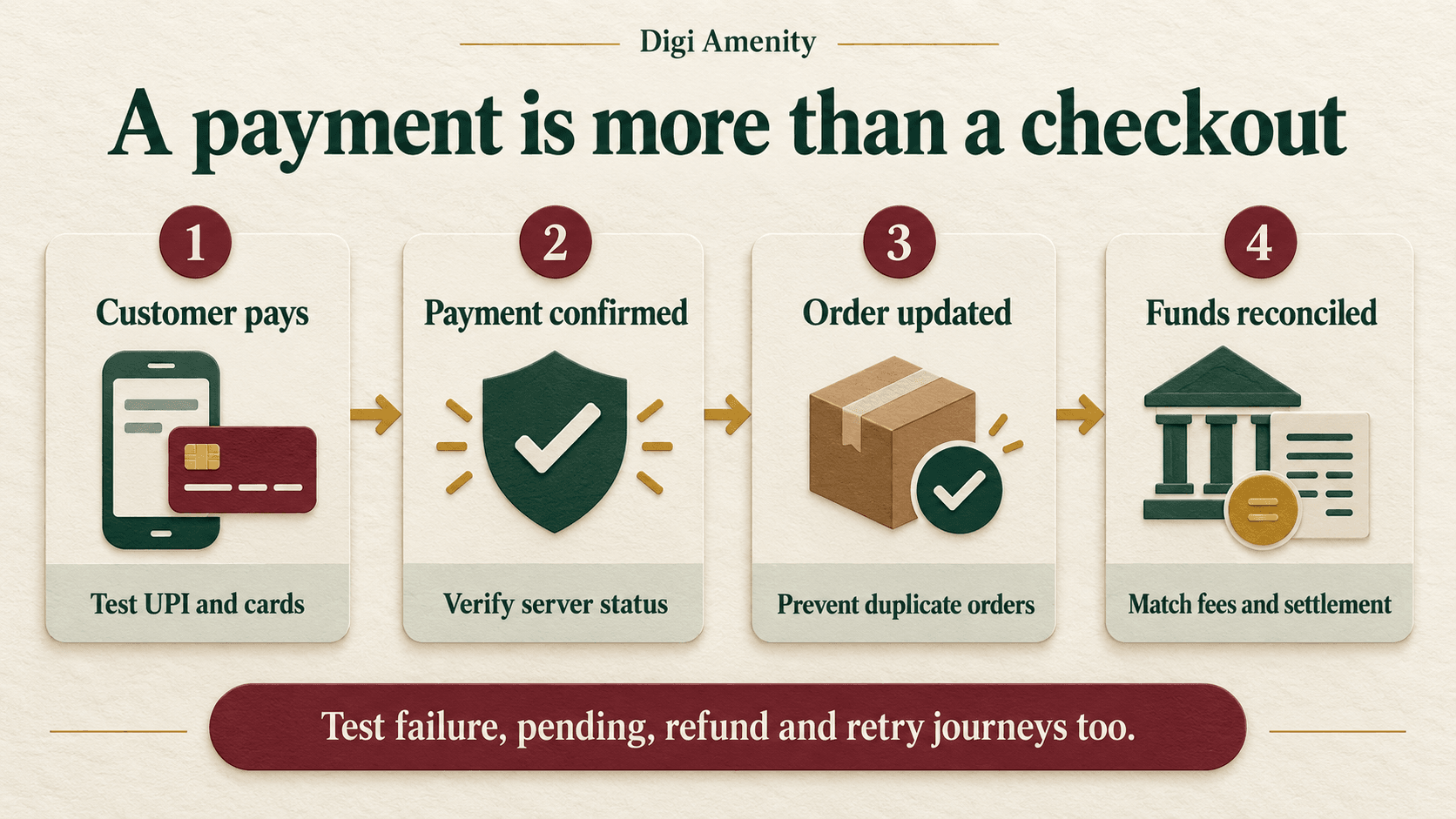
Use the provider’s maintained integration and keep secret keys on the server or in the platform’s protected settings. Your developer should verify signed callbacks/webhooks, match payment amount and currency to the order, and handle duplicate notifications safely. “Idempotent” processing means the same event cannot fulfil the same order twice.
A customer reaching a return page is not enough evidence of successful payment. Read the provider’s confirmed status and distinguish authorisation from capture where applicable. Razorpay’s webhook documentation, for example, covers signature validation and duplicate-event handling; follow the equivalent current guidance for the chosen provider.
Step 6: test successful and unsuccessful journeys
- UPI app switch and return on Android and iPhone; desktop QR where offered.
- Card authentication success, decline, cancellation and retry.
- A payment left pending when the customer closes the browser.
- A delayed or repeated webhook, with only one order fulfilment.
- Full and partial refunds, including inventory and customer communication.
- Discounts, shipping, taxes and final charged amount.
- Purchase tracking with the correct transaction ID, value and currency.
- Settlement reports matched to the bank and order ledger.
Use sandbox tests first. After approval, the merchant can perform authorised low-value live checks under the provider’s rules. Never use another customer’s payment data or treat test orders as marketing results.
Step 7: launch with monitoring and a rollback plan
Assign an owner to payment incidents and record the old configuration before a switch. Keep historical refund and dispute access available when migrating. Watch results by device and payment method. If errors rise, investigate the affected step rather than immediately replacing the provider or increasing advertising spend.
Which metrics show whether your gateway is working?
Use a consistent reporting period, timezone and status cut-off. Pending payments need time to resolve; do not silently count them as final failures.
On mobile, swipe the table sideways to see all columns.
| Metric | Definition for your dashboard | Interpretation |
|---|---|---|
| Attempt success rate | Successful confirmed payment attempts ÷ recorded attempts | Separate methods, devices and failure reasons; document treatment of pending attempts. |
| Order payment completion | Unique paid orders ÷ unique orders that reached the payment step | Deduplicate retries; one buyer may generate several attempts. |
| Effective payment cost | Payment-related fees ÷ successful processed value | State whether taxes, platform fees and fixed costs are included. |
| Settlement timeliness | Settlements received by the agreed deadline ÷ settlements due | Investigate exceptions against the contract, not a generic T+1 promise. |
| Refund completion time | Elapsed time from refund initiation to confirmed completion | Track unresolved cases separately; a dashboard request is not proof of customer receipt. |
| Paid-order tracking match | Compare verified paid order IDs with recorded purchase events | Identify duplicate events, missing events and incorrect values; consent and attribution can explain some differences. |
Hypothetical diagnosis: if mobile UPI attempts fail while card payments stay stable, investigate the app-switch flow and provider status before rewriting all ad creatives. If payments succeed but orders remain unpaid, inspect status updates and webhook handling. If fewer users reach payment at all, look at shipping charges, trust and checkout usability.
Digi Amenity’s approach connects the acquisition channel to the final order. Ad-platform ROAS can mislead if a purchase event fires on an unconfirmed return page. For wider checkout drop-offs, see our Shopify abandoned checkout recovery guide.
What should your final payment gateway checklist include?
- Business category and required domestic/international methods approved.
- Correct legal entity, bank details and authorisation scope checked.
- Two written quotes compared using identical volumes and payment mix.
- Promotion expiry, cap, exclusions and later rates documented.
- Taxes, fixed fees, platform fees and optional charges included.
- Refund, dispute, reserve and settlement conditions understood.
- Supported integration installed and secrets protected.
- Payment status verified server-side; duplicate events handled safely.
- Mobile UPI, cards, pending, cancellation and retry paths tested.
- Full/partial refunds and order-state updates checked.
- Purchase events validated against unique paid orders.
- Settlement reconciliation, incident owner and rollback plan ready.
Need help assessing your checkout? Digi Amenity can review your Shopify or WordPress payment journey, integration requirements and purchase tracking before you switch gateways or increase ad spend. Explore our website development and ecommerce services to discuss the issues your store needs to solve.
Frequently asked questions
1. Which is the best payment gateway in India for a small business?
Start with providers that approve your business and support your selling platform. Compare two written quotes and test the actual checkout. A service business collecting advances may prioritise payment links; an ecommerce store needs reliable order updates, refunds and reconciliation. There is no evidence-based single winner for every business.
2. Which payment gateway has the lowest charges?
The answer depends on payment mix, order count, taxes, platform charges and negotiated terms. Temporary offers can reduce initial costs but should be separated from ongoing pricing. Use the worked cost model above; a fixed fee can make a lower percentage more expensive for small orders.
3. Is a UPI payment gateway completely free?
Not necessarily. A provider may charge for hosted checkout or other services even where the underlying bank-account UPI payment has zero MDR. Get an itemised quote and check whether credit-card-funded UPI or other instruments have separate terms.
4. Which payment gateway is best for Shopify in India?
Choose from providers available for your store and approved business category. Compare the gateway charge, Shopify’s additional transaction fee and any plugin or checkout-app costs. Then test refunds, payment status updates and the mobile journey. A provider’s API feature list does not guarantee that its Shopify integration exposes every feature.
5. Can I accept payments without a website or GST registration?
Payment links can support collections without a complete ecommerce website, subject to provider approval. GST registration and onboarding documents depend on your legal structure, business activity and applicable requirements. Check the provider’s current checklist for your situation; do not assume that “individual signup” removes KYC or tax obligations.
6. How long do settlements and refunds take?
Use the schedule agreed for your account and payment method. Activation status, cut-offs, working days, risk reviews and optional accelerated services can affect settlement. A refund initiated in the dashboard may still require processing before the customer receives it. Track the provider reference and confirmed status.
7. Can an Indian business use Stripe or PayPal?
They require a different availability check from a general domestic gateway shortlist. Stripe currently describes Indian onboarding as invite-only. PayPal’s India guidance supports international payments. Verify eligibility and your intended transaction flow before building either into a launch commitment.
8. Should I use two payment gateways?
A second approved provider can be useful when your platform supports it and you have a clear fallback or payment-method requirement. It also adds integration, refund and reconciliation work. Plan routing and order deduplication carefully, and never retry an uncertain payment blindly through another gateway; establish the first attempt’s status first.
