

To fix GA4 duplicate purchase events, trace one confirmed order through every system that sends a purchase, compare its transaction ID, and remove the repeated reporting path. Then test a fresh order, a confirmation-page refresh and a payment retry. A dashboard total that looks high is a reason to investigate; it is not enough evidence to disable a tag.
For an Indian online store, the problem can sit between the website, a plugin, a tag manager and the payment-return journey. Digi Amenity’s recommended starting point is an order-level measurement contract: define the purchase you intend to count, identify the system responsible for reporting it, and record the evidence needed to prove that it happened once.
What should count as one purchase for your business?
Agree on the business event before inspecting analytics. An accepted order, a successful payment and an order delivered to the customer are different milestones. Choose the appropriate purchase milestone for your implementation, document it and keep it consistent. A payment-button click alone cannot prove that an order was completed.
This is particularly useful for cash-on-delivery, deposits and delayed payment confirmation. If an order has a deposit and a later balance payment, decide how the order lifecycle should be represented before letting two integrations report the full order value independently. That is a measurement-design decision, not something a generic GTM snippet can settle.
Write four lines in your implementation brief: the qualifying order status, the canonical order identifier, the revenue definition and the owner of the purchase sender. Record refunds and cancellations separately. If your next question is how to report money returned after a purchase, use the separate GA4 refund tracking guide.
Does GA4 automatically deduplicate purchases?
Google documents purchase deduplication using transaction_id for transactions from the same user. Use a unique, stable order identifier and preserve it when the same transaction is reported again. Do not reuse an ID for different orders or include information that identifies a customer. An empty-string ID is especially dangerous: Google warns that purchases carrying transaction_id="" are deduplicated together.
The current transaction-ID guidance also discusses sending IDs through the Firebase SDK for app streams. Do not rely on an older article’s blanket “web-only” statement. This guide concentrates on a website purchase workflow; app implementations need their own SDK validation.
A transaction ID is a safeguard, not proof that your implementation is correct. If two senders use different order identifiers or inconsistent user context, investigate the actual payloads. Do not assume that adding a parameter called event_id provides the same deduplication behaviour across GA4 and other advertising platforms.
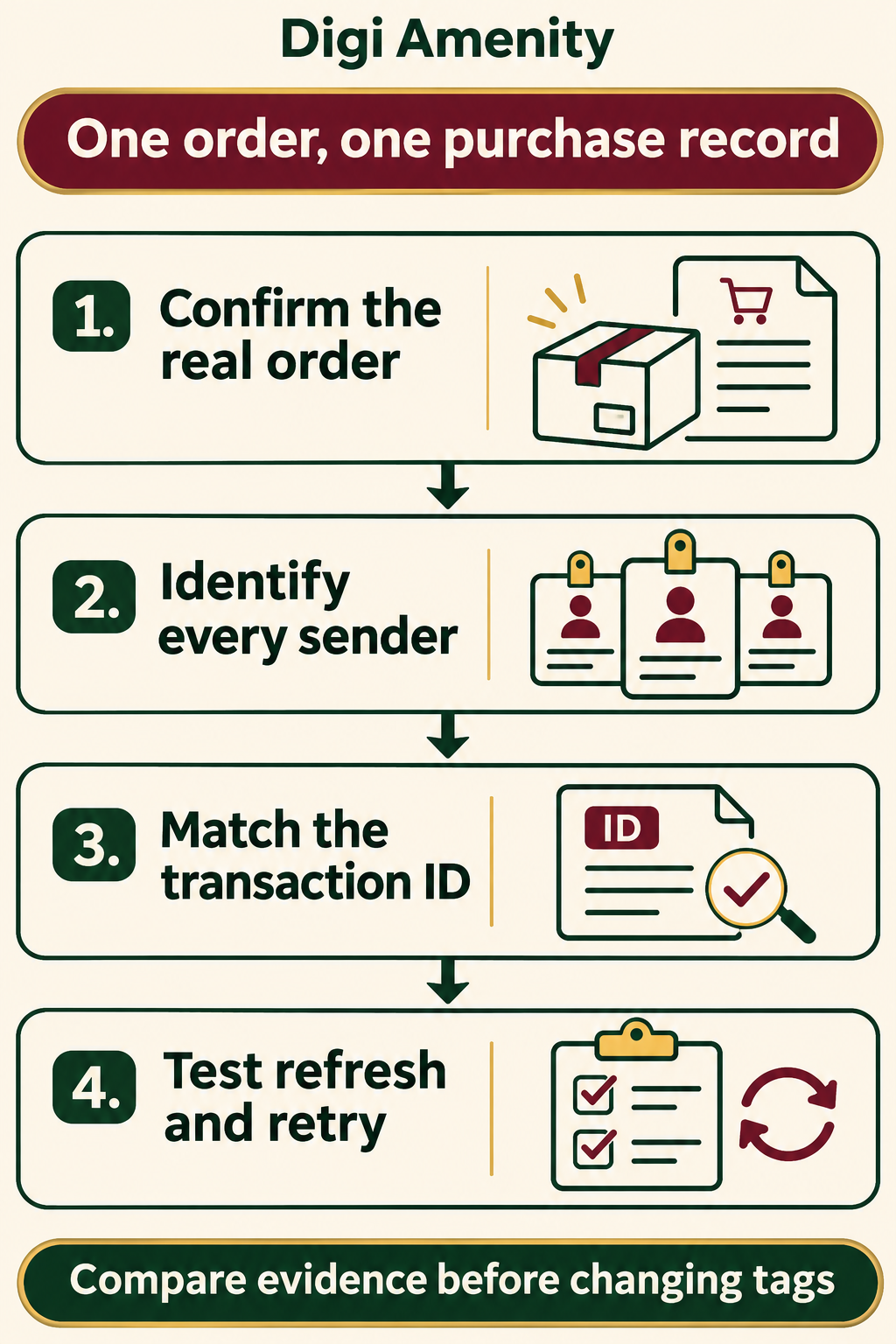
What evidence should you collect before changing tags?
Use a small set of authorised test orders in a test environment where possible, or an approved test-payment process. Keep real customer information out of the shared audit worksheet. Record the affected property and stream so that requests sent to different destinations are not mistakenly treated as duplicates within one property.
The following worksheet is a practical investigation asset. Populate one row for each observed purchase attempt, then group rows by the store’s order ID. A missing field remains unknown; do not invent it from the page URL.
| Evidence field | What to record | Why it matters |
|---|---|---|
| Store order | Order ID, qualifying status and confirmation time | Establishes the business event |
| Analytics destination | Property/stream or measurement ID | Separates different reporting destinations |
| Sender | App, plugin, GTM tag, site code or server job | Names the owner of each request |
| Payload | Event name, transaction ID, value and currency | Exposes mismatched identity or amounts |
| Trigger and timing | Confirmation, reload, callback or retry | Explains why another attempt occurred |
| Evidence and decision | Debug screenshot or sanitised log; keep, fix or investigate | Makes the proposed change reviewable |
Compare strings exactly before normalising them. An order number such as DA-2048, a checkout token and a payment gateway reference might all relate to one order, but they are not interchangeable. Retain the original values and document the mapping. Never collapse different real orders just because they have the same amount.
How do you find the second purchase sender?
Make a sender inventory with the developer or implementation owner. Include the platform’s analytics integration, customer-event apps, tag-manager containers, custom theme code and server-side jobs. For each, record the destination and the condition that produces a purchase. Installed software is a lead for investigation; it is not evidence that the software actually sent the event.
Use Tag Assistant or GTM Preview for an authorised test journey. Inspect the event timeline and tag activity, then compare the actual purchase parameters with the order record. Google’s DebugView documentation explains enabling debug mode for your own device, selecting that device and opening an event’s parameters. Consent and privacy controls can affect visibility, so an empty DebugView is not proof that no other sender exists.
If the browser path looks correct but the mismatch remains, request the corresponding server-job or integration logs. Record what was attempted and what response was received. A front-end preview cannot establish what an independent backend job did. The server-side and client-side tracking guide explains the distinction.
Also inspect event-creation rules and configuration changes with the property administrator. Preserve a configuration snapshot before changing anything. Remove or narrow the specific redundant purchase path only after identifying its owner; deleting an entire container could also remove unrelated measurement.
What does a convincing diagnosis look like?
Hypothetical example: a Mumbai homewares store has one confirmed order, DA-2048, with merchandise value ₹2,400. Its platform integration reports that order ID. A custom purchase tag also runs on the confirmation page but uses payment reference PAY-781 as the transaction ID. Both report the same merchandise value to the same GA4 destination.
The evidence supports investigating two reporting paths for one order. It does not support claiming the customer purchased twice. The proposed repair is to select the authoritative purchase path, align the ID contract and retire the redundant path after testing. These are illustrative values, not a client result or a measured improvement.
Now change the scenario: two separate confirmed orders have different order IDs but the same customer and ₹2,400 value. They should not be merged merely because they look similar. A valid repair must preserve legitimate repeat orders as well as stop repeated reporting of one order.
How should transaction identity and retries be handled?
Generate the canonical order ID in the system that owns the order, and make it available to the reporting integration. Do not generate a new random transaction ID each time the confirmation page renders. If a retry represents the same purchase, its identity should remain stable.
For custom server implementations, ask the developer to design an idempotent reporting process: repeated execution for the same business event should not create additional business records. It needs an explicit state for pending, attempted, confirmed and uncertain delivery. Simply marking an event “sent” before a network attempt can lose a valid purchase if the request fails; endlessly retrying without stable identity can create another problem.
A browser-only flag may reduce refresh repeats within that browser, but it cannot coordinate an independent server sender or every device. Treat it as an implementation detail with known limits, not the complete control.
Check the payload alongside the trigger. Google’s purchase event reference specifies transaction, value, currency and item parameters. The documented value calculation uses item price multiplied by quantity and excludes shipping and tax; send the corresponding fields separately. Review discounts and currency handling against that definition before comparing revenue totals.
Which tests must pass before the fix is accepted?
Use the same audit worksheet before and after the change. Record the deployment version and test time, so a later investigator can separate older behaviour from the repaired implementation.
| Test | Expected business result | Evidence to retain |
|---|---|---|
| Fresh successful order | One qualifying order with the intended purchase payload | Order receipt and sender trace |
| Refresh or revisit confirmation | No new business purchase for the existing order | Reload timeline and repeated-attempt handling |
| Failed payment followed by retry | No completed-purchase claim for the failed attempt; valid success captured | Order-status transitions and final ID |
| Second genuine order | A distinct purchase with its own transaction ID | Two confirmed orders and matching records |
| Deposit or delayed confirmation | The documented order lifecycle, without repeating full order revenue | Agreed rule and integration logs |
Test the payment methods and device paths that actually matter to the store. The acceptance criterion is correct business-event reporting, not merely a lower event count. A change that suppresses every purchase can look like a successful deduplication fix if nobody checks for missing orders.
How do you reconcile GA4 with store revenue afterwards?
Compare equal, complete periods using the same timezone, sales channel, currency and revenue definition. List exclusions such as test orders, cancellations, shipping, tax and refunds. Consent choices and collection gaps can still prevent perfect agreement even after a duplicate sender has been removed.
Keep three quantities separate: observed requests or raw event rows, distinct confirmed store orders, and the processed metric shown in the report. A repeated row is an investigation candidate; it does not by itself prove how much processed revenue was inflated.
If BigQuery export is already available, an analyst can group purchase rows by ecommerce.transaction_id, then inspect timestamps, stream and user context. Google’s export schema documents those fields and explains that daily tables can receive late updates. Avoid combining daily and intraday copies of the same date carelessly. Review candidates against real orders before removing anything from an analysis.
Record the affected historical period in reporting notes. Fixing collection today does not establish that past dashboards have been repaired. For budgeting decisions, use a clearly labelled reconciled view and document its adjustments instead of silently rewriting earlier performance claims.
Frequently asked questions
Does a purchase event firing twice always mean double revenue?
No. You must inspect transaction IDs, user context and the specific processed metric. Two observed attempts may be handled differently from two distinct transactions. Trace the order and compare evidence before estimating the impact.
Can I use the payment gateway ID as transaction_id?
Use an identifier that consistently represents the transaction your measurement design intends to count. A gateway reference may change across retries or instalments. If it does not map one-to-one to your purchase definition, use the canonical order identifier and retain the payment reference separately in your internal audit.
Should I switch off GTM when I find another integration?
Not automatically. Identify which system sends each purchase and which other events depend on it. Keep the authoritative path, test the replacement coverage and remove only the proven redundant implementation with a rollback plan.
Why can GA4 and my store still disagree after a fix?
The comparison may include different timezones, channels, order statuses, tax, shipping or refunds. Collection and consent coverage can also differ. Reconcile a defined cohort of orders before treating the remaining difference as another duplicate problem.
Will correcting transaction IDs repair historical reports?
Do not assume it will. Verify future collection separately and document the period affected by the previous implementation. Any historical adjustment needs an explicit, reviewable method and should remain labelled in business reporting.
Can I guarantee zero duplicate attempts with one browser script?
No single browser guard proves what plugins, another device or server jobs will do. Use stable business identity, clear sender ownership and scenario testing. Measure both repeat attempts and missing valid purchases so the fix does not hide a different failure.
Need a purchase-tracking review before changing budgets?
If reported revenue has jumped but confirmed orders have not, Digi Amenity can review the website’s purchase path, tag ownership and order-to-report reconciliation through its web development and tracking implementation work before you use that uplift to justify more ad spend.
