

To identify Google Search traffic, use the HTTP Referer signal as one piece of evidence, then compare it with Search Console, analytics and your actual enquiries. Do not change campaign budgets simply because two reports show different totals. First establish what each report counts and whether its filters describe the same audience.
This guide explains Google’s November 2026 documentation update and provides a practical audit worksheet for Indian business owners. The worksheet and examples are recommendations, not claims about a Digi Amenity client account.
What changed in Google’s November guidance?
Google added a dedicated traffic-identification guide on 12 November 2026. This documents how to interpret existing signals; it is not an announcement that missing historical traffic can now be recovered. See the official documentation update log.
The important boundary: a source signal helps classify a visit. It does not tell you whether that visitor became a qualified customer. Digi Amenity’s approach is to connect source diagnosis with the landing page, form and follow-up process before judging marketing performance.
Which Referer values should you recognise?
Google documents web origins such as https://www.google.com/ and local Google domains. The Android Google app can also send an android-app origin. Search uses an origin policy, so the header does not reveal the search query. Discover and other Google surfaces can share these values. Privacy settings can remove the header, and scripts may miss visits because of consent or blocking. Match landing-page requests, not image or stylesheet requests. These limits are explained in Google’s Referer documentation.
For a custom implementation, ask the developer for an explicit list of recognised hosts and test cases. Avoid a rule that simply accepts any text containing “google”: an unrelated hostname can contain that word. Keep unknown values in an unknown bucket until there is evidence to classify them. This is a proposed quality-control rule, not a Google-provided implementation.
Why don’t clicks and sessions match?
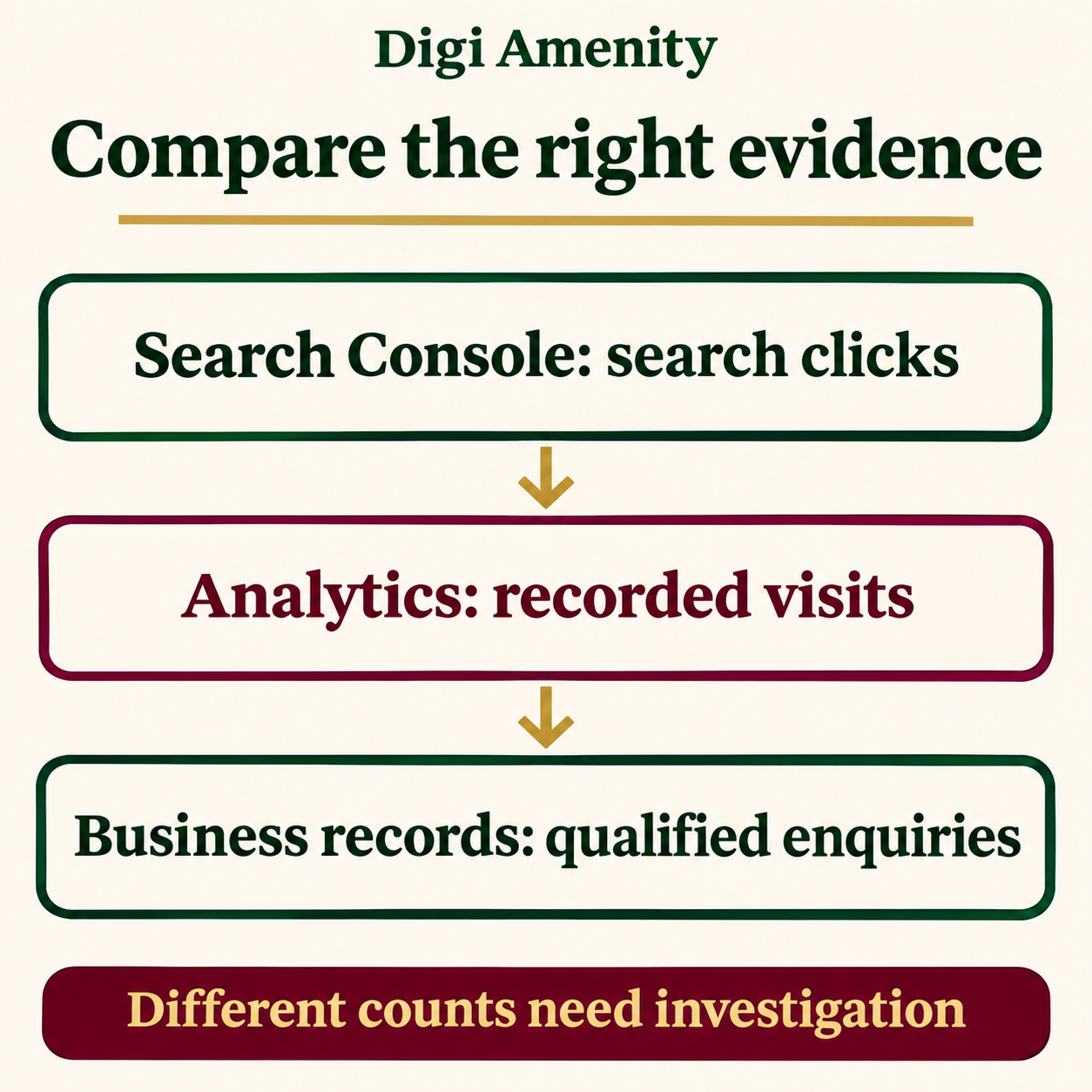
Search Console clicks and Analytics sessions have different definitions. Google’s comparison guide recommends inspecting patterns and filtering Analytics to session source google and medium organic. Date boundaries also matter: Search Console’s standard reporting timezone is Pacific Time, while your Analytics property may use India Time. Canonical URLs and tracking implementation can create further differences. See Google’s comparison guidance.
Use the same complete reporting period and record the timezone of each export. For an Indian business, a sale near midnight can sit on different calendar dates across systems. A daily mismatch is therefore a reason to inspect the setup, not a calculation of lost customers.
How can you run a useful audit without changing live tracking?
- Choose one landing page and one question. For example: why did recorded organic visits change after a website release? Write down the release date and the exact page URL. Avoid starting with every channel and every page.
- Preserve the evidence. Export the relevant reports before changing rules. Record property, filters, dates, timezone and extraction time. Keep private exports inside your approved workspace.
- Compare the page journey. Ask your developer to document the initial address, each redirect and the final landing URL. Include mobile and desktop routes if they differ. Record observed behaviour rather than guessing from the final address alone.
- Check the classification. Review custom channel rules and exclusions with the analyst. Compare raw evidence with the label in the report. Do not add an exclusion simply to make an unattractive source disappear.
- Verify the business endpoint. Agree what counts as an enquiry: a successfully received form with usable contact details, for example. A button click is a different event. Check the receiving system with an authorised test process before calling the measurement complete.
- Make one documented correction. Save the previous configuration, owner, proposed change and expected observable effect. Recheck an equal-length complete period after the fix; retain the original observations.
If the issue involves paid click identifiers, use the separate GCLID guide. If payment providers or external domains are disturbing attribution, consult the unwanted-referrals guide. Neither investigation should be substituted for this organic-source audit.
What should your audit worksheet contain?
Copy these fields into a local spreadsheet. Use one row per finding, not one row per suspected explanation.
- Scope: landing URL, release/change date, reporting window, property, device and country filters.
- Observation: the exact mismatch and the evidence file supporting it.
- Hypothesis: the proposed explanation, clearly marked unconfirmed.
- Check: the smallest test that could support or reject that hypothesis.
- Decision: keep, investigate or propose a correction, with a named owner.
- Follow-up: implementation date if approved, comparable remeasurement window and unresolved limitations.
An empty evidence field means the finding is not ready to drive a budget change. This simple rule prevents a technical suspicion from becoming an unsupported commercial conclusion.
What does a realistic diagnosis look like?
Hypothetical example: a Mumbai interiors business sees fewer recorded organic sessions after replacing its enquiry landing page. Search clicks look broadly steady, while the sales team says enquiry volume feels unchanged. Those observations do not yet identify the cause.
The owner asks for three checks: compare the same complete dates and filters, verify the tracking setup on the new page, and reconcile successfully received enquiries against the reporting event. If the new template lacks the expected measurement, the action is a documented implementation fix. If measurement works, the next investigation may concern consent behaviour or report scope. “SEO stopped working” is not justified by the initial mismatch.
How should you judge whether the work helped?
Track completed diagnostic checks, confirmed defects, unresolved hypotheses and the time needed to resolve them. For business performance, retain qualified enquiries and sales as separate outcomes. Do not promise that repairing measurement will itself increase demand: it should improve the evidence available for decisions.
If your reports disagree and your team cannot explain which visits become real enquiries, Digi Amenity can review the landing-page journey, tracking implementation and reporting definitions through its website development and improvement services before you change the marketing budget.
Frequently asked questions
Does a Google Referer reveal the keyword?
No. Google’s documented origin signal does not include the query. Use Search Console for query reporting, and avoid presenting a guessed keyword as visitor-level evidence.
Does a blank Referer mean the visitor typed my address?
No. Missing source information has several possible causes. Keep the observation separate from the explanation; do not relabel every unknown visit as a loyal customer returning directly.
Can the header prove a visit came from an AI answer?
Do not make that claim from a shared Google origin alone. An attribution label needs evidence that distinguishes the surface, not simply a plausible story about current search behaviour.
Should I force Analytics totals to equal Search Console?
No. Compare their trends and investigate material changes with consistent filters. A configuration chosen only to make the totals equal can hide the actual problem.
Should a small business collect every server-log field?
Start with the minimum evidence needed for the diagnostic question and restrict access appropriately. Ask your technical owner to define retention and sanitisation; raw logs should not be pasted into an external writing tool.
When is the audit complete?
When each finding has evidence, a decision and an owner, and approved corrections have been rechecked. Unresolved causes remain documented as unknown. A nicer-looking dashboard alone is not completion.
