
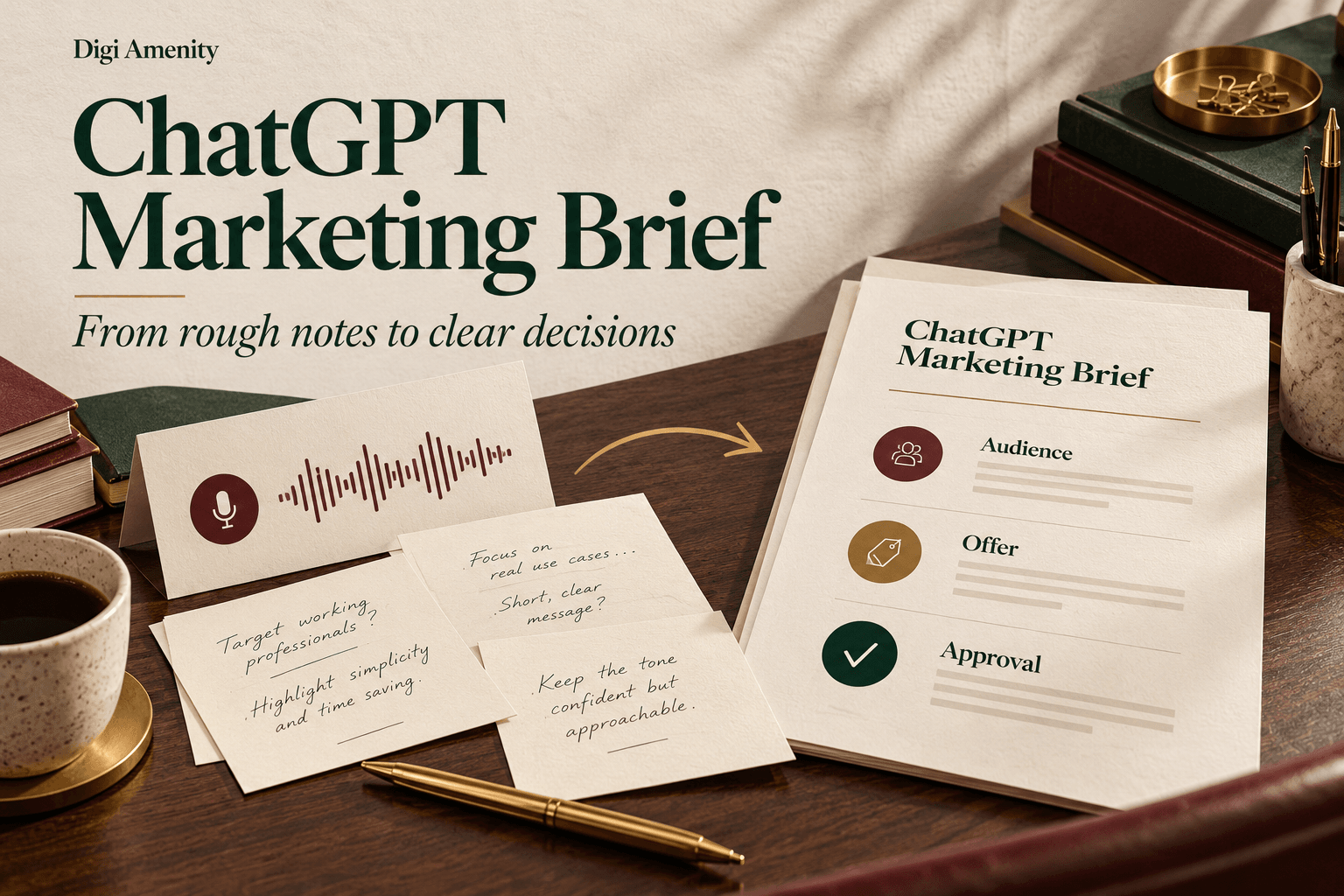
A useful ChatGPT marketing brief starts with approved business facts, then turns them into clear campaign decisions: who you want to reach, what you can promise, where the enquiry goes and who follows up. Give ChatGPT your notes, ask it to flag missing information before drafting, and have the decision owner approve the result. If you start with audio, check the transcript first.
For an Indian business working with an agency, the value is a more precise handoff. A polished brief is still incomplete if the ad promises a consultation that the team cannot deliver, the landing page describes a different offer or nobody has defined a qualified lead. This guide shows how to connect those decisions, with reusable prompts and a hypothetical Mumbai example.
Product details checked on 18 October 2026. The workflow and examples below are editorial recommendations, not a reported client project or a tested claim of time savings.
What is a ChatGPT marketing brief?
It is a marketing brief prepared with ChatGPT’s assistance and approved by people responsible for the campaign. It should tell the creative, advertising, website and sales teams what they need to execute. ChatGPT can organise inputs and suggest questions; the business must supply or approve the decisions.
A brief differs from a full strategy, which chooses priorities across a longer period. It also differs from a content outline, which mainly organises one article or asset. A campaign brief connects an agreed business objective to the work required to pursue it.
OpenAI’s campaign-kit guidance describes using supplied launch materials to prepare drafts while flagging missing assets, claims and approvals. The practical discipline is to make those unresolved items visible before they become instructions to a designer or media buyer.
What should you give ChatGPT before asking for a brief?
Prepare a small source pack. You do not need a large research presentation; you need enough reliable information to avoid expensive guesses. Name each source and include its date or version.
| Input | What to provide | Why it affects execution |
|---|---|---|
| Audience and service area | Buyer role, problem, eligibility and places actually served | Prevents the campaign attracting customers you cannot help |
| Offer and exclusions | Deliverable, approved price wording, conditions and unavailable services | Keeps ads, pages and sales replies consistent |
| Evidence | Approved specifications, public examples and substantiated claims | Stops plausible but unsupported benefits becoming promises |
| Budget and capacity | Media cap, production budget, timeline and response capacity | Avoids a plan the team cannot fund or fulfil |
| Destination | Landing-page URL or planned page, form requirements and booking route | Connects the campaign message to an actual next step |
| Measurement | Enquiry definition, qualification criteria, reporting owner and exclusions | Distinguishes an interaction from a valuable lead |
| Approvals | Who signs off the offer, claims, spend and creative | Prevents an AI suggestion being mistaken for an authorised decision |
For a learning exercise, use public information or synthetic inputs. Do not paste customer contact lists, credentials, private analytics or confidential meeting recordings into a tool merely to make the prompt more detailed. For real work, use only information your organisation has authorised for that product and workspace. If you are choosing an assistant for this workflow, compare the AI chatbot options for business tasks against your input requirements, data controls and review effort.
Give the model source precedence too. For example, “The approved offer sheet dated 16 October overrides the earlier brainstorming notes.” If two current documents conflict and no owner has resolved them, ask a question instead of choosing whichever sounds more persuasive.
Can you turn voice notes into a marketing brief?
Yes, where audio upload is available, but separate transcription from planning. OpenAI announced audio uploads on 6 October 2026 for paid ChatGPT subscriptions and workspaces. Access can vary by region, workspace settings, client version and model. That announcement does not establish that every Indian account has the feature. Check your own account before depending on it. See the official release notes.
The current file and audio guidance lists formats including MP3, WAV and M4A, and warns that transcripts and speaker identification can be wrong. If audio upload is unavailable, paste a reviewed text transcript or type your notes; the briefing process below still applies.
Check prices, quantities, deadlines, locations and words that reverse meaning, such as “not”. With a Hindi-English or Marathi-English recording, preserve the speaker’s intended meaning and verify important terms against the recording. Do not convert an unclear phrase into a confident English claim. Only use a recording you are authorised to share.
A sensible first request is: “Extract the business requirements. Mark unclear words and speaker uncertainty. Do not write a campaign plan yet.” Read that output against the original before moving on.
How do you create a ChatGPT marketing brief step by step?
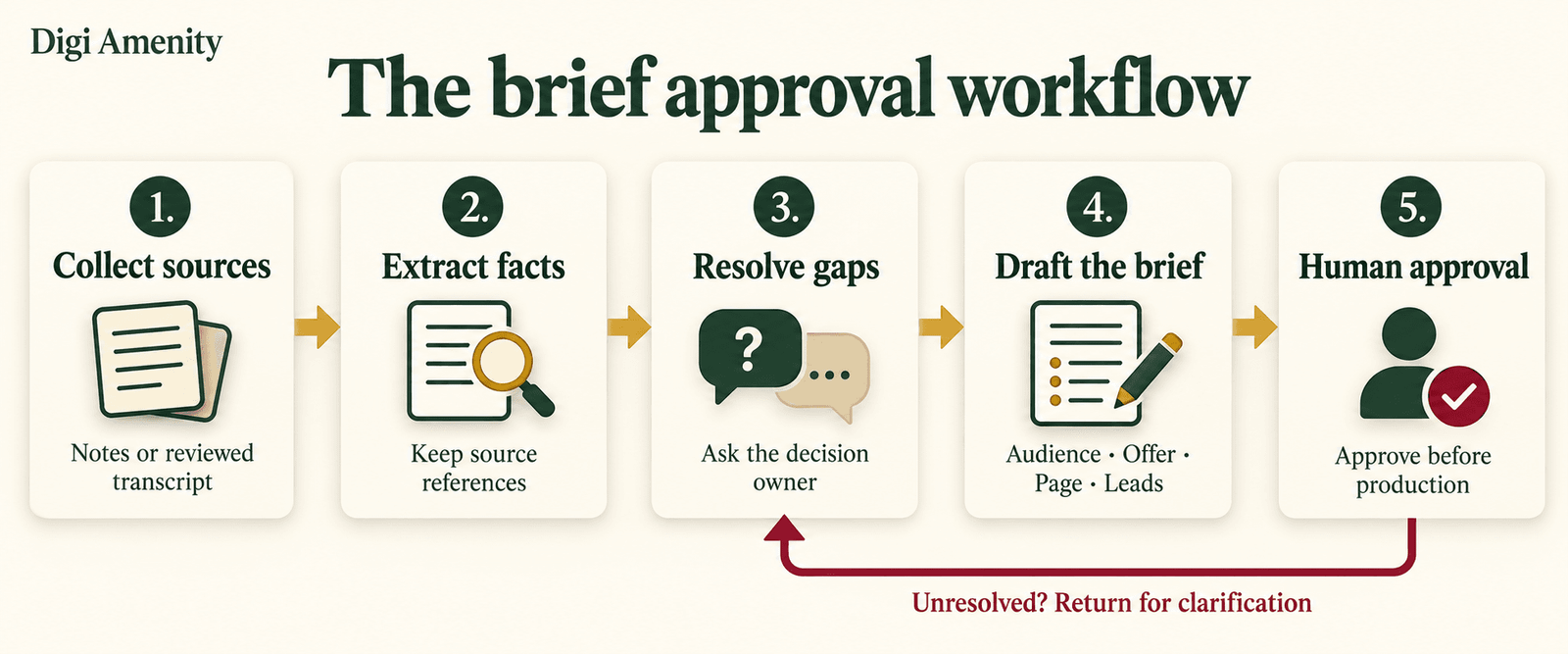
1. Extract facts and separate suggestions
Start with extraction, not creative writing. Ask for a compact table containing the requirement, source reference and status. Use three statuses: supplied fact, proposed decision and unresolved question. A statement appearing in a document is a supplied statement, not independent proof that the statement is true.
OpenAI’s prompting guide recommends giving clear context, instructions, constraints and acceptance criteria. For this task, the acceptance criterion is a traceable brief with visible gaps, rather than a complete-looking answer at any cost.
Act as a campaign briefing assistant.
Use only the sources below. Do not add market statistics, prices,
customer quotes, performance targets or business capabilities.

First return a table:
Requirement | What the source says | Source ID and location |
Supplied fact / Proposed decision / Unresolved question

List contradictions separately. Ask up to five questions that would
most affect the offer, targeting, budget, destination or follow-up.
Do not draft campaign copy yet.

Sources and precedence: [insert approved source list]
Notes: [insert public, synthetic or authorised material]
2. Resolve the decisions that block useful work
Some gaps can wait; others change the entire campaign. Missing image dimensions can be resolved during production. Uncertainty about whether a consultation is free, which customers qualify or who handles enquiries should be resolved before ads or a landing page are written.
Do not ask ChatGPT to choose a sales target simply because a template contains a target field. If there is no trustworthy baseline, specify the measurement method and leave the numerical goal pending. A budget cap is an instruction; it is not evidence of the leads that budget will buy.
3. Draft one campaign brief from the resolved source pack
Once the owner answers the questions, label those answers as a new source. Request a short brief with an appendix for evidence and unresolved items. Keep the main document usable in an approval meeting.
Draft one campaign brief using the approved source pack and answers.
Include: business objective; audience and exclusions; offer;
message and permitted proof; proposed channel and reason;
landing-page requirements; deliverables; budget and timeline;
qualified-lead definition; follow-up owner; measurement; approvals.

Separate agreed decisions from recommendations. Reference the source
ID beside consequential claims, prices, dates and constraints.
Write UNKNOWN where information is missing. Do not invent a forecast.
End with blockers and the person who must resolve each one.
4. Review the journey from ad to follow-up
Read the brief as four different people: the customer, the creative producer, the website developer and the person answering enquiries. Each should know what happens next. An attractive offer can still fail if it leads to an unrelated homepage or a form that asks for information the business will never use.
The website and landing-page work should therefore be part of the brief, including the mobile form, confirmation message, relevant proof and the destination after submission. Keep a successful form submission separate from a button click in the measurement specification.
5. Approve a version before creating channel assets
Save the approved version, approval date and owner. When the offer changes, update the brief before generating new copy. Do not leave a designer using version one while the sales team follows version three.
Review this brief for execution gaps.
Check: ad-to-page promise; eligibility; offer exclusions; evidence;
budget scope; mobile enquiry journey; lead definition; response
ownership; tracking exclusions; and approval responsibility.

Return only: issue | likely consequence | required decision | owner.
Do not silently fix a business decision. Do not mark it approved.
Brief: [paste draft]
What does a useful brief look like for a Mumbai business?
Hypothetical example, not a Digi Amenity client result: a Mumbai corporate-training provider wants enquiries from HR managers for instructor-led Excel workshops. Its owner records: “We want company teams, not individual students. Maybe ₹40,000 for the pilot, including some creative work. We have two workshop dates available, but I need to check instructor capacity.”
A weak brief might allocate the entire ₹40,000 to media, invent a target of 50 leads and promise flexible workshop dates. That would conceal three decisions: how much can actually be spent on ads, what evidence supports the lead target and which dates operations can fulfil.
The team creates source A: reviewed notes; source B: approved workshop details; and source C: written owner decisions. In this fictional scenario, source C allocates ₹30,000 to media and ₹10,000 to production within the ₹40,000 pilot cap, subject to confirming tax and billing treatment. Operations confirms that availability must be checked before a date is offered. The lead target remains pending because no comparable baseline was supplied.
| Brief field | Illustrative approved instruction | Still to check |
|---|---|---|
| Audience | HR or learning managers arranging team training in the locations listed in source B; exclude individual course enquiries | Service area and the organisation’s actual training need |
| Offer | Request a workshop proposal after discussing team size, skill level and preferred dates | No invented certification, placement or productivity guarantee |
| Budget | ₹30,000 media and ₹10,000 production within the fictional pilot cap approved in source C | Dates, tax treatment and spend controls before launch |
| Qualified enquiry | Genuine company-team requirement, serviceable location and a contact involved in arranging training | Sales records qualification separately from a submitted form |
| Landing page | Explain workshop scope; ask company, team size, current skill level and preferred dates | Mobile submission and confirmation work |
| Follow-up | Named coordinator checks instructor availability before suggesting dates | Owner confirms a realistic response commitment |
| Success measure | Track valid enquiries, qualified team requirements and proposals requested; no promised lead volume | Baseline and commercial target remain pending |
The brief now prevents specific mistakes: attracting individual students, spending the production allocation on media, promising unavailable dates and treating an invented lead target as a forecast. Those decisions also make subsequent Google Ads planning more concrete.
Which marketing brief template can you reuse?
Copy this approval card into your project document. Fill it before commissioning deliverables; keep “unknown” visible until someone resolves it.
- Campaign: name, version, owner and review date.
- Business problem: what needs to change and why now.
- Audience: buyer, intent, service area and exclusions.
- Offer: exact deliverable, conditions and approved price wording.
- Evidence: source IDs for each material claim; prohibited claims.
- Journey: channel → message → landing page → enquiry → follow-up.
- Production: required formats, inputs, owners and dependencies.
- Resources: media and production budgets, dates and capacity.
- Measurement: event definitions, qualification rules, exclusions and reporting owner.
- Approval: unresolved blockers, decision owner, sign-off date and approved version.
Use a simple stop rule: if the offer, permission to use a claim, budget authority or enquiry handling remains unresolved, the brief can be discussed but should not be treated as launch approval. This is a recommended working rule, not a platform requirement.
How should the brief change for different channels?
Keep the offer and evidence consistent, then adapt the execution. Search campaigns need the customer’s likely intent, relevant exclusions and a matching destination. Social creative needs a clear opening idea, permitted visual assets and enough context for someone who was not actively searching. Email needs a legitimate audience, message purpose and a suitable next step.
For social media content planning, a useful handoff includes what the viewer should understand, what the visual must demonstrate and what the team can substantiate. “Make it engaging” leaves the producer guessing. “Show the three stages of our approved scoping process without implying a free design package” gives a concrete boundary.
For ecommerce, replace the lead definition with the relevant purchase journey: product discovery, product-page information, offer conditions, checkout and post-purchase communication. Do not judge an AI marketing brief by ad copy alone when shipping, stock or checkout issues could undermine the campaign.
Why do ChatGPT marketing prompts produce unusable briefs?
- The input is an aspiration: “premium and affordable” becomes contradictory messaging. Supply a real positioning decision or ask the owner to choose.
- Every field must look complete: missing budgets and targets become invented numbers. Require unknowns and decision owners.
- The source is stale: an old offer survives because it sounds attractive. State which version governs the brief.
- The persona is imagined: simulated buyer opinions become “customer research”. Label them as hypotheses and validate them separately.
- Channels are disconnected: the ad, page and follow-up each describe a different next step. Review the complete journey together.
- The recording is treated as exact: a mistranscribed amount changes the offer. Check consequential details before drafting.
How do you measure whether this workflow helps?
Measure the cost of reaching an approved brief, including preparation and review. Track time spent assembling inputs, drafting, correcting facts and resolving questions. Compare similar campaigns with similar complexity; a shorter first draft is not necessarily a faster approval.
Useful process measures include the number of unresolved blockers at handoff, revision rounds caused by missing information and factual corrections required before approval. Record what changed in the process so a comparison is interpretable. Do not count word volume as a business result.
After launch, evaluate the campaign using its agreed conversion and qualification definitions. A better brief may help execution, but improved results cannot automatically be attributed to ChatGPT: the offer, targeting, landing page, tracking and follow-up may have changed too.
Frequently asked questions
Can ChatGPT write a marketing brief from scratch?
It can produce a structure and suggest questions, but it cannot supply your approved offer, budget authority or operating capacity without reliable inputs. Use an initial draft to expose gaps. Treat any invented customer profile, result or target as a proposal to validate, not a fact.
Do I need a paid plan for this workflow?
The core process can start with typed notes. Audio upload is a separate capability: the official guidance checked on 18 October 2026 places it on paid subscriptions and workspaces, with account and regional variation. Confirm access before relying on recordings; a reviewed text transcript is a practical alternative.
Can I use Hindi, Marathi or mixed-language voice notes?
Check whether your account accepts the recording, then review the transcription closely. OpenAI notes that audio performance varies across languages. Verify names, amounts, locations and negations, and ask the speaker about uncertainty. Translating a sentence into fluent English does not prove that its meaning was preserved.
How long should the brief be?
Long enough for the people doing the work to understand the objective, offer, constraints, journey and approval requirements. A short main brief with an evidence appendix is often easier to use than a large undifferentiated document. Complexity, not a fixed word count, should determine the length.
Can ChatGPT choose the campaign budget and lead target?
It can help structure options when valid inputs are supplied, but a generated figure is not an approved budget or a reliable forecast. The owner should approve spending. Set targets using relevant evidence, unit economics and delivery capacity; if those inputs are missing, keep the target pending.
What is the difference between a marketing brief and an SEO content brief?
A marketing brief coordinates a campaign across audience, offer, channels, destination, measurement and ownership. An SEO content brief focuses on a specific page’s search intent, coverage, sources and optimisation requirements. The latter can be one deliverable within the former, but it does not replace campaign decisions.
Who should approve an AI-assisted brief?
The people accountable for the relevant decisions: the business owner or marketing lead for objectives and budget, the service or product owner for claims, and the delivery or sales team for fulfilment and follow-up. A tool-generated checklist can support their review; it cannot grant their approval.
Turn the brief into coordinated execution
If your campaign notes keep turning into disconnected ads, website changes and sales instructions, Digi Amenity can help review the audience, offer, landing-page journey and lead follow-up before creative production begins. Bring the approved business facts and unresolved decisions so the next step is a workable campaign brief.
