

Google’s November 2026 core update began on 10 November and was still rolling out when we checked on 16 November 2026. It applies worldwide and across languages, including searches in India. Google estimated up to two weeks for the rollout. For a business seeing fewer organic enquiries, the most useful step today is to save a baseline and test the enquiry path. A reliable before-and-after ranking comparison needs a complete week of data after Google confirms the rollout has finished. Google’s November rollout record
Which Google core updates happened in 2026?
Google’s ranking history lists three broad Search core updates through 16 November. Use the dates for the update that overlaps your traffic change. A decline that began in October needs an explanation that predates November’s rollout.
- March: 27 March to 8 April. A separate spam update began on 24 March. If your decline started between the two launches, keep both dates in your notes.
- May: 21 May to 2 June. For a retrospective, make sure the comparison period falls after the June completion date.
- November: 10 November onward. Google recorded the start at 10:06 a.m. Pacific Standard Time, or 11:36 p.m. in India that day. The completion date was still open at the time of writing.
These are Google’s reporting dates. Its history also lists a February Discover update and several spam updates. A publisher investigating a Discover traffic drop should check the Discover report separately from website clicks in Web Search. Google’s ranking update history
What did Google actually change in November?
A core update changes how Google’s systems assess relevant, helpful results across the web. A page can move down even if its owner changed nothing. Another result may now serve the searcher better. Google’s November announcement identifies the timing and scope but gives no list of industries, content formats or ranking factors receiving special treatment.
That distinction matters when deciding what to fix. If a Mumbai packaging supplier loses visibility for “corrugated box sizes” but keeps its position for “custom corrugated box manufacturer Mumbai”, the losses concern two different customer tasks. A sizing chart might help the first audience. Rewriting the manufacturer page could disrupt the enquiries it already earns. Google Search Central’s core update guidance
What should you check while the rollout is active?
- Save the baseline. In Search Console, open the Search results performance report. Choose Web, select India if it is your market, and export 3–9 November as one complete seven-day period before launch. Save the selected dates, country, device and search type with the export. If the week included a promotion, festival or closure, flag it and keep a longer comparison for context.
- Identify where the loss started. Look at landing pages, then filter to one affected page and inspect its queries. Separate branded searches from generic ones and mobile from desktop where volume permits. Digi Amenity’s guide to Search Console regex filters can help group brand spellings or related product terms.
- Test a real customer action. Open the affected page on a phone. Check its response, inspect the canonical URL and indexing status in Search Console, then submit a clearly labelled test enquiry or test the shopping path. Verify that the test reaches the correct destination. A broken form merits a fix immediately.
- Keep a change log. Record site releases, stockouts, price changes, analytics changes and the dates of major promotions. A template edit that added a noindex directive the day before launch gives you a specific hypothesis to test.
How do you compare the weeks once Google confirms completion?
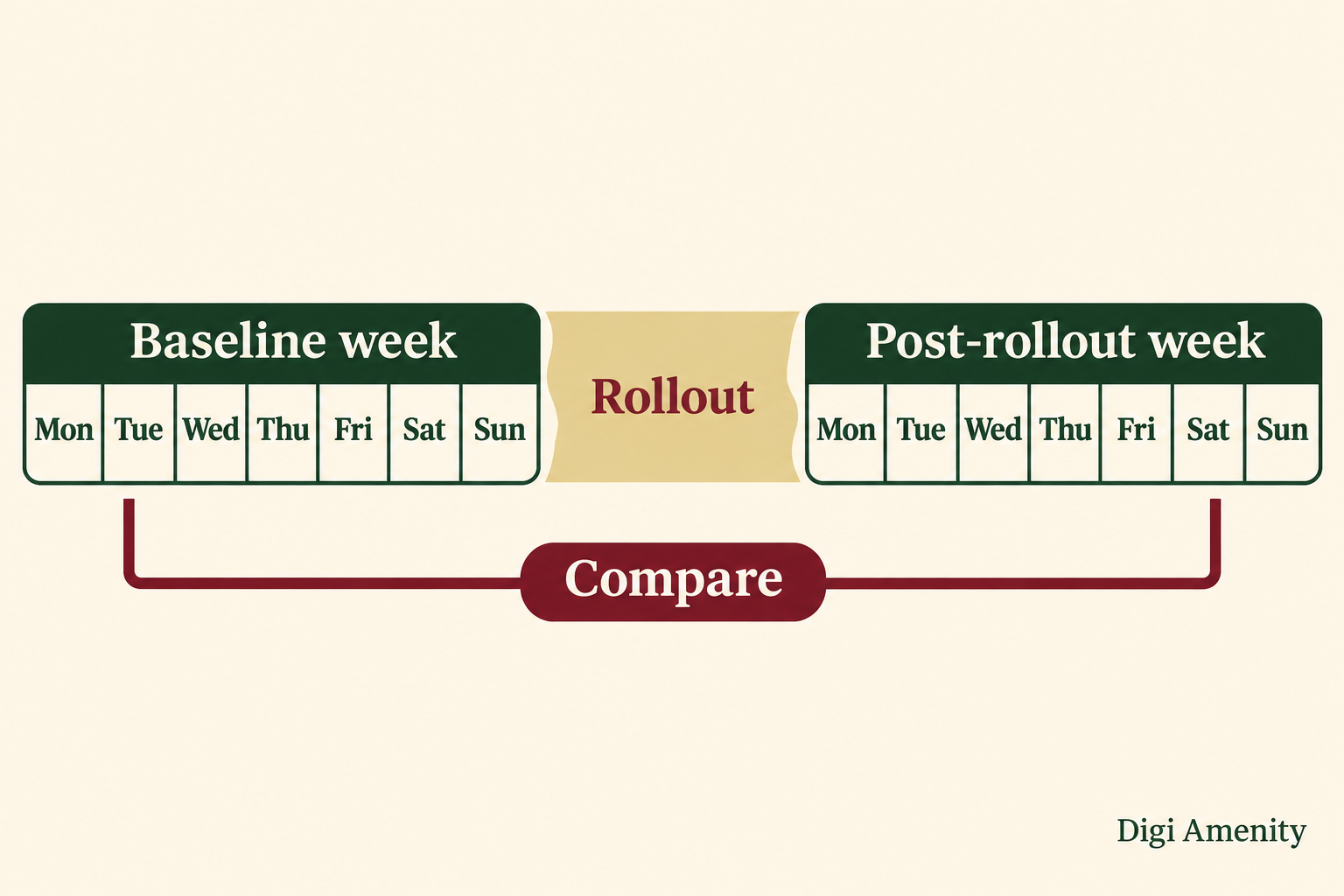
Google recommends waiting at least one full week after completion before assessing the change. Return to the incident record for the actual end date. Compare a complete post-rollout week with a complete pre-rollout week using the same filters and weekday mix. Exclude partial or still-processing days. A small site with five leads a month may need several weeks before its enquiry counts can support a business decision.
Start with clicks and impressions. Then inspect click-through rate (clicks divided by impressions) and average position for the same page and query group. Average position describes a mix of impressions. Losing a group of low-ranking queries can improve that average even as total clicks fall. Check the queries behind the number before presenting it as a ranking gain.
- Impressions fall while positions for comparable queries hold. Check seasonal demand, the previous promotion and whether fewer products were available. Compare the same period last year if the catalogue and tracking were comparable.
- Impressions hold while clicks fall. Inspect the current search results for the affected queries. Check whether the page title still describes the offer and whether the layout gives shoppers other ways to answer the question.
- Positions and clicks fall across related pages. Inspect a sample for indexing and template issues. If those checks pass, compare what the pages help a buyer decide against the pages now appearing for those searches.
- Clicks hold while qualified enquiries fall. Check the form, phone routing, CRM handoff and sales follow-up. In ecommerce, check stock, shipping promises and checkout. Search visibility alone cannot explain why visitors failed to complete a purchase.
What would a useful business review look like?
Hypothetical example. A packaging supplier records 600 Google organic clicks in its baseline week and 450 in a comparable week after a completed rollout. Qualified enquiries from organic landing sessions go from 12 to 11. Those figures show a 25% fall in clicks and one fewer qualified enquiry. They do not establish what caused either change.
The team finds that 140 of the 150 lost clicks came from a general box-size guide. Its quotation page retained nearly all its traffic. Before commissioning a sitewide rewrite, the owner asks sales which sizing questions buyers still raise. If buyers confuse internal and external dimensions, the editor can add a labelled drawing and a worked packing example. The sales team can then track how often that question comes up again. For a qualified-enquiry rate, use organic landing sessions from the same analytics setup as the denominator and keep the CRM qualification rule consistent.
Copy this review row: page or group | search task | country and device | before and after dates | clicks and impressions | position for comparable queries | qualified enquiries or completed orders | competing explanation | one proposed change | owner | review date. Record unknowns as blank. If evidence points to a broken mobile form, assign that repair to the web team. If it points to unanswered sizing questions, assign the guide to the catalogue expert.
When is a content change worth making?
A small position change on a page that still answers its audience well rarely justifies a rewrite. A sustained, substantial drop across related queries deserves a closer read. Ask someone familiar with the product to complete the task implied by the query using only the page. Can a buyer select the right size, identify delivery constraints or understand how to obtain a quote? Write down where they had to guess.
Make the smallest change that addresses the gap, record the date, and measure the same group again. A technical correction can be tested as soon as it ships. Search performance needs time and fresh data. Google gives no guaranteed recovery date or promise that an earlier position will return.
Frequently asked questions
Has the November 2026 Google core update finished?
Google still listed it as active on 16 November. Its two-week estimate is a planning guide. Use the completion entry in the official incident record to choose your post-rollout week.
Does the November update affect Indian-language websites?
Yes. Google says the rollout covers all languages globally. If your site has English, Hindi and Marathi sections, compare each section with its own baseline. Different audiences and query volumes can produce different patterns.
Does a ranking drop mean Google penalised my website?
A drop during a core update does not establish a penalty. Check the Manual Actions report for a reported manual action. Separately investigate indexing, demand and the pages competing for the same queries.
Should I delete articles that lost traffic?
First check their purpose and whether they still help customers. A low-traffic installation guide may resolve support questions for existing buyers. Google treats deletion as a last resort when content cannot be improved and provides little value.
Do I need to wait for the next core update to see improvement?
Google says some changes can take effect sooner, while broader reassessment can take several months. Give each edit a measurable purpose and track its effect without committing the business to a recovery deadline.
What should I send to an SEO reviewer?
Include the affected URLs, two comparable Search Console exports, the filters used, a dated site-change log and your definition of a qualified enquiry or completed order. Aggregate counts are sufficient for an initial review.
If organic enquiries have fallen, Digi Amenity’s SEO team can review the affected search terms, landing pages and conversion path with you before you commit to a rewrite.
