

Meta creative diversification means creating ads that speak to different customer needs, motivations or use cases through genuinely different messages and executions. A new background colour, a shorter edit or another call to action can improve an existing ad, but those changes alone do not give your business a broader set of ideas.
For business owners, the job is to supply customer insight, believable evidence and a clear commercial goal. For creative teams, the job is to turn those inputs into distinct concepts, produce suitable assets and learn from sales or qualified enquiries—not simply deliver more files.
This guide explains the meaning of diversification, shows separate eCommerce and lead-generation examples, and provides a practical workflow your strategist, copywriter, designer, editor and media buyer can use. Guidance checked on 30 October 2026.
What does diversification mean in plain English?
Diversification means introducing useful variety. In advertising, that variety should reflect how different customers decide—not random changes to make a creative folder look busy.
Imagine an Indian brand selling a reusable water bottle. One buyer wants something convenient for a train commute. Another wants a bottle that is easy to clean. A third is choosing a practical gift. The product can stay the same while the situation, question, proof and story change.
A commute demonstration, a cleaning tutorial and a gifting walkthrough are three possible concepts. Five versions of the same product photograph with different discount headlines are mainly variations of one sales message.
The useful question is: What does this ad help a customer understand that our other ads do not? If the team cannot answer, the new file may still be valuable production work, but it probably does not address a new customer need.
What does Meta officially say about creative diversification?
In its 16 December 2025 explanation, Meta distinguishes creative diversification from creative iteration. It describes distinct assets tailored to different potential customers or use cases, and says its system groups ads that share key visual and thematic characteristics, sharing learning and delivery optimisation at the creative level.
This supports making the underlying stories and executions meaningfully different. It does not establish a public rule that every image must change by a particular percentage, or that a fixed number of ads guarantees better delivery.
Meta’s April 2025 creative guidance also connects varied themes, messages and visuals with the opportunities available to its automated advertising systems. Our Meta Andromeda guide explains candidate retrieval, while our GEM guide explains foundation-model learning and knowledge transfer. Its Blueprint course separates diversification by concept and motivators from diversification by format.
These are useful planning principles. They are not a promise that adding assets will reduce your acquisition cost. Product demand, offer, budget, conversion signals and the experience after the click still matter.
How is diversification different from iteration and resizing?
Use the following distinctions in your brief and asset library. These are practical production labels, not a claim about Meta’s internal classification of an individual ad.
On mobile, swipe the table sideways to view all columns.
| Type of work | What changes? | Question it helps answer |
|---|---|---|
| Diversification | Customer situation, central message, story or evidence approach | Can another relevant idea persuade customers? |
| Iteration | Opening, order of scenes, copy, pace or CTA within an idea | Can we communicate this idea more effectively? |
| Format adaptation | A concept becomes a video, carousel or static asset | Does another presentation suit the message or placement? |
| Technical adaptation | Crop, aspect ratio, subtitles or safe-area positioning | Can people see, read and understand the ad correctly? |
All four activities can be worthwhile. A carousel explaining product care may communicate more clearly than a compressed video. A vertical version may prevent important text being cropped. Neither requires pretending that every export is a completely new concept.
Similarly, a new creator is not automatically a new strategy. If they read the same script in a different room, you have changed the delivery. If their experience reveals a different use case with relevant evidence, they may help develop a distinct concept.
What should an eCommerce brand diversify?
Hypothetical example: a reusable-bottle brand wants more purchases without relying entirely on discount-led advertising. The following is an illustrative planning exercise, not a client case study or tested result.
Concept A: “Will it fit into my commute?”
Show the actual bottle being placed into a real bag pocket, carried through a normal journey and used at a desk. Use dimensions and compatibility details the brand has checked. The visual story is about everyday practicality; the destination should make size and capacity easy to find.
Concept B: “How much effort does cleaning take?”
Film the cleaning process according to the product’s care instructions. Show removable parts accurately and explain any restrictions. This addresses a maintenance objection. Do not invent dishwasher compatibility or imply a demonstration proves hygiene claims.
Concept C: “Would this make a useful gift?”
Show the actual packaging, available colours and what arrives in the order. Explain a real delivery deadline only when operations can support it. This concept answers a different buying question from the commute video, even though it promotes the same bottle.
The creative team should map each idea through ad → product page → variant selection → delivery information → checkout. An ad about convenient gifting will disappoint if packaging costs or delivery restrictions appear only at checkout.
Judge the portfolio using purchase economics. Review acquisition cost alongside average order value, margin, cancellations and returns. A concept that attracts low-margin orders can look strong in platform revenue reporting while contributing little profit.
How should lead-generation businesses approach it?
Hypothetical example: a commercial office-fitout company serves businesses planning workspace projects. Its creative needs to help suitable prospects recognise the service and understand the enquiry process.
One concept could explain planning a fitout around an occupied office, using a clearly labelled sample project sequence. Another could explain what information is needed for a useful quotation, showing an enquiry checklist. A third could demonstrate how material samples and layout options are reviewed, using genuine samples and an accurate account of the company’s process.
These concepts should not claim completed projects, guaranteed timelines or savings without evidence. A sample plan must be described as a sample. Real case studies require permission, accurate scope and verified outcomes.
Make eligibility visible: service geography, project type, what the consultation includes and any genuine minimum scope. The best-performing ad for this business is not necessarily the one generating the cheapest form submissions. It is the one contributing useful enquiries and commercially viable projects.
Define a qualified lead before testing. For example: a reachable business contact with an in-scope project, suitable location and an agreed next step. Keep the definition consistent across concepts, and record why enquiries are rejected.
Illustrative arithmetic: ₹12,000 spent on 40 enquiries gives a CPL of ₹300. If 10 meet the agreed qualification criteria, cost per qualified lead is ₹1,200. Another concept with fewer raw enquiries could still be more useful if it produces better qualification and sales outcomes. These numbers explain the calculation; they are not expected benchmarks.
What should business owners provide before production starts?
“Make something different” is an incomplete brief. Give the team enough commercial information to make the differences relevant.
- Customer questions: anonymised recurring questions from sales, support, reviews and product enquiries. Separate observed patterns from guesses.
- Offer boundaries: actual price, inclusions, stock, geography, delivery terms and service capacity.
- Proof: approved product specifications, demonstration footage, permissioned testimonials and substantiated results.
- Decision barriers: what stops suitable buyers from proceeding—unclear fit, missing information, risk, timing or cost.
- Commercial target: the outcome that matters and the cost the business can support.
- Approval owner: one person responsible for checking business facts before launch.
Do not provide private customer conversations to a public AI tool. Summarise patterns without personal details, and use approved systems for confidential research. A useful insight might be “buyers repeatedly ask whether installation is included,” without sharing anyone’s name or order history.
For Indian audiences, language and context should follow evidence. Hindi, Marathi or another language may improve understanding for a relevant audience, but translation alone does not create a new customer motivation. Keep the offer and factual meaning consistent.
What should each member of the creative team do?
On mobile, swipe the table sideways to view all columns.
| Owner | Deliverable | Quality check |
|---|---|---|
| Business or product lead | Offer, evidence and customer constraints | Can we substantiate every promise? |
| Strategist | Distinct customer problem and hypothesis for each concept | Are we filling a real gap in current messaging? |
| Copywriter | Script, headline, proof sequence and CTA | Does the opening match the rest of the ad? |
| Designer or art director | Visual treatment and storyboard | Does the visual explain the chosen idea? |
| Editor or creator | Clear demonstration, sound, captions and placement exports | Can a mobile viewer understand it without guessing? |
| Media buyer | Launch plan, budget boundary and evaluation method | Will the test answer the intended question? |
| Analyst and sales owner | Outcome review and reasons for poor-fit enquiries | Do reported conversions represent business value? |
A small business can assign several roles to one person. The point is accountable decisions, not a larger payroll. A designer should not have to invent the product’s benefits, and a media buyer should not be expected to diagnose sales quality from click-through rate alone.
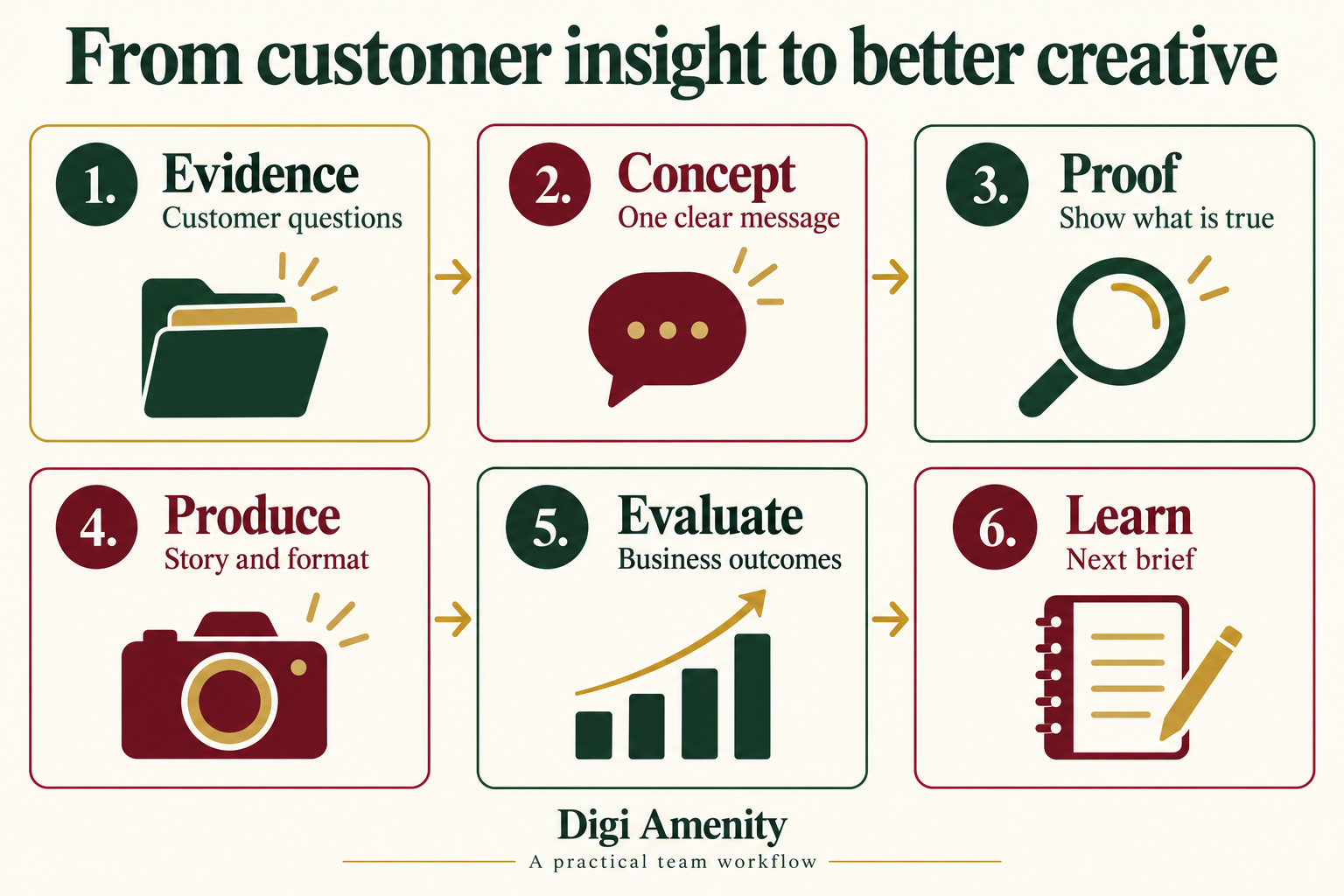
How do you write a useful creative diversification brief?
Create one brief per concept before requesting variations. Copy the template below into your team’s working document.
- Concept ID and name: a stable identifier that survives new edits.
- Customer situation: what is happening when this product or service becomes relevant?
- Evidence source: what observed question or objection supports the idea?
- Single message: what should the viewer understand?
- Proof: what can we show or explain honestly?
- Visual story: setting, presenter, demonstration and sequence.
- Opening and CTA: how we earn attention and what happens next.
- Destination: exact page or form and information it must contain.
- Format requirements: placements, captions, readable text and rights.
- Learning question: what outcome would support, weaken or leave the hypothesis unresolved?
- Owner and review date: who approves facts and who reviews results?
For the bottle’s cleaning concept, the hypothesis might be: “Showing the actual care process will help shoppers who hesitate because maintenance is unclear.” That is more useful than “create a viral Reel.” It gives the editor a story, the product team a fact-checking task and the analyst a question to revisit.
Use readable file names such as BOTTLE_C02_CLEANING_VIDEO_9x16_V01. Keep the concept ID separate from the execution version and retain the ad ID after launch. This helps the team connect outcomes to the correct assets instead of comparing screenshots called “final-final.”
How many ads should you make, and how should you test them?
There is no universal number that makes a campaign diversified. Start with the number of meaningful ideas you can produce, fund and evaluate responsibly. Do not copy the output of a large advertiser without its budget, demand and production capacity.
A small team might prepare three concept briefs and produce one clear execution for each as a first production batch. That is an illustrative planning choice, not a Meta minimum and not an instruction to launch all three simultaneously. The media buyer must decide what the account can support.
Separate two purposes:
- Finding useful ads in normal delivery: several concepts may run while Meta allocates spend. Results help operational decisions, but exposure is unequal and comparisons are not controlled experiments.
- Answering a specific causal question: use an appropriately designed experiment, with comparable conditions and adequate data. Check which testing options are available in the account before committing to a method.
Do not change audience, landing page, offer and creative at once and then credit the result entirely to the creative. Equally, when testing complete concepts, accept that message, visuals and proof may change together; the finding concerns the concept package, not one isolated component.
Agree a spend boundary, evaluation window and primary metric before launch. Allow for purchase or sales-cycle delay. If a concept receives too little delivery, label it insufficient evidence, not “failed.” More testing is worthwhile only when the potential learning justifies the cost.
What should you measure beyond clicks?
Keep reporting definitions consistent across creatives and periods. Our Meta creative performance analysis guide provides a deeper companion for evaluating ad performance.
For eCommerce, track spend, purchases, purchase CPA and reported ROAS alongside store-side order quality. For lead generation, connect spend to valid enquiries, qualified leads, appointments or proposals and eventual sales. Report conversion delay and attribution limitations; platform-attributed revenue is not proof of incremental profit.
Use click-through rate, video engagement and landing-page behaviour to investigate why a concept struggles. They are diagnostic signals. A strong opening can attract curiosity without purchase intent, while a more selective message can produce fewer clicks and better enquiries.
Check the post-click journey when ads attract relevant interest but outcomes disappoint. Mobile readability, product information, forms and checkout can limit results. Improving the website journey may be more valuable than commissioning another batch of ads.
At the review, assign one action to each concept: keep, iterate, test a different concept, investigate the destination, or wait for enough evidence. Record the reason and next question. Avoid “make more like the winner” unless the team can explain which customer need the winner addressed.
What mistakes should teams avoid?
Confusing similarity with fatigue. Similarity describes ads that look or feel alike. Fatigue concerns repeated exposure and weakening response. Meta distinguishes these in its guidance; a worsening CPA alone does not establish either cause.
Changing the brand’s truth. Different creative stories should still represent the same product accurately. Diversification does not justify invented testimonials, inconsistent pricing, exaggerated claims or false urgency.
Treating diagnostics as targets. If Ads Manager shows creative insights or recommendations, use them as inputs. Availability and wording can vary. Do not sacrifice profitable delivery merely to chase a score or assume an unverified threshold controls reach.
Using AI only to multiply near-duplicates. AI can help organise approved research, draft alternative storyboards and explore copy. Human review must check truth, rights, visual accuracy and relevance. Do not manufacture a customer testimonial or present generated product behaviour as real evidence.
Ignoring the sales team. If a campaign consistently attracts people outside the service area or with the wrong project needs, reflect that feedback in the brief and destination. Creative and qualification need to work together.
How can you start this week?
First, group current ads by the customer question they answer. Then identify one important unanswered question using actual customer feedback. Write a concept brief, confirm the evidence and produce a clear execution that the team can afford to evaluate.
Keep useful existing ads running where appropriate. Review the new concept against its intended business outcome, document uncertainty and use the finding to choose the next brief. The aim is a repeatable learning process—not an endless demand for more creative.
If your team is producing many ads but struggling to explain what each one should achieve, Digi Amenity can review your Meta creative strategy, tracking, landing-page journey and lead or purchase quality before you increase production or media spend.
Frequently asked questions
1. What is Meta creative diversification?
It is the practice of developing distinct advertising assets around different relevant customer needs, motivations or use cases. Message, story, visuals and format should work together to make those differences understandable.
2. Is changing the hook enough?
A new opening can improve an ad, but it is often an iteration of the same idea. Consider whether the rest of the ad addresses another customer question or provides a different reason to act. Classify the work honestly rather than treating every new hook as a new concept.
3. Can a business with one product diversify its ads?
Yes. One product can serve several situations or face different objections. Use real customer evidence to decide which stories are relevant. Do not invent a benefit simply to create another angle.
4. Do we need ten or twenty creatives?
Not as a universal rule. Production and testing volume should reflect your budget, conversion volume, learning questions and team capacity. Meta’s guidance supports meaningful variety; a fixed file count does not establish it.
5. Does diversification replace audience targeting?
No. Relevant creative helps communicate who the offer is useful for, but campaign objectives, applicable audience controls, geography, budget and conversion signals remain part of the strategy. Do not assume an ad message alone enforces business eligibility.
6. Does every brand need influencers or UGC?
No. Product demonstrations, staff explanations, diagrams and clear static ads can all communicate useful ideas. If using creators or customer content, obtain the necessary rights and make sure testimonials reflect genuine experiences.
7. How can a small team manage this workload?
Work from a small set of prioritised briefs, batch compatible filming tasks and keep an organised asset library. Assign responsibility for facts, production and evaluation even when one person fills several roles. Reuse footage when it genuinely supports the new story.
8. How do we know diversification is helping?
Look for useful business outcomes and learning across concepts, with consistent definitions and enough data. For sales, consider acquisition economics; for enquiries, consider qualification and sales progression. Unequal delivery and attribution limits mean a simple ad ranking does not prove causality.
