

The Meta GEM algorithm is best understood as a large foundation model for advertising recommendations. GEM learns patterns from advertising and engagement data, then transfers useful knowledge to other models involved in ad delivery. Its full name is Generative Ads Recommendation Model, although Meta also uses the shorter name Generative Ads Model.
GEM is not a new campaign type, an advertiser-controlled targeting setting or the tool that automatically writes your ad copy. For a business owner, its relevance is how Meta improves predictions about which advertising may be useful to a person. Your practical priorities remain a suitable objective, accurate measurement, credible creative and a customer journey that converts interest into business value.
This guide explains the technology without turning engineering announcements into advertising guarantees. It separates the original explanation from the October 2026 update, then shows what eCommerce and lead-generation businesses should review. Research checked on 30 October 2026.
What is GEM, and why does the name cause confusion?
People often use “the algorithm” as shorthand for everything that determines ad performance. Meta’s advertising system contains multiple models and processes. GEM is an important part of that wider system, not a complete description of every auction, targeting rule or campaign feature.
Meta’s November 2025 engineering explanation describes a foundation model that improves other recommendation models through knowledge transfer. A helpful analogy is a research team developing knowledge that many specialist teams can use. The specialists still perform their individual tasks.
The word “generative” does not make GEM equivalent to a creative-generation feature in Ads Manager. Learning representations and improving recommendation predictions are different jobs from producing an image, rewriting a headline or adding music to a video.
Also distinguish an announcement date from a launch date. The November 2025 article says GEM had launched earlier that year. Calling November the date when every advertiser suddenly moved onto GEM would go beyond that evidence.
How does the Meta GEM algorithm work?
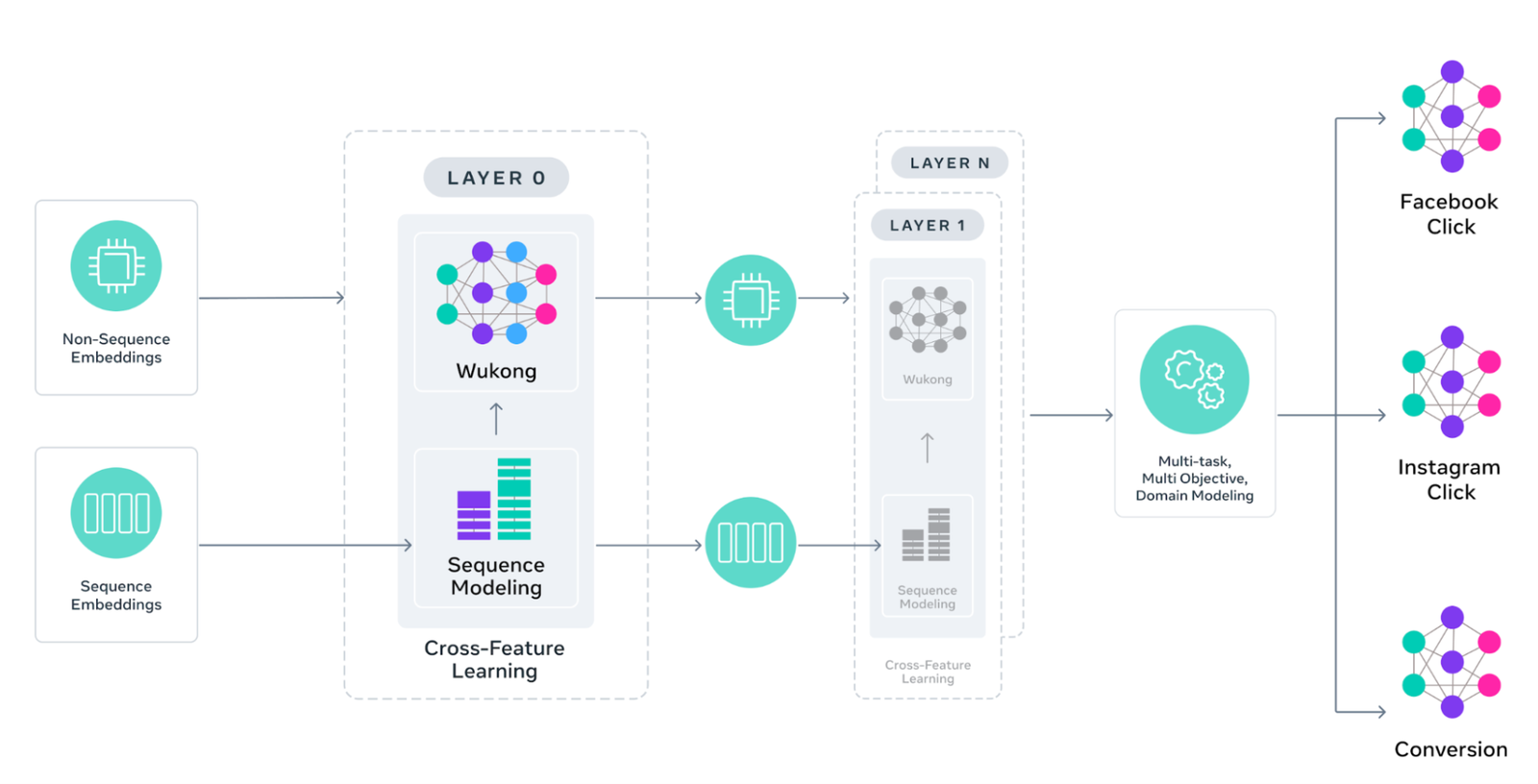
At a high level, GEM learns relationships between people, advertising and behaviour, and makes that learning useful to smaller or specialised models. Three ideas make the architecture easier to understand.
1. Activity history provides context
A single click is a limited observation. A sequence of interactions can provide more context about what someone has been engaging with and how that behaviour changes. Meta describes sequence features such as activity history alongside non-sequence features, such as attributes of the person or ad.
This does not mean advertisers receive a private dossier of each person’s activity. Nor does it prove that the system follows a fixed journey from awareness ad to testimonial to discount. Learning from historical sequences is different from guaranteeing a marketer’s preferred order of exposure.
2. The model learns relationships between signals
An ad’s characteristics and a person’s context can matter in combination. Meta’s architecture is designed to model those interactions rather than treating each signal as an isolated label. The important business distinction is between a predicted response and a known outcome: a model estimates what may happen; it does not know that an individual will buy.
3. Knowledge reaches models that serve advertising
A very large model is expensive to evaluate inside a time-sensitive request. Meta describes techniques that let downstream models benefit from GEM’s learning. These include learning from the larger model’s predictions, using compact representations and reusing learned components.
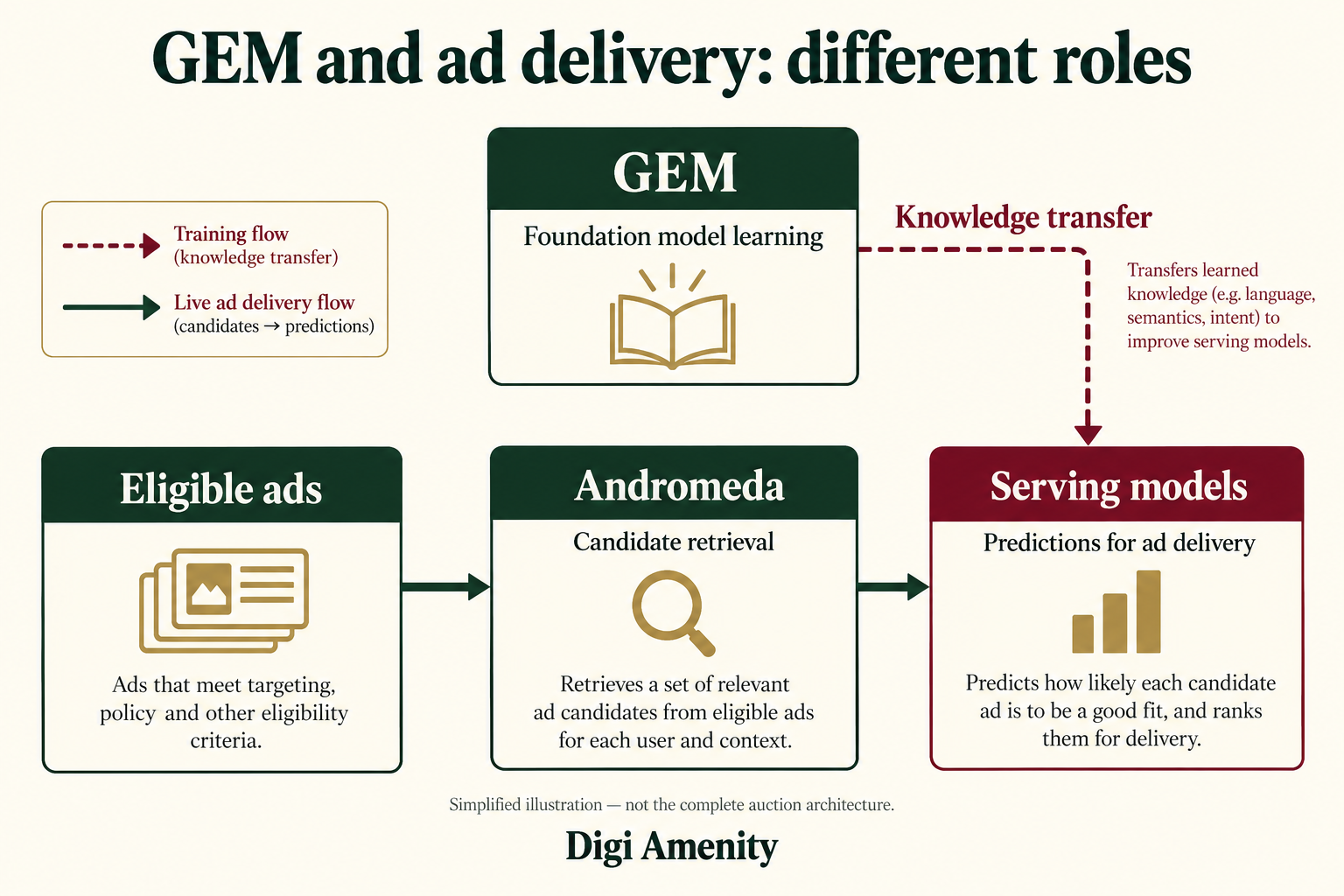
This is why “Andromeda finds 500 ads, then GEM personally selects the winner” is an overly rigid explanation. The published architecture includes learning transfer and serving models; it should not be reduced to a guaranteed two-box process with a fixed shortlist size.
What changed in Meta’s October 2026 GEM update?
The 13 October 2026 engineering update describes a more unified foundation model across advertising surfaces and objectives. It also introduces architecture and knowledge-transfer improvements. The following is a brief translation of the technical terms.
Kunlun: the updated architecture supports more efficient scaling and longer engagement context. It concerns how Meta builds the recommendation model, not a setting an advertiser should locate.
LoopFM: a way to pass structured representations and historical context to downstream models. The purpose is to make more of the foundation model’s learning useful elsewhere in the system.
Solaris: speculative precomputation of likely user–ad representations, so downstream models can use fresher information without evaluating the full foundation model within every live request.
Meta also describes joint learning across surfaces and objectives, including click and conversion prediction. Its discussion distinguishes capabilities already used in production from further scaling capability and future ambitions. Those distinctions matter: infrastructure capacity is not proof that every possible capability is active for every advertiser.
A separate August 2026 training article explains the hardware and software work behind efficient large-scale training. These engineering improvements help explain Meta’s investment in GEM; they do not specify a campaign recipe or an advertiser’s expected return.
How is GEM different from Andromeda and Advantage+?
These names describe different things. Confusing them can lead a team to change a campaign setting in response to an infrastructure announcement that did not require that change.
On mobile, swipe the table sideways to view all columns.
| Name | Useful distinction | What an advertiser should avoid assuming |
|---|---|---|
| GEM | Foundation-model learning and knowledge transfer for advertising recommendations | It is a switch, a creative generator or the complete auction |
| Andromeda | Ad-candidate retrieval technology | Every account has an identical fixed shortlist or rollout date |
| Serving and ranking models | Models involved in producing predictions for ad delivery | One public model name explains every delivery decision |
| Advantage+ | Advertiser-facing automation products and features | Choosing a particular setup is the same as manually activating GEM |
For the retrieval side, read our Meta Andromeda explanation. The practical takeaway from the distinction is simple: evaluate available campaign controls against your business objective, rather than trying to configure an internal model directly.
For Indian advertisers, the sources reviewed do not establish a separate India-specific GEM activation process. They also do not provide an account-by-account feature availability list. Check the actual options in your account before following instructions for any related advertising product.
Does GEM explain a sudden fall in your results?
Not by itself. An engineering announcement and a decline in your account can occur around the same time without one proving the cause of the other.
Before blaming GEM, compare the date of the change with your own change log. Did the website release a new checkout? Did an offer end? Did a payment method fail? Did the team change the optimisation event, budget, audience or landing page? Did stock or service capacity change?
Then check measurement. A missing purchase event can make reported performance look worse even when orders continue. Duplicate events can create the opposite illusion. For leads, an increase in form submissions can conceal a fall in reachable or qualified enquiries.
Use consistent time windows and allow for conversion delay. If only one product, page or form deteriorated, investigate that specific path. A platform-wide explanation is weaker when the problem is isolated to an asset your business controls.
Should advertisers expect Meta’s reported performance gains?
No individual advertiser should treat platform-level engineering results as a forecast. Meta reports improvements from its systems, but those results are tied to the experiments, populations, surfaces and comparisons described by Meta.
They are not a promise that your CPA will fall by the same amount. A model improvement can coexist with rising auction competition, a weaker offer, poor website conversion or inaccurate reporting.
Do not add percentages from separate announcements together or apply a headline uplift to a revenue forecast. A better question is whether your own account produces commercially useful outcomes under a stable, documented measurement method.
If you want to assess the effect of an advertiser-controlled change, design a suitable experiment. A before-and-after screenshot alone cannot isolate a platform model’s contribution.
What should an eCommerce business do now?
The recommendations below are Digi Amenity’s practical interpretation for account management. They are not hidden GEM rules or instructions from an engineering specification.
Validate the purchase journey and its signals
Confirm what your business calls a purchase, when that action is recorded and which systems send it. Where browser and server tracking both report the same action, have the implementation checked for duplication. Verify order value and currency against the source transaction.
Server-side tracking is not a reason to bypass consent, data restrictions or customer privacy choices. Use supported integrations and send permitted information for a defined purpose. More events are not automatically better when their meaning is wrong.
Match advertising to the product decision
A strong ad cannot resolve information that the product page hides. Show accurate dimensions, variants, stock status, delivery conditions and returns information where shoppers need them.
Hypothetical example: a desk brand promotes a compact desk for small home workspaces. If the creative shows it fitting into a corner but the product page makes width and depth difficult to find, the next useful action may be improving product information. Producing another dramatic video does not address that obstacle.
Separate reported revenue from viable economics
Review purchase CPA and reported ROAS alongside margin, cancellations, returns and fulfilment costs. Keep the definitions of new customer, gross order revenue and net revenue explicit.
Illustrative calculation: spending ₹20,000 for ₹80,000 in attributed order revenue gives a reported ROAS of 4. That ratio alone says nothing about profit. If those orders carry high product costs or later cancellations, the business result changes. This is arithmetic, not a performance benchmark or a claimed client result.
What should a lead-generation business do differently?
Lead businesses need a reliable connection between an enquiry and its eventual value. A model-assisted delivery system cannot make a poorly defined lead metric useful to your sales team.
Write down the stages: submitted enquiry, valid contact, qualified opportunity, appointment or proposal, and sale. Define who updates each stage and how long it usually takes. Track duplicates and rejection reasons rather than treating every form submission as equivalent.
Hypothetical example: a company selling corporate training receives many enquiries from individuals seeking low-cost personal courses. The ad may be attracting attention, but the message and form are failing to communicate that the service is for company teams.
A better response is to explain the audience, programme scope and enquiry requirements accurately, then measure whether suitable business enquiries improve. Do not immediately widen budgets or rebuild every campaign under the assumption that GEM needs more data.
Where a supported integration can send appropriate later-stage outcomes, evaluate it with the technical and sales owners. Verify availability, permissions, event meaning and matching before using it. An integration being connected is not proof that useful outcomes are arriving correctly.
Use cost per qualified lead and sales progression alongside raw CPL. Keep response time visible: an enquiry that nobody contacts promptly is a follow-up problem, not necessarily a targeting problem.
What should creative and media teams change?
Keep creative decisions tied to customer evidence. Different buyers may need a demonstration, a clear explanation of suitability or credible proof. Prepare distinct creative concepts around those questions instead of treating a large export folder as evidence of strategic variety.
However, do not claim that a specific image guarantees access to a particular audience. Creative communicates relevance; it does not replace applicable location, eligibility or campaign controls.
For each concept, document the customer question, evidence, central message, destination and business outcome. Give the media buyer enough context to distinguish a weak idea from a poor execution or a broken post-click experience.
Use creative performance analysis to investigate patterns, with consistent attribution and reporting periods. Video engagement can diagnose attention; it should not become the final success measure for a campaign whose purpose is sales or qualified enquiries.
Do not pause a profitable asset simply because a generic recommendation says every creative must be replaced after a set number of days. Review actual performance, fatigue signals, offer relevance and production capacity.
Should you consolidate campaigns or remove targeting?
Review fragmentation, but avoid a universal restructuring rule. Separate campaigns or ad sets may exist for legitimate reasons: different countries, product economics, service eligibility, contractual budgets or distinct objectives.
If several small ad sets pursue the same objective with nearly identical settings and little data, simplification may be worth evaluating. If the separation protects a genuine business constraint, keep that constraint in the decision.
Similarly, assess placement flexibility against asset suitability and business requirements. Learning across surfaces does not prove that every placement is equally valuable for your account, or that purchasing impressions on one surface guarantees improvement on another.
Document the hypothesis before making changes. Preserve a baseline, choose a meaningful evaluation window and avoid simultaneous edits that make the result impossible to interpret.
What practical audit can you run without guessing about GEM?
Use this worksheet with the person responsible for advertising, the website and sales. Mark each item as verified, issue found or not checked. “Not checked” is more useful than an unsupported green tick.
On mobile, swipe the table sideways to view all columns.
| Review area | Evidence to collect | Next action if evidence is missing |
|---|---|---|
| Business objective | Written purchase or qualification definition | Agree the definition with finance or sales |
| Measurement | Test action, sender inventory and source-system comparison | Assign an implementation review before changing spend |
| Creative | Concept list linked to customer questions and approved proof | Brief the most important unanswered question |
| Destination | Mobile journey, form or checkout verification | Fix the observed friction |
| Commercial outcome | Net order quality or sales-stage evidence | Connect reporting to the business system |
| Evaluation | Change log, date window, attribution and conversion delay | Establish comparable conditions before judging |
Choose the highest-impact verified issue first. Assign an owner and a review date, then measure the result. If no clear issue appears, preserve the working setup and test a defined hypothesis within an agreed budget boundary.
This approach is useful whether or not you can identify the contribution of a particular model. It turns the conversation from “How do we beat GEM?” into “Which part of our advertising system can we improve with evidence?”
If your Meta results are difficult to explain, Digi Amenity can review your Meta advertising setup, conversion signals, creative and customer journey before recommending a campaign restructure or higher budget.
Frequently asked questions
1. What does GEM stand for?
Meta uses Generative Ads Recommendation Model and the shorter Generative Ads Model. It is a foundation model supporting advertising recommendations through learning and knowledge transfer.
2. Is GEM the same as Meta Andromeda?
No. Andromeda concerns candidate retrieval. GEM develops learning that improves other advertising models. They are related components of a wider system, not interchangeable names for the same feature.
3. Can I turn GEM on in Ads Manager?
The engineering sources reviewed do not describe an advertiser-facing GEM switch. Use the available campaign settings for your business objective; do not confuse enabling an automation feature with directly activating GEM.
4. Does GEM create my ad images and copy?
GEM’s described role is recommendation modelling. Meta also offers creative-generation features, but those are a different function. The word “generative” alone does not make the products equivalent.
5. Did GEM launch in November 2025?
Meta published a detailed engineering explanation on 10 November 2025, but that article says the model had launched earlier that year. Publication date should not be presented as an exact universal rollout date.
6. Will GEM automatically improve my ROAS?
No account-level gain is guaranteed. Platform research does not remove the effects of offer quality, competition, costs, tracking or the website journey. Judge your results using consistent definitions and commercially useful outcomes.
7. Does GEM mean every business should use broad targeting?
No engineering description establishes a universal targeting recipe. Evaluate available controls, business eligibility, geography, evidence and testing capacity. Keep restrictions that serve genuine business or policy requirements.
8. What should a small business do first?
Confirm the intended outcome and verify that it is measured correctly. Then check the mobile destination and whether the creative answers a real customer question. Fix a demonstrated problem before adding complexity or increasing spend.
