

Instagram SEO means making your profile and content easier to find for relevant searches. Start with a recognisable business name, a clear description of what you offer, and posts that answer customer questions in natural language. Then check visibility settings, give interested visitors a useful next step, and measure enquiries alongside reach.
For an Indian business, the objective is not to appear for every popular term. A product photography studio needs the right brands to discover its work, understand its service and submit a useful brief. A widely viewed Reel about an unrelated trend may contribute very little to that journey.
This guide explains the practical work, the limits of platform data, and a 30-day process you can adapt. Platform documentation was checked on 26 October 2026; older official explanations are identified by their publication dates.
What is Instagram SEO—and what does it actually influence?
Instagram search optimization is the work of making an account and its posts relevant and understandable to people searching inside Instagram. It overlaps with broader content discovery, but there are three different systems to keep separate.
| Discovery route | What the person is doing | What your team should check |
|---|---|---|
| Instagram Search | Looking for an account, topic, product or place | Clear profile language, relevant post descriptions, actual query intent |
| Explore and Reels recommendations | Browsing content selected for their interests | Useful creative, audience response and recommendation eligibility |
| Google or another external search engine | Searching the web, where eligible Instagram content may appear | Public-content eligibility, accuracy and privacy; indexing is not guaranteed |
Instagram's May 2023 ranking explanation describes different systems for different surfaces. A tactic that improves how people understand a Reel is not automatically a proven ranking factor for every surface.
Think of SEO as improving relevance and the customer journey. It cannot compensate for an unclear service, weak creative, an unusable mobile landing page or enquiries that nobody answers.
What has Instagram said about search ranking?
In its August 2021 explanation of Search, Instagram described three broad inputs: the text someone searches, their previous activity, and information about potential results, including popularity signals. It recommended relevant profile names, descriptive bios and keywords or hashtags in captions.
That is a useful historical foundation, not a complete specification of the 2026 ranking system. Do not turn it into a formula claiming that a certain number of keywords, saves or hashtags guarantees a position.
Personalisation also changes what you see. Searching your business from your own account is a spot check, not an independent ranking report. Record the query, date, location context and account used if you repeat these observations. Avoid selling a single screenshot as proof that everyone sees the same result.
How do you choose useful Instagram SEO keywords?
Start with the language customers use before they buy. Group questions by the decision they are trying to make, rather than collecting a long list of loosely related popular words.
For a hypothetical product photography studio, useful groups might be:
- Service: product photography, jewellery photography, catalogue photography.
- Problem: reflections on product photos, inconsistent product colours, unclear packaging details.
- Comparison: lifestyle photos versus white-background product photos.
- Preparation: how to prepare products for a photoshoot, what to include in a photography brief.
- Location: product photography in Mumbai, if that is a genuine service location.
Use your own enquiry records to identify repeated questions, removing personal details from planning documents. Look at relevant Instagram search suggestions and results, then read public questions under comparable content. A suggestion is an idea to investigate; it is not a search-volume estimate.
Google keyword tools can help you understand broader demand, but their Google volumes are not Instagram volumes. Likewise, a frequently used hashtag does not tell you how many buyers search for your service.
Build a small working list and assign one principal question to each post. Prefer “what products should we send for a catalogue shoot?” over a caption trying to cover photography, branding, social media, weddings and web design simultaneously.
How should you approach Instagram profile optimization?
A useful profile answers four questions quickly: who are you, what do you do, who is it for, and what should someone do next?
Keep the handle recognisable. Before changing an established handle, check where it is printed or linked, including packaging, proposals and other profiles. Do not create avoidable confusion just to insert another keyword.
Use the display name and bio to make the offer concrete. The following is a hypothetical example, not a real client account or performance result:
| Profile field | Vague version | Clearer version |
|---|---|---|
| Display name | Studio North | Studio North · Product Photography |
| Bio | We bring brands to life. DM for magic. | Product photos for D2C brands. Mumbai studio. Share your SKU list and shoot brief below. |
| Link destination | An unrelated homepage promotion | A service page with relevant work, scope and an enquiry form |
| Pinned content plan | Three unrelated recent posts | Service overview, preparation guide and clearly explained portfolio example |
Pinned posts and Highlights are useful navigation choices for visitors. This is a user-experience recommendation, not a claim that pinning content directly boosts search rank.
For local businesses, state the real city or service area. Do not list suburbs you do not serve. If buyers use English, Hindi or another regional language, test natural phrasing that reflects their questions; do not fill the bio with repeated translations.
Choose the account type and category that fit the business and its tools. Do not describe a professional account as an automatic organic reach boost. Check the actual contact options, privacy settings and dashboard available to that account.
How do you make captions and creative easier to understand?
Write the answer before the promotional language. A reader should understand the topic from the opening line and the asset itself.
Hypothetical caption opening: “Preparing products for a catalogue shoot? Send one clean sample of each SKU, confirm which colours need separate images, and include a shot list before dispatch.”
The rest of that post can explain packaging, fragile items and references. The phrase belongs there because it describes the task. Repeating “product photography Mumbai” in every sentence adds no useful information.
For a carousel, give each slide one job. A preparation checklist might cover sample condition, variant naming, required angles, usage rights to discuss and the approval process. Put important qualifications in readable text, not only in a tiny final slide.
For a Reel, show the problem and demonstration clearly. Check the first frame, text contrast, subtitles and sound-off understanding on a phone. Explain technical terms in the caption when the video is necessarily brief. These are practical comprehension and accessibility checks; they are not promises that every spoken or on-screen word receives a particular ranking weight.
Use the format that suits the question. A visual demonstration may work as video; a comparison can be easier to review as a carousel. You do not need to turn every useful answer into a trend-led Reel.
Plan repeatable themes such as preparation, process, examples and buyer questions. Our social media calendar guide explains how to connect those ideas with production deadlines, approvals and a review schedule.
Do hashtags and alt text still deserve attention?
Yes, but give them specific jobs.
Hashtags: choose tags that honestly describe the subject, location or relevant community. Check the current composer and official account guidance for supported limits. This guide does not prescribe a universal magic count. Unrelated popular tags do not make an irrelevant post useful to a buyer.
Alt text: describe the image for people using screen readers. Instagram's official alt-text instructions explain that automatic descriptions can be replaced and show device-specific editing steps. On the computer flow checked for this guide, the field is under Accessibility when preparing or editing a photo.
For a hypothetical image of a photography setup, a useful description could be: “A glass skincare bottle on a white background, with a softbox to the left and a white reflector to the right.”
“Best product photographer Mumbai affordable studio book now” describes a sales pitch, not the image. Keep the visual description accurate. Add essential information from text-heavy slides to an accessible text version so the meaning does not depend entirely on the image.
Alt text is not a hidden container for keyword stuffing, and this guide does not claim that adding it guarantees higher Instagram or Google rankings.
Can your Instagram content appear on Google?
Eligible content can be available for external search indexing, but that does not mean every eligible post will appear or rank well.
Instagram's current indexing help describes public professional accounts, an adult account holder and eligible content posted from 1 January 2020 onwards. The page uses “over 18” in its criteria and “18 or older” later; check the account's actual eligibility rather than relying on an assumption at that boundary. It also describes an account privacy control for external search visibility.
Review that setting deliberately. A business may welcome discovery while still needing to remove outdated prices or obtain permission for identifiable customer images. Turning a setting off does not promise immediate removal from third-party search results.
Do not use blanket advice that every Instagram format is indexed or that personal-profile information can never appear. The official page distinguishes content eligibility from profile information, and its wording can change. Recheck it when reviewing a sensitive or unusual case.
Your website still matters. It is where you can explain service scope, delivery constraints, product information and contact routes in more detail. Do not abandon website SEO because an Instagram post appears in a Google result.
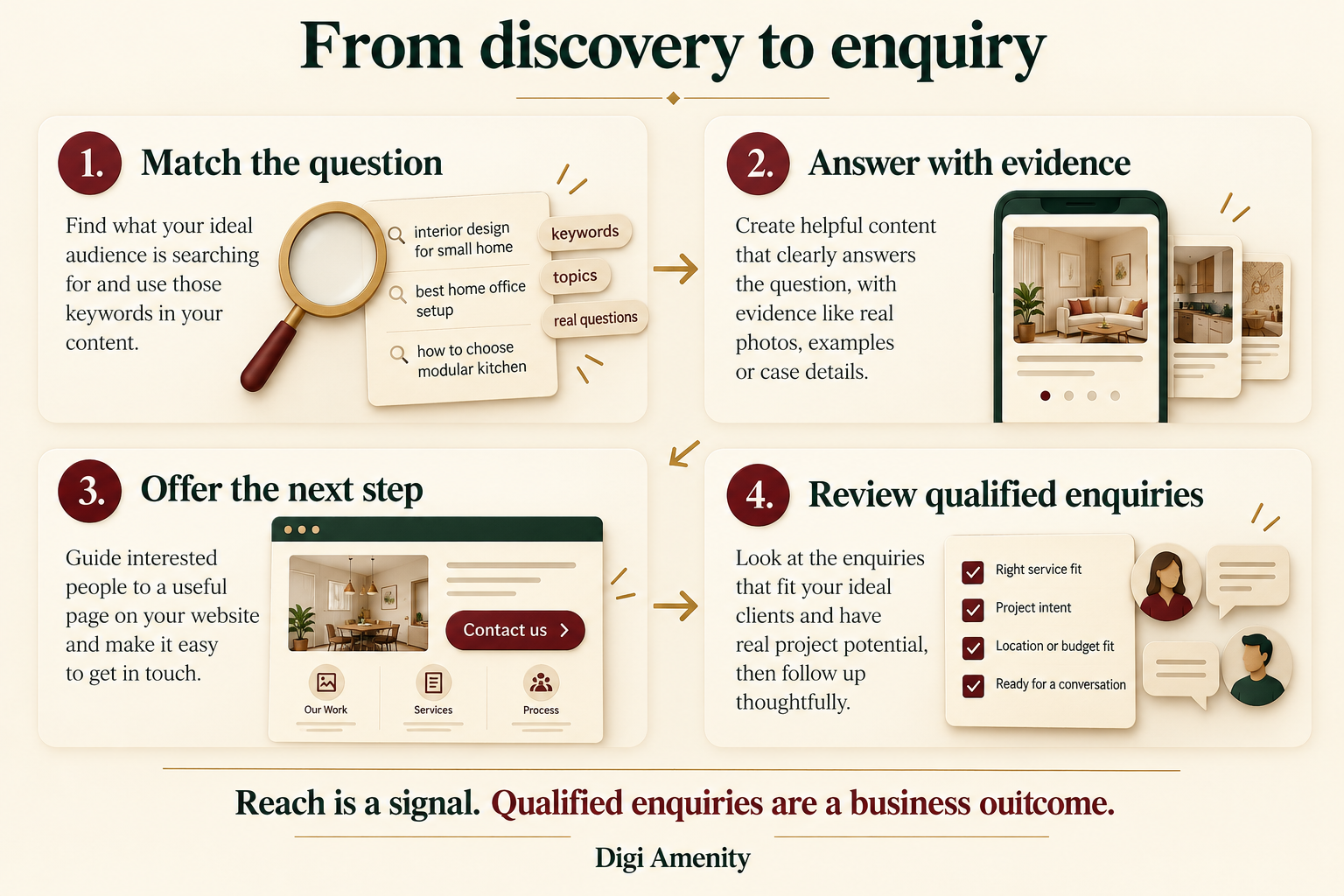
How do you connect discovery to a qualified enquiry?
Give each piece of content a next step that matches the question. Someone comparing product-image styles may need a portfolio example before they are ready to request a quote. Someone looking for shoot preparation may benefit from a checklist.
Use the account's supported link or contact route. Test the destination on a phone: does it load, match the promise, explain the offer and allow a useful enquiry without unnecessary friction? If the destination needs work, review the website and landing-page experience alongside the content.
Define qualification before reporting leads. For the hypothetical studio, a relevant enquiry might include the product category, approximate SKU count, intended image usage and required timing. A like, profile visit or WhatsApp-button click is not itself a confirmed qualified enquiry.
Assign someone to respond, and record the outcome. Otherwise, improving discovery can simply send more people into an unanswered inbox.
What should your Instagram SEO worksheet contain?
Copy this table into your existing planning document. The rows below are hypothetical planning examples, not tested campaigns.
| Customer question | Content and evidence needed | Next step | Review signal |
|---|---|---|---|
| How do I prepare products for a shoot? | Carousel showing a sample packing and shot-list checklist | Read preparation page | Relevant brief enquiries; useful customer questions |
| Why do glass bottles show reflections? | Reel demonstrating one lighting change, with honest conditions | View comparable portfolio work | Content response and relevant profile activity |
| Lifestyle or white-background images? | Side-by-side comparison explaining use cases | Review service scope | Visits to the relevant destination and qualified requests |
| Can you shoot our products in Mumbai? | Accurate location, logistics and service explanation | Submit SKU count and timing | Enquiries that match service area and capacity |
For each row, add an owner, target phrase, publication date, asset version, source or permission check, destination, reporting window and next action. Keep the evidence behind claims accessible to the reviewer.
A compact pre-publication checklist:
- The opening answers one identifiable customer question.
- Profile details, location and offer match the website.
- Caption language is natural; hashtags are relevant.
- Images have useful descriptions and video text is readable.
- Demonstrations, customer permissions and factual claims are checked.
- Visibility and Account Status have been reviewed where relevant.
- The mobile destination and enquiry route work.
- A response owner and measurement window are assigned.
How do you measure Instagram SEO without inventing search data?
Use the metrics your account actually provides. Instagram's Insights access guide currently describes access for public personal and professional accounts, with different dashboard routes. Avoid older blanket advice that only professional accounts can see any insights. Available fields, history and breakdowns still need checking in the account.
The current official metric definitions distinguish Views (plays or displays), Viewers (unique accounts exposed on screen) and Accounts engaged (unique accounts that interacted). For Reels, appearing on screen can count towards Viewers even without playback; Views can include repeats. Some metrics are estimated or rolling out.
Record the displayed metric name and definition. Do not quietly replace a retired metric with a new one and treat the series as directly comparable.
| Measurement | What it can help you assess | What it does not establish |
|---|---|---|
| Views and the account's unique-audience metric | Exposure and audience size, using the displayed definitions | That every view came from Search |
| Non-follower audience, where available | Discovery beyond current followers | The exact search query or a search ranking |
| Saves, shares and relevant comments | Whether people found the content useful enough to act | Qualified demand or revenue by themselves |
| Profile activity and external link activity | Movement towards further information | A completed enquiry or a unique buyer |
| Tagged website sessions and verified enquiries | The next stage of the journey | A complete account of cross-device, DM or later-return behaviour |
Use consistent campaign tags on external links to your website. For example, a hypothetical profile link could include utm_source=instagram, utm_medium=social, utm_campaign=product_photo_education and utm_content=profile_link. Follow your existing naming convention rather than introducing a second one.
Google's campaign URL guidance explains how these parameters identify referred campaign traffic. They do not tell you which Instagram query originally exposed someone to a post. A shared profile link also cannot reliably attribute its visitors to one specific Reel.
For a website enquiry-rate calculation, use sessions with a verified enquiry ÷ tagged sessions × 100, with the same cohort and period. Hypothetically, 6 sessions with a verified enquiry out of 120 tagged sessions equals 5%. That is arithmetic, not an expected result. If qualification happens later in a CRM, report that separately with a defined matching method and deduplication.
Compare equal-length complete periods and posts at similar ages. Separate boosted content from organic reporting where possible, and note offers, format changes and seasonal events. A before-and-after change is useful evidence to investigate, not automatically proof that a keyword caused the result.
What can you implement in the first 30 days?
Days 1–7: establish the baseline. Save profile details, inspect visibility and Account Status, collect buyer questions, and check the main mobile destination. Record current metrics and which fields are unavailable. Select a manageable group of questions and assign an owner.
Days 8–14: improve clarity. Update vague profile language, prepare several useful answers and check accessibility. Fix misleading or expired information in the content you control. Agree on the definition of a qualified enquiry before counting results.
Days 15–21: publish and observe. Use a cadence the team can sustain. Keep a log of what changed, answer relevant questions and record enquiry outcomes. Avoid changing the profile, offer, creative style and destination simultaneously if you want to understand which change may matter.
Days 22–30: review and choose the next action. Continue useful topics, improve unclear explanations, investigate destination friction and stop content that repeatedly attracts an irrelevant audience. Low-volume accounts may need longer observation; 30 days is a working cycle, not a promised time to rank.
Which Instagram SEO best practices prevent common mistakes?
The most common operational mistake is optimising isolated fields while ignoring the offer and follow-up. Other mistakes include copying competitor keyword lists without checking intent, adding irrelevant city names, treating bought engagement as demand, and publishing attractive images with no useful explanation.
Do not diagnose every reach decline as a “shadowban.” Instagram's official ranking explanation points to Account Status for eligibility information. Check the actual notices and appeal options before drawing a conclusion. Eligibility alone does not guarantee distribution.
Keep older discoverable content accurate. Prices, service availability and delivery conditions can become misleading after a campaign ends. Assign a review date to posts with time-sensitive claims instead of assuming their useful life ends after publication day.
Frequently asked questions
1. Is Instagram SEO the same as hashtags?
No. Hashtags are one way to describe a topic. Profile clarity, useful captions, relevant content, eligibility and the next step for a potential customer all need attention. A large hashtag list cannot repair an irrelevant post.
2. Where should I put Instagram SEO keywords?
Use them naturally where they explain the business or post: the display name, bio and caption are practical starting points. Keep a recognisable handle. Describe images accurately in alt text rather than inserting a separate keyword list.
3. How many hashtags should a business use?
Use a relevant selection within the limit currently shown by Instagram. There is no universal count that guarantees results. Check the current publishing interface before reusing an old template, and remove tags that do not describe the content.
4. Does switching to a professional account improve rankings?
Do not treat the switch as an automatic ranking boost. Choose an account type for appropriate business tools and visibility needs. External content-indexing eligibility is a separate consideration, and current official guidance allows some Insights access on public personal accounts too.
5. Does alt text improve Instagram SEO?
Its clear, documented purpose is accessibility. Write an accurate image description and review automatic descriptions. This guide does not claim a verified ranking increase from alt text or recommend filling it with promotional terms.
6. How long does Instagram SEO take to work?
There is no reliable universal timeline. Use the first month to improve the profile, publish useful answers and establish comparable measurement. Audience size, content quality, demand and the business journey affect what you can learn; small samples may require more time.
7. Can I see the exact keywords that brought Instagram visitors?
Do not assume your dashboard provides a complete organic keyword-to-visit report. Use only fields actually available, labelled manual search observations and website attribution. Non-follower reach and tagged sessions are not substitutes for exact Instagram query data.
8. Can a local business do Instagram SEO without posting daily?
Yes. Build a sustainable process around the questions buyers need answered. A useful comparison or preparation guide can be more valuable to the business than daily filler. Review actual enquiries and response capacity before increasing output.
What should you do next?
Choose one important buyer question, improve the relevant profile or post language, and check the entire route to an enquiry on a phone. Record what you changed so the next review has something concrete to assess.
If your Instagram content attracts attention but few relevant enquiries, Digi Amenity can review the audience questions, profile, creative, landing-page journey and follow-up together. Explore our social media marketing services to discuss the part of that journey that needs attention.