

To use Muse for Small Business for Meta ads, give it the decision you need to make: which customers you want, what action counts as success, how much you can spend and when you will review the result. In an eligible account, connect the relevant business assets and ask Muse for a campaign draft you can inspect. “Help me book six showroom consultations within my budget” gives it a much better starting point than “improve my ads.”
Can you use it in India? As checked on 16 November 2026, Meta’s Business Help Centre limits Muse to people aged 18 or older in the United States and Canada. If you run your campaigns from India, you can use the brief, calculations and Ads Manager steps below yourself. You do not need Muse to run the test. Meta’s eligibility guidance.
What can Muse actually do for an advertiser?
Meta introduced Muse for Small Business on 29 September 2026. It can connect to a Facebook Page, Instagram professional account analytics and a Meta ad account. Meta gives reviewing previous ads and drafting a campaign for the following week as one example. Its product page describes an activity history and approval before actions such as publishing, sending or spending. Treat the campaign draft as a proposal you can question. Meta’s launch announcement and Muse’s business product guide.
A connected ad account can tell you which advert generated a form submission. If the sales team later discovers the customer lives outside your delivery area, that fact may exist only in a sales register. Give Muse aggregate outcomes for the same period or ask it to mark lead quality as unknown. Otherwise it can produce a persuasive recommendation based entirely on cheap forms.
How do you turn a business goal into a Meta Ads objective?
Write one sentence that includes a customer, a completed action, a deadline and a limit. Then decide what you can reliably measure. The business goal belongs in your brief. The campaign objective is a separate choice in Ads Manager that guides delivery. Meta lists Leads, Sales, Traffic, Engagement, Awareness and App promotion as distinct objectives. Meta’s campaign objective reference.
- “Book showroom appointments.” Start with Leads if the next action is submitting an enquiry. Define qualification with sales, then count booked and attended consultations separately. Someone can complete a form without ever agreeing to visit.
- “Sell chairs online.” Consider Sales with a website purchase event if checkout and purchase tracking work. Reconcile purchases with your order system after cancellations and returns. A low cost per add-to-cart tells you little about delivered margin.
- “Find distributors.” A trade enquiry might require a serviceable territory and the ability to place a minimum order. Put those conditions in the offer and form. Evaluate qualified distributor conversations; a campaign attracting retail shoppers could otherwise appear successful.
What should you prepare before asking Muse for a plan?
For an eligible user, start from Muse’s business product page, sign in and select the business connections needed for the task. Confirm the Page, Instagram identity and ad account belong to the intended business. Check account currency and reporting time zone before comparing spend. A historical analysis needs fewer permissions and fewer connected tools than a task that changes an account.
Prepare a short brief: the actual offer, serviceable locations, a verified product fact, the customer’s main objection, your campaign budget and the person responsible for follow-up. Add a small performance table with dates, spend, leads and qualified leads for each advert. Use totals rather than a customer list for this exercise. When a field is missing, label it unknown. A blank sale count means something quite different from zero sales.
What is a useful Muse prompt for a Meta Ads campaign?
The following is a hypothetical brief for a Mumbai furniture showroom. It can be used as a manual planning exercise in India or adapted by an eligible Muse user for their own market. The rupee figures are illustrative.
Prepare a draft Meta Ads plan for a showroom that sells made-to-order desks. We want ten qualified enquiries in 14 days with a total test budget of ₹12,000. A qualified enquiry is a unique customer in our installation area who wants a made-to-order desk and agrees to a design consultation. Count bookings separately.
Compare two creative ideas: a demonstration of the desk fitting a small room and a walkthrough of our measuring service. Keep the offer, area, form and follow-up process consistent. Return a suggested campaign objective, a shot list and copy for each ad, form questions, a measurement sheet and reasons the test might mislead us. Flag missing inputs and unsupported claims. Prepare drafts only. Ask before publishing, sending messages or spending.
A useful response should tell the owner what to film. For the fit demonstration, show a chair pulled out with the desk fully open and put the verified dimensions on screen. For the measuring service, show what the installer measures and who is eligible for a visit. If the draft promises free installation or guaranteed delivery, check the terms before approving the copy. Neither promise follows from the brief.
How do you review the plan in Ads Manager?
- At campaign level, check the objective. For the showroom brief, select Leads. Write the qualified-lead definition in the test record so the sales team evaluates both ads consistently.
- At ad-set level, choose where the enquiry happens. Use an instant form if your staff can retrieve and respond to submissions, or a website form if customers need to see installation details first. Check the performance goal and available events for that destination. Record what delivery will optimise for. If that signal is a form submission, continue measuring qualification separately.
- Confirm the budget and schedule. Check whether budget is set at campaign or ad-set level, whether it is daily or lifetime, and which dates and currency the account uses. A ₹12,000 total test entered as ₹12,000 per day is a materially different commitment.
- At ad level, follow the customer journey on a phone. Read the first line, watch the demonstration without sound, open the form and inspect the confirmation screen. For a website form, make a labelled test submission and confirm a staff member receives it. Exclude the test from results.
- Review approval scope. Check the exact creative, identity, offer, destination, amount and dates. If Muse suggests expanding the audience or adding spend after launch, evaluate the proposed change against the original brief. Record it so that later comparisons have context.
How would you know which ad deserves more budget?
Hypothetical results, not a live Muse test. Ad A spends ₹6,000, generates 30 enquiries and produces six qualified leads. Ad B spends ₹6,000, generates 20 enquiries and produces ten qualified leads. The cost per form is ₹200 for A and ₹300 for B. On that measure alone, A looks cheaper.
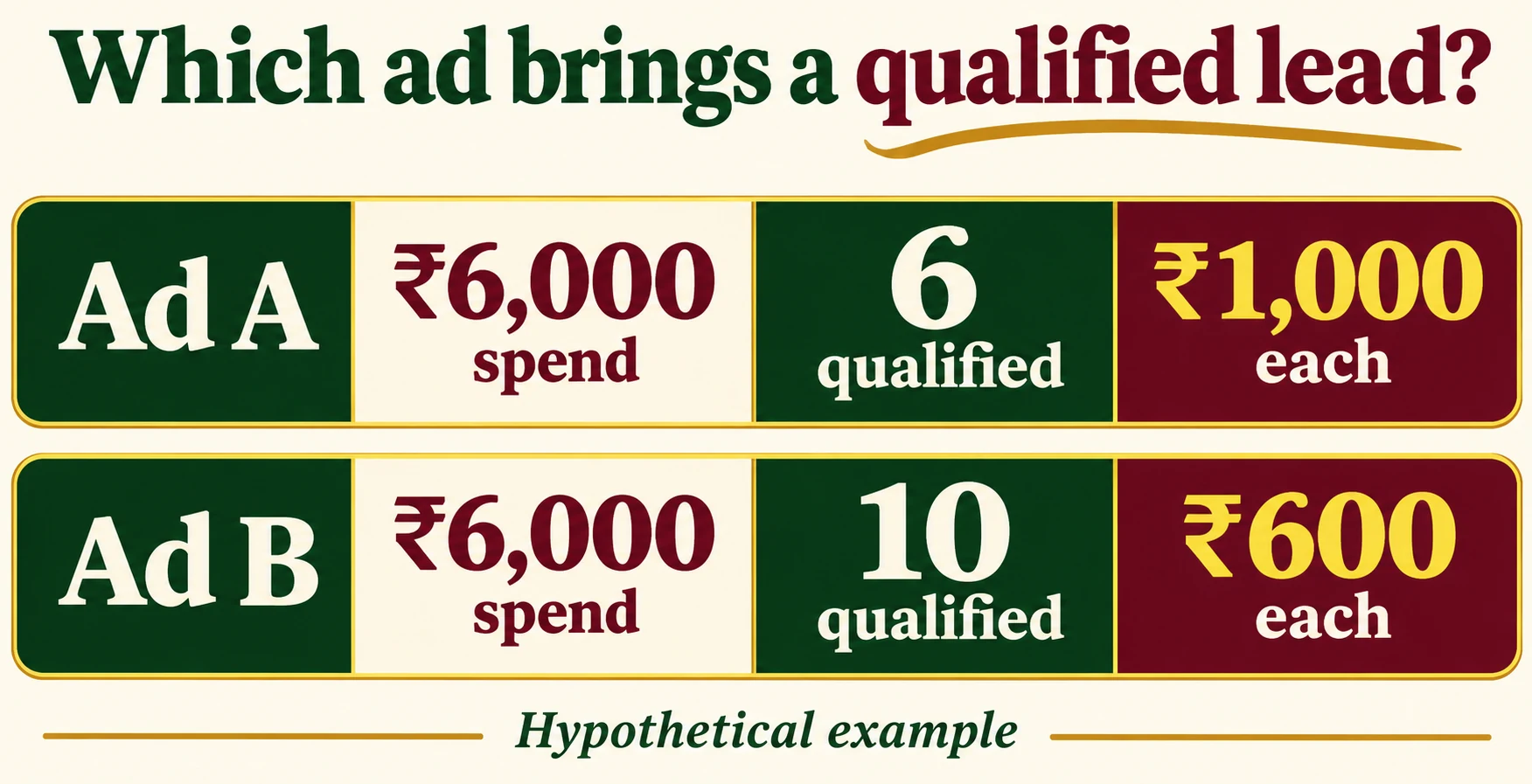
Ad B costs ₹600 per qualified lead; A costs ₹1,000. Together they generate 16 qualified enquiries for ₹12,000, or ₹750 each. The example meets the volume target. Whether it meets the business goal depends on subsequent consultations, orders and margin. If zero leads qualify, report the spend and zero qualified leads and leave cost per qualified lead undefined.
Before shifting budget, give both groups the same follow-up time and check for duplicates. Were leads from B called the same day while leads from A waited until Monday? Did one advert run during a promotion? If the comparison holds after those checks, give B a further capped test and track attended consultations. The difference between six and ten qualified leads is worth investigating; it does not establish a permanent winner.
What should a business do if the results disappoint?
People click but few enquire. Open the destination on a phone. Check whether the price, product or service area changes between the ad and the landing page. Fix a broken form or unclear offer before commissioning new creative. A landing-page and form review can isolate that part of the journey.
Forms arrive but few people qualify. Ask sales to assign a reason to each rejected enquiry. Wrong location suggests checking area targeting and serviceability copy. A flood of bargain enquiries suggests showing a substantiated starting price or describing the made-to-order service more plainly.
Qualified buyers enquire but few book. Review callback time, consultation availability and the handover between the form and the showroom. Buying more leads can amplify a staffing problem. If you need help deciding where the next rupee should go, Digi Amenity can review the creative, conversion destination and sales outcomes together through its Meta Ads campaign service.
Frequently asked questions
Where is the Muse business goal option in Ads Manager?
Meta describes this workflow in the Muse product, where eligible users can connect a Meta ad account and give the agent a goal. Open Ads Manager to inspect the campaign objective, destination and delivery settings. A missing Muse button in Ads Manager alone does not diagnose an account problem.
Can an India-based advertiser use Muse by targeting the US?
Meta’s current eligibility notice applies to the person using Muse. Choosing a US audience changes ad delivery geography. It does not establish the advertiser’s eligibility. An India-based team can prepare the same brief and review the campaign directly in Ads Manager.
Can Muse spend money as soon as I connect my ad account?
Meta says publishing, sending and spending require approval. Read the action presented for approval, particularly the account, amount, duration and scope. For an analysis-only exercise, request a written recommendation and keep the live campaign settings as your reference.
What if my business has never run Meta ads?
Provide the offer, audience, service limits and known customer questions. Ask for two hypotheses and a first test. With no performance history, a forecast for cost per lead needs to be labelled as an assumption. Choose a budget you can afford to use for learning.
How much should I pay for a qualified lead?
Work backwards. If a completed order can support ₹4,000 in acquisition cost and one in five qualified leads becomes a completed order, the illustrative ceiling is ₹800 per qualified lead. Use your own mature sales data and allow for selling costs. If you have no reliable close rate, treat the ceiling as provisional.
How do I check whether Muse itself saved time?
Track minutes from the first brief to an approved, usable campaign plan, including fact-checking and revisions. Compare that with a similar plan prepared manually. Keep this workflow measure separate from ad performance, which also depends on the offer, auction, customer journey and follow-up.
