
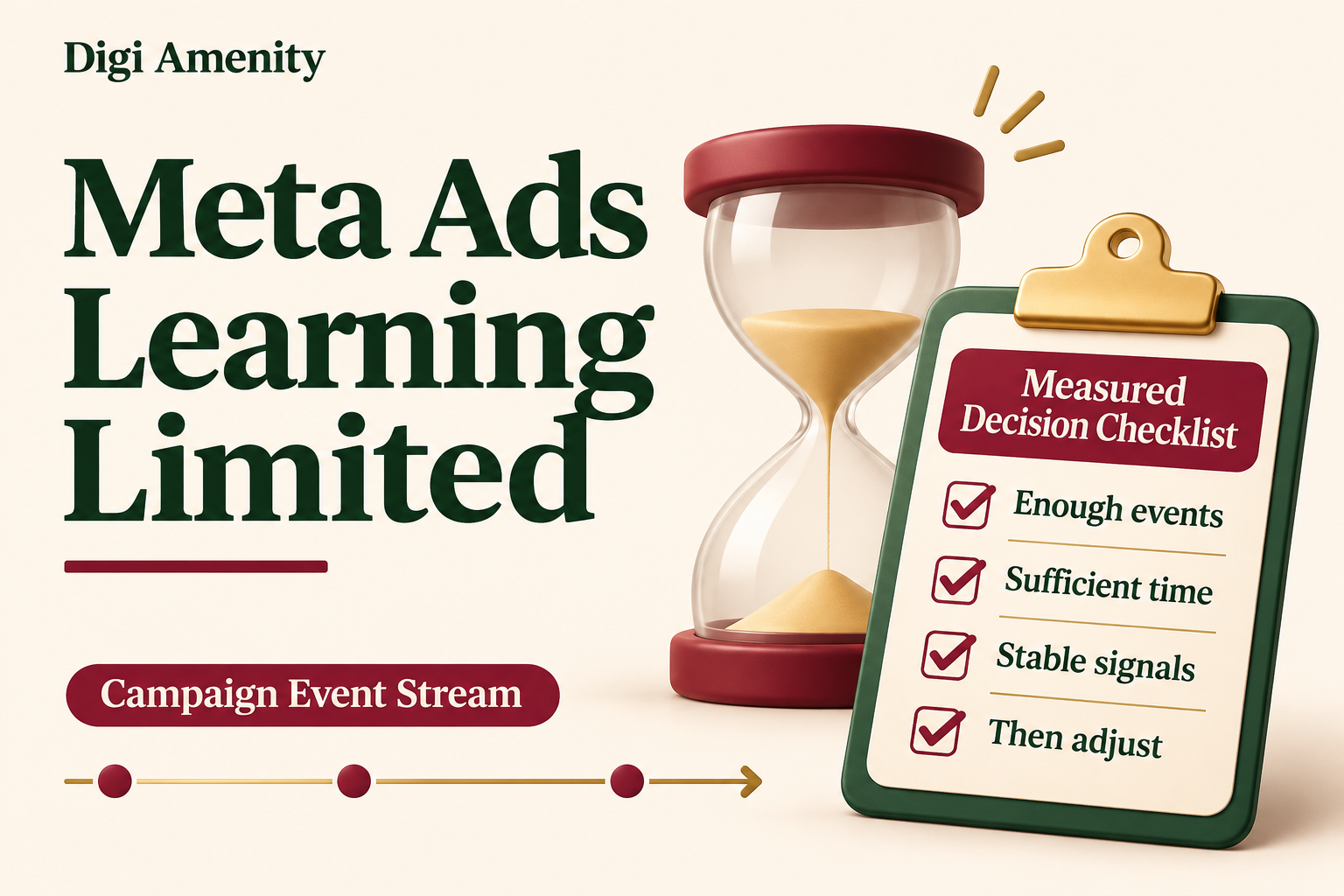
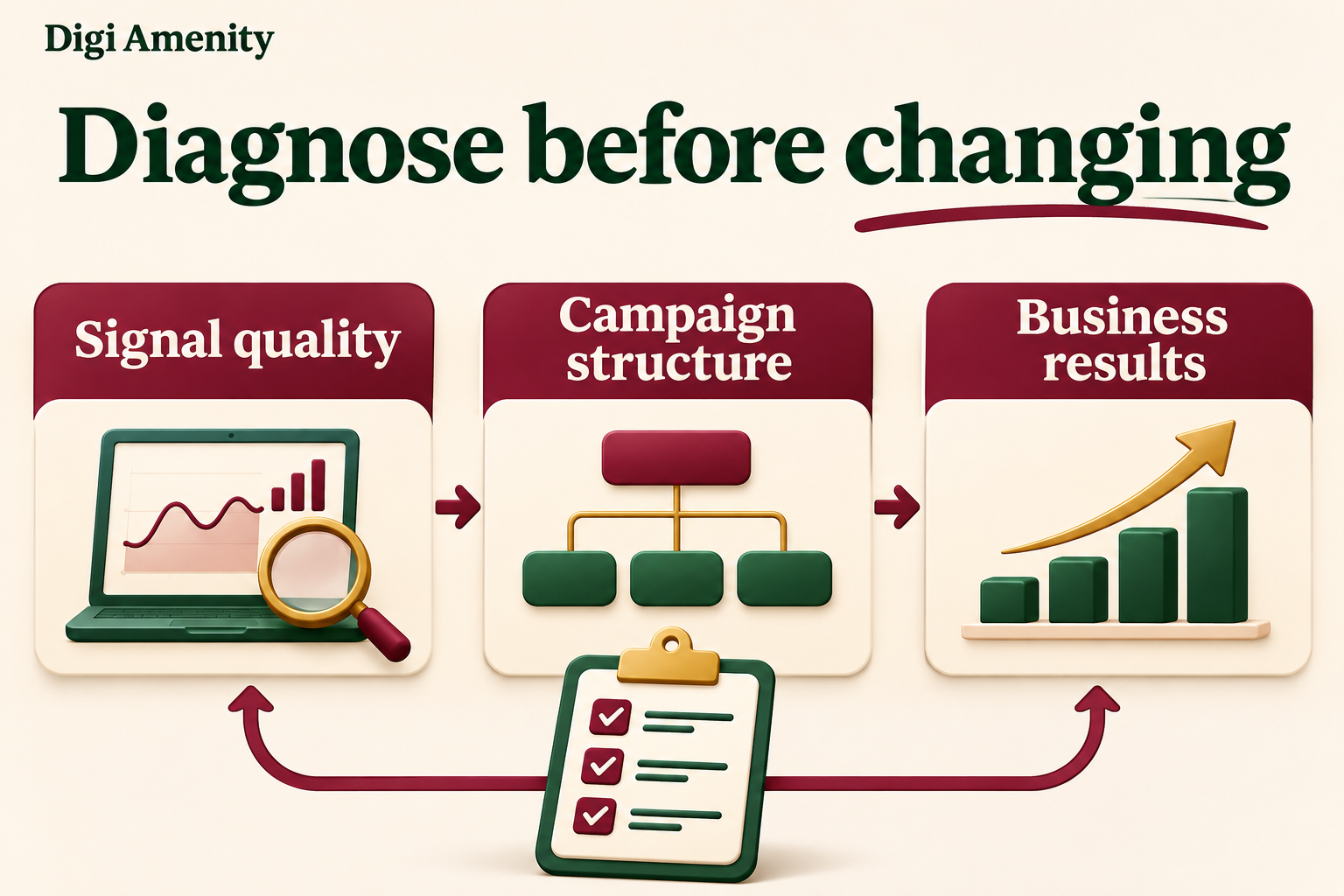
Meta Ads learning limited means an ad set is unlikely to receive enough optimisation events to complete its learning phase with the current setup. It is not an account penalty. Check the event being optimised, signal accuracy, recent significant edits, audience constraints, budget and campaign fragmentation before changing anything. Judge the response by profitable purchases or qualified leads, not just whether the status disappears.
Meta’s current Help Centre describes approximately 50 optimisation events in the week after the last significant edit as its general reference. This is not a promise that 50 events produce profitable advertising, and it is not a universal spending requirement. The guidance also contains a separate Shops-ads exception, so always check the configuration you are actually using.
How is learning limited different from learning or an account restriction?
During learning, Meta’s delivery system explores how to deliver a new or significantly changed ad set. Meta says performance is less stable and CPA is usually higher during that period. Learning limited is a diagnosis that the current setup is unlikely to supply sufficient events. An advertising restriction, payment failure or rejected ad is a different problem requiring its own investigation.
On a phone, swipe the table horizontally to view all columns.
| What you see | What to inspect | What not to assume |
|---|---|---|
| Learning | Recent launch/edit, event flow and time for results | That early CPA is a reliable long-term forecast |
| Learning limited | Optimisation event volume and constraints | That the account is penalised or every result is unprofitable |
| Active | Actual delivery and business outcomes | That an active label guarantees efficiency |
| Restricted, rejected or payment issue | The specific policy, review or billing notice | That increasing budget will solve it |
The definition and available remedies come from Meta’s learning-limited documentation. The business decision about whether a change is worthwhile still requires your own economics and outcome data.
Where should you look in Ads Manager?
Start at the ad-set level. Read the Delivery status and any associated explanation. Add the optimisation-event and last-significant-edit information where available, then use a date range that makes sense relative to the edit. An account-wide purchase total is not a substitute for the relevant ad set’s selected event.
- Identify the campaign objective, conversion location, performance goal and selected event.
- Open the columns controls and add optimisation events, results, spend and cost per result as available.
- Add or inspect the last significant edit information.
- Record the attribution setting and reporting window.
- Check the delivery explanation for bid or cost-control constraints.
- Compare platform results with real orders or qualified enquiries.
Column names and availability can vary by setup and interface. Meta’s learning-phase guidance describes reviewing results and the last significant edit. Use the available account controls rather than copying a screenshot from a different campaign type.
Is the event signal accurate before you try to increase it?
For website campaigns, test that the intended event corresponds to the actual action. A Purchase event should not be generated by a product-page visit. A Lead event should not simply fire when someone opens an empty form. Confirm event timing and investigate duplicate or missing records.
If browser and server integrations both send the same business event, check their deduplication implementation against the integration’s documentation. Seeing events arrive through two sources does not prove that each purchase is counted exactly once. Equally, differences between backend orders and attributed ad results do not by themselves prove missing tracking; attribution and consent affect what is reported.
For instant forms, inspect whether leads reach the team and whether records retain the information needed for qualification. A working lead export that nobody follows up is not a learning-status problem. For website lead generation, test the form, notification and CRM routing as one process.
Does the budget support the event you selected?
Use arithmetic to understand the constraint, not to dictate spend. Divide the weekly budget allocated to an ad set by a realistic cost per optimisation event. The result is an estimate of event volume if that cost remains stable.
Hypothetical example: an ecommerce brand spends ₹7,000 per week in one ad set and expects purchases to cost ₹700 each. That suggests about 10 purchases, not 50. At the same assumed CPA, 50 purchases would correspond to ₹35,000 weekly spend. This does not mean the brand should spend ₹35,000 or that doing so guarantees 50 purchases.
The important next question is whether those purchases are profitable. If contribution per acquired order is ₹500 before advertising, a ₹700 CPA already needs investigation. Raising spend to improve a delivery label could enlarge the loss.
Conversely, a high-value business may receive relatively few conversions at acceptable acquisition cost. The status is worth monitoring, but an arbitrary volume target should not override margin, cash flow, fulfilment capacity or the business’s appetite for risk.
When does consolidating ad sets make sense?
Consolidation is worth considering when several small ad sets have genuinely similar objectives, offers, geography and economics. Fragmentation can leave each with sparse results. Meta lists combining ad sets and campaigns among its remedies, but consolidation is not a guarantee that CPA remains unchanged.
Hypothetical example: four similar ad sets each spend ₹3,500 weekly and receive about seven leads at ₹500 each. Combining the allocation creates a ₹14,000 budget around one coherent opportunity, but it does not magically prove that the combined ad set will produce 28 leads or exit learning. Audience, auction and delivery behaviour may change.
Keep meaningful business differences visible. Distinct countries, fulfilment restrictions, regulated offers, substantially different margins or separately managed budgets may justify separation. “Put everything into one ad set” is too blunt when those constraints matter.
Also review the number of creative concepts competing for the available spend. The objective is enough useful creative diversity with an interpretable test, not hundreds of superficial variants. The creative-diversification guide explains how to distinguish a new message or concept from a cosmetic edit.
Should you broaden the audience or loosen cost controls?
First identify which restriction is doing useful business work. A local installer cannot fulfil enquiries nationwide simply because a wider audience would create more events. Preserve service boundaries, eligibility requirements and other necessary constraints.
Within those boundaries, unnecessary exclusions or fragmented overlapping segments may reduce opportunity. Test a justified simplification while retaining the same qualified-outcome definition. Record which constraint changed and whether the additional leads or orders remained suitable.
A restrictive bid or cost control can also limit delivery. If the account identifies that constraint, assess whether the target is realistic and affordable. Raising it accepts a different potential cost; it is not a free optimisation. Decide the maximum tolerable acquisition cost before adjusting it.
Should ecommerce brands switch from Purchase to Add to Cart?
Meta lists a more frequent optimisation event as one possible remedy. The trade-off is that you are asking the system to find people likely to complete a different action. More carts can improve event volume while purchases, delivered orders or contribution remain weak.
If you test a higher-frequency event, define the reason, budget ceiling and purchase-quality checks in advance. Compare purchase conversion, customer acquisition cost, order quality and contribution after allowing for the normal delay. Do not declare success only because add-to-cart cost falls or learning limited disappears.
Before changing the event, inspect product availability, delivery charges, checkout errors, payment options and the offer. A checkout problem can depress purchases regardless of the ad set’s learning status. For cash-on-delivery businesses, reconcile placed orders with delivered and paid orders rather than treating all placed orders as equivalent revenue.
What should lead-generation businesses do differently?
Define a useful lead in operational terms. For a hypothetical B2B service, it might require a real company, a relevant requirement, a serviceable location and contactability. A form submission is an earlier stage; a qualified opportunity is a later one.
More inexpensive submissions can reduce raw CPL while making the sales team’s workload worse. Compare contactable rate, qualification rate, booked appointments and customer acquisition cost using the same lead cohort. Do not compare this week’s fresh leads with last month’s fully matured sales outcomes without recognising the delay.
Where supported by the account and integration, feedback from CRM outcomes can help align optimisation with meaningful stages. Validate the event definition and data quality first. Use the Meta lead-quality guide for the connection between advertising, forms and follow-up.
Which edits should you avoid making repeatedly?
Meta advises avoiding unnecessary significant edits that restart learning, while also recognising that testing new creative and strategies is necessary. Do not interpret that as a rule to leave a broken destination or harmful error untouched.
Record a hypothesis, make the necessary change and allow a suitable observation period. There is no universal “safe percentage” that this guide can promise for every budget edit. The effect depends on the change and setup; inspect the current account guidance and change history.
A planned review should distinguish corrections from experiments. Repairing a broken event is a correction. Testing a different offer is an experiment. Combining both and several targeting edits makes the cause of any improvement harder to understand.
Use this decision checklist
- Is this learning limited, or a separate rejection, restriction or billing problem?
- What exact event is the ad set optimising for?
- Does that event accurately represent the intended action?
- How many relevant events occurred since the last significant edit?
- What does weekly budget divided by observed cost per event suggest?
- Are similar ad sets unnecessarily fragmenting the available opportunity?
- Which audience or cost constraints are necessary, and which are testable?
- Will a proposed event change still be judged on purchases or qualified leads?
- What is the spending ceiling and when will outcomes be mature enough to review?
- Will the final decision be keep, revise, stop or inconclusive?
For creative-level reporting, use the creative-performance analysis guide rather than selecting winners on engagement alone. If learning limited is accompanied by weak sales or unsuitable enquiries, Digi Amenity’s Meta Ads services can review event quality, campaign structure, creative and follow-up before recommending a budget change.
Frequently asked questions
Is learning limited a penalty?
No. Meta describes it as a signal that the current setup is not providing enough optimisation events for effective delivery learning. It is separate from an account restriction or ad rejection. Check those notices independently if they are present.
Do I always need exactly 50 conversions?
Meta’s general guidance says about 50 optimisation events in the week after a significant edit. “About” matters, and the event is the one relevant to the ad set. Shops ads have separate guidance. The count is not a universal profitability or spending threshold.
Can I leave a profitable ad set in learning limited?
It can be reasonable to monitor it rather than force an uneconomic change. Confirm that profitability uses reliable outcomes and a mature period. Keep investigating avoidable constraints, but do not increase spend solely to remove the label.
Will increasing the budget fix it?
It may help if insufficient budget is the real constraint and demand, event quality and economics support more spend. It will not repair an incorrect event or a broken checkout. Estimate the trade-off and set a spending limit first.
Will changing to Add to Cart improve sales?
Not necessarily. It changes the action being optimised, so additional carts may not become purchases. Treat it as a controlled test and judge downstream purchases, delivered orders and contribution rather than cart volume alone.
Should I duplicate an ad set to escape learning limited?
Duplication does not resolve the underlying reason for sparse or poor-quality events. It may create another setup needing learning and split your budget further. Diagnose the constraint before creating additional ad sets.
How long should I wait after a change?
Use the selected event, conversion delay, amount of relevant data and the last significant edit to plan the review. Check faults immediately, but avoid drawing a commercial conclusion from a very short unstable period. Record an inconclusive result when evidence remains insufficient.