
Google Ads cost in India depends on the auctions you enter, the number of qualified visitors you need and how reliably those visitors become customers. There is no single useful national price per click. Start with the contribution you earn from a customer, calculate an affordable cost per lead, then use a location-specific forecast to decide whether a controlled test is viable. Keep media spend separate from management, landing-page, tracking and creative costs.
This guide explains the calculation for an Indian service business, with an ecommerce adaptation. All numerical scenarios are hypothetical planning examples, not Digi Amenity client results, market averages or quotations.
What are you actually paying for?
A Google Ads budget and an agency invoice are different costs. Media spend buys advertising delivery. Management pays for research, campaign work, optimisation and reporting. A landing page or tracking repair may be a separate project. A proposal that bundles everything into one number should still show the breakdown.
On a phone, swipe the table horizontally to view all columns.
| Cost line | What to establish before launch | How to budget |
|---|---|---|
| Advertising spend | Campaigns, locations and approved spending limits | Separate monthly allowance paid to the platform |
| Management | Scope, review cadence, fee basis and minimum fee | Fixed, percentage or agreed hybrid fee |
| Setup and measurement | Account build, conversion tests and CRM requirements | One-time work plus maintenance if required |
| Website and creative | Landing pages, forms, imagery and revisions | Named deliverables and approval limits |
| Other costs | Software, payment charges and applicable taxes | Confirm invoice treatment; avoid double counting |
Ask who owns the account, whether you retain access, and how media charges reconcile with Google billing. If the agency fee changes with spend, compare the fee at your expected budget and at a higher scenario. A small initial quote can become a different commercial arrangement when spend increases.
Why can two Indian businesses pay different amounts per click?
The query, competition, location, timing, ad relevance, landing experience and bidding settings all affect the opportunities available to a campaign. A broad research query and a specific urgent service enquiry are not equivalent traffic. Neither are brand searches and searches from people who have never heard of you.
A lower CPC is useful only when the resulting customers remain valuable. A campaign buying cheap research clicks can cost more per qualified enquiry than one paying more for clear purchase intent. Comparing Search clicks with video views or display interactions is especially misleading because the advertising formats serve different purposes.
For a Mumbai business, define the area you can actually serve. Do not pay for all of India when fulfilment is local, but do not exclude out-of-city decision-makers if they legitimately buy your service. Geography is a business requirement, not an automatic cost-reduction trick.
How do you calculate break-even cost per lead?
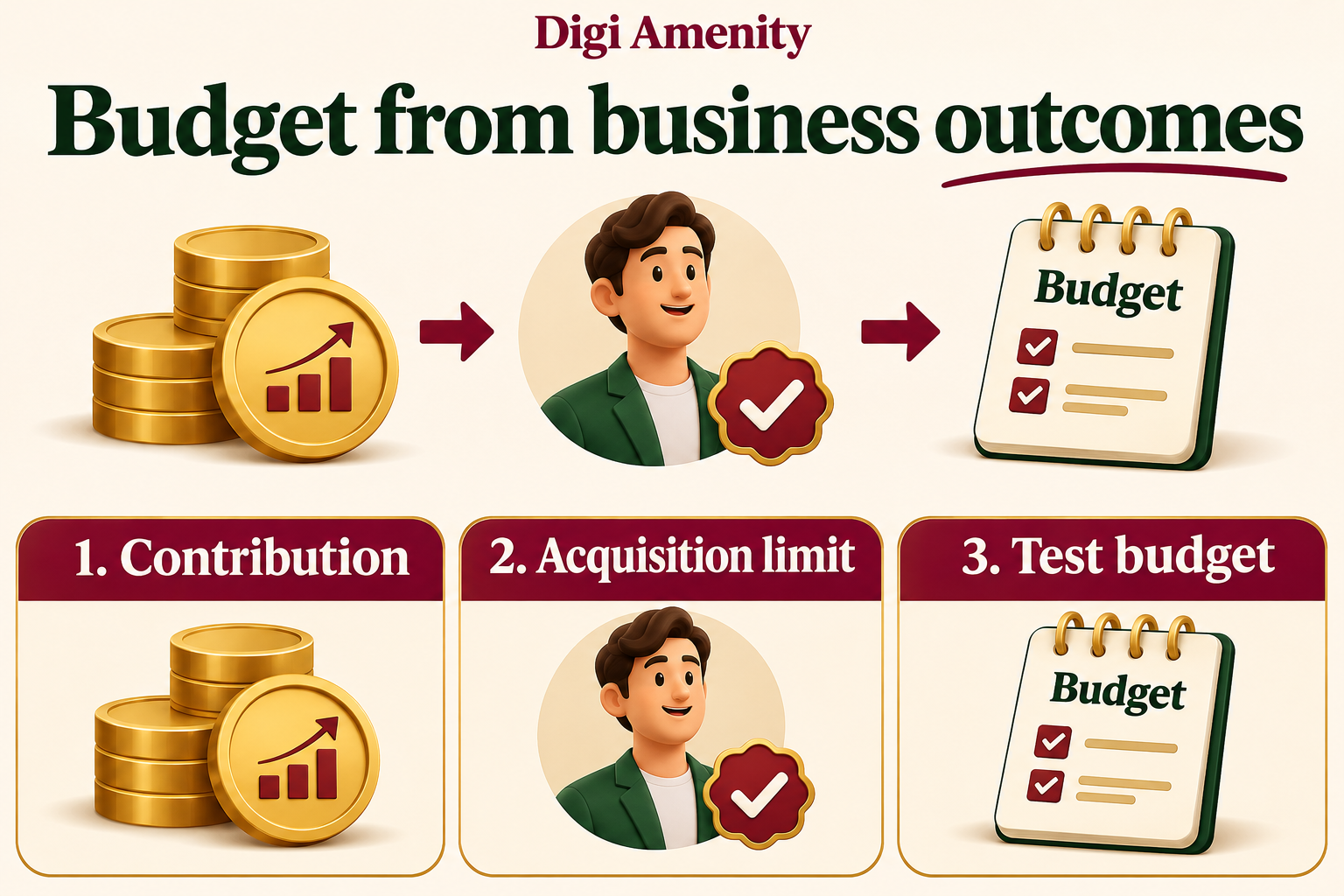
Use contribution, not sales revenue. Contribution is the amount left after the variable costs of fulfilling a customer: materials, delivery, payment charges and other directly attributable costs. Define the period you are using. First-order contribution is more conservative than assumed lifetime value when repeat-purchase evidence is weak.
Media-only break-even CPL = contribution per customer × lead-to-customer rate − non-media acquisition cost per lead.
This is a planning model. It assumes the same lead definition, a mature sales cohort and a reasonable allocation of costs. It is not the business’s total accounting break-even point unless all relevant overheads are included. To retain a profit allowance, subtract that allowance per customer before multiplying by the close rate.
Hypothetical service example: a completed job leaves ₹12,000 contribution. Out of 100 genuine enquiries, 10 become paying customers: a 10% close rate. Non-media acquisition work allocated to those enquiries costs ₹200 per lead. The media-only break-even CPL is ₹12,000 × 10% − ₹200 = ₹1,000.
If the business wants to retain ₹4,000 per acquired customer before other fixed overheads, its target media CPL becomes (₹12,000 − ₹4,000) × 10% − ₹200 = ₹600. Paying ₹900 might remain below the modelled break-even ceiling, but it would miss that target.
Do not calculate with a qualified-lead close rate and then compare the answer with raw-form CPL. If half the submissions qualify, the denominators differ substantially. Our guide to Google Ads lead quality explains why this distinction matters.
How can you estimate traffic costs before spending?
Build a small keyword plan around the services or products you intend to advertise. In Keyword Planner, set the intended geography, language, network and forecast period. Separate brand from non-brand terms and remove research themes that do not fit the offer. Compare the forecast at more than one budget instead of assuming spend and leads increase in a straight line.
Google distinguishes historical search statistics from forecasts. Forecasts incorporate settings and factors such as budget and seasonality. A top-of-page bid range is historical bid information; it is not your promised average CPC. See Google’s explanation of Keyword Planner forecasts.
Use your own measured click-to-genuine-enquiry rate if it is reliable. If it is unknown, build conservative, central and optimistic assumptions and label them. Forecasts become more useful when you can explain which input is uncertain.
On a phone, swipe the table horizontally to view all columns.
| Hypothetical scenario | Average CPC | Click-to-enquiry rate | Modelled media CPL | Media for 50 enquiries |
|---|---|---|---|---|
| Conservative | ₹60 | 3% | ₹2,000 | ₹1,00,000 |
| Central | ₹40 | 5% | ₹800 | ₹40,000 |
| Optimistic | ₹30 | 6% | ₹500 | ₹25,000 |
The formula is CPC divided by conversion rate expressed as a decimal. These scenarios are deliberately not industry benchmarks. In the earlier service example, only the optimistic scenario meets the ₹600 target. That is a reason to validate the offer and landing page, not to pretend the central forecast is profitable.
How much should you allocate to the first test?
Choose a test you can afford even if it does not generate an immediate return. Define the question: can one service, in one viable market, produce genuine enquiries below the target cost? Concentrating the test makes the result easier to interpret than splitting a small allowance across many services and campaign types.
Set a maximum authorised spend, a sales-cycle-aware review date and operational stop conditions. A broken form, wrong destination or clearly irrelevant traffic warrants immediate action. A handful of clicks without a lead does not establish a reliable conversion rate. There is no universal number of clicks that guarantees an answer.
Include setup work in cash planning even if you spread its economic cost over several months. If a ₹40,000 media test also requires ₹12,000 management and ₹8,000 setup, the initial cash requirement is ₹60,000 before other applicable charges. That is a hypothetical allocation, not a Digi Amenity package.
If this total is unaffordable, narrow the question or postpone launch until the enquiry path works. Buying a tiny amount of traffic across many unrelated offers may produce activity without enough evidence to improve a decision.
How do daily budgets translate into monthly spend?
For most campaigns, Google documents a daily spending limit of twice the average daily budget and a monthly limit of 30.4 times that budget. Budget changes and campaign start dates affect the calculation; some campaign types have exceptions. Check the budget report rather than treating the average daily amount as a fixed daily bill. Google’s spending-limit documentation explains these rules.
For an unchanged full-month budget of ₹30,400, ₹1,000 is the corresponding average daily budget. Do not assume restricting ads to weekdays automatically reduces the monthly allowance: Google’s current guidance says ad scheduling can still pace towards the full monthly limit. This matters when the business expects spend only on staffed days.
What changes the calculation for ecommerce?
Replace the lead-to-customer step with purchase conversion and order contribution. Account for discounts, shipping subsidies, payment costs, returns and cancellations. Where cash-on-delivery orders are material, distinguish an order placed from an order delivered and paid.
If an order contributes ₹800 before acquisition and other fixed costs, ₹800 is the modelled media acquisition ceiling only when no other acquisition costs or profit allowance remain to be covered. A revenue ROAS target alone will not capture differences between high-margin accessories and low-margin hero products.
Keep customer acquisition and retention analysis separate. Repeat-order value can justify a different ceiling only when observed cohorts, repeat rates and payback timing support it. Do not finance today’s spend with an invented lifetime-value estimate.
Use this budget worksheet before approval
- Define the customer, service area and genuine enquiry or purchase event.
- Record contribution per customer and the period used.
- Record a mature lead-to-customer rate, or mark it unknown.
- Allocate management, creative and sales-handling costs consistently.
- Choose a profit allowance and calculate target media CPL or CPA.
- Save the keyword forecast settings and three conversion scenarios.
- Set the test spending ceiling, owner, stop conditions and review date.
- Report genuine leads, qualified leads, customers and contribution alongside platform conversions.
Before launch, verify the measurement path using the conversion-tracking diagnosis guide. Then use the landing-page audit checklist to check the experience you are paying to send people to.
If you need a defensible budget before committing spend, Digi Amenity can review your search intent, customer economics, conversion tracking and landing-page journey through its Google Ads services, then identify the assumptions a controlled test needs to validate.
Frequently asked questions
Is there one minimum Google Ads budget for India?
No single amount is commercially sensible for every business. The useful minimum depends on forecast traffic cost, the question being tested, conversion frequency and what the business can afford to lose. A platform accepting a small budget does not mean that budget can answer your business question.
Should I choose the agency with the lowest management fee?
Compare scope and accountability first. Check whether tracking tests, search-term reviews, landing-page recommendations and qualified-lead reporting are included. A cheaper fee can become expensive if essential implementation is excluded or nobody checks lead quality.
Is CPC or CPL more important?
CPC helps explain traffic costs. Genuine or qualified CPL is closer to acquisition performance, while customer acquisition cost and contribution show the business outcome. Use them together; optimising CPC alone can encourage irrelevant cheap clicks.
Can I estimate leads by dividing my budget by an online average CPL?
You can create a scenario, but not a credible promise. A published average may use another industry, country, lead definition or attribution window. Prefer a relevant forecast plus your own conversion assumptions, then replace assumptions with measured results.
Does a higher budget automatically improve results?
No. It may buy more opportunities, but it does not fix a broken form, weak offer or poor follow-up. Scaling can also change marginal acquisition cost. Increase spend against a documented hypothesis and monitor qualified outcomes.
Should agency fees be included in acquisition cost?
Yes, when reporting fully loaded acquisition cost. Keep media-only CPL separately labelled so it remains comparable with the platform. Allocate fees and setup costs consistently across the period and campaigns being evaluated.
When should I judge the first test?
After enough relevant observations and time for the normal conversion and sales cycle, subject to the agreed spending ceiling. Check technical failures immediately. If volume is too small for a confident decision, record the result as inconclusive instead of declaring success or failure.