
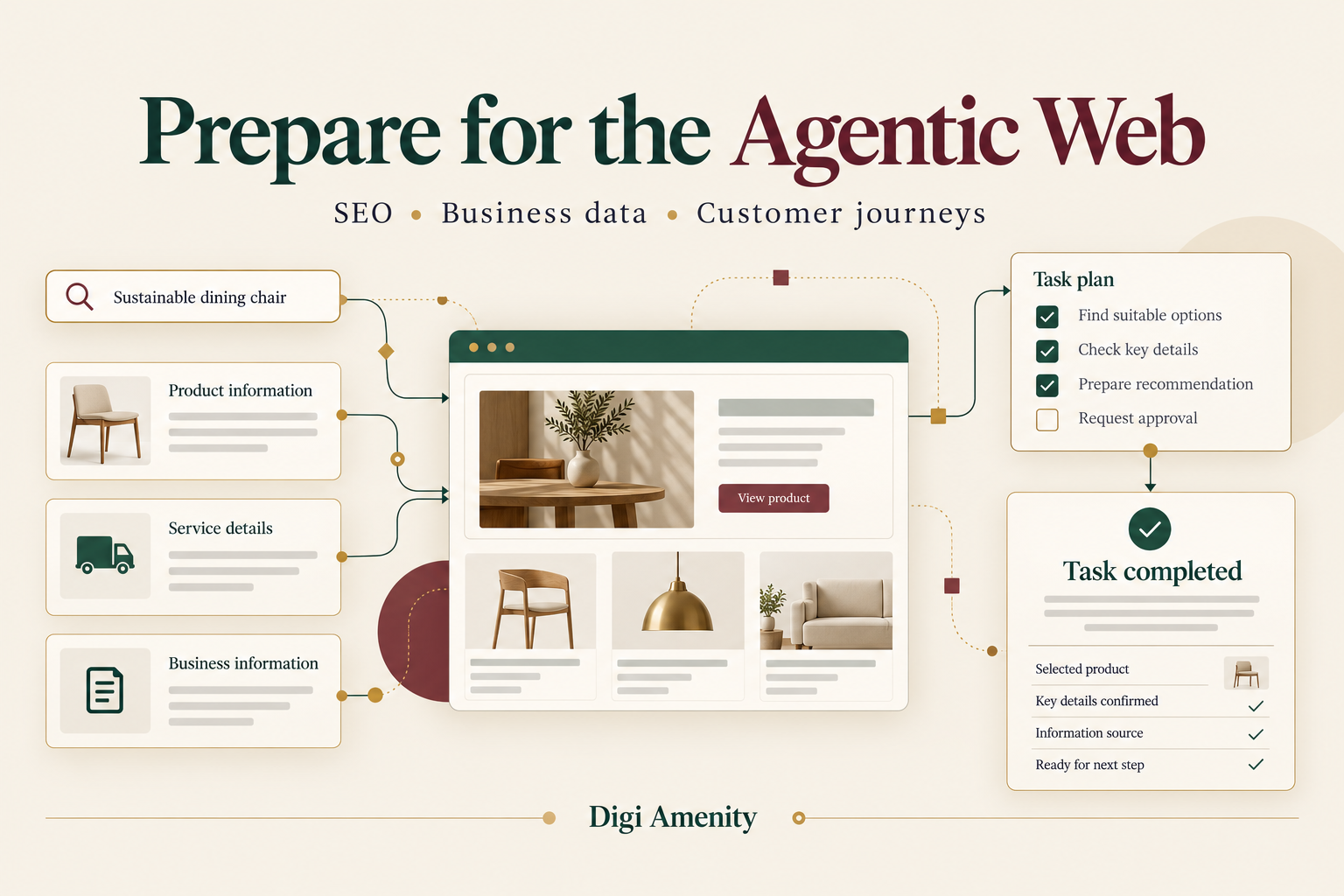
Agentic web SEO means preparing your business to be found, understood and used by AI systems that help people complete tasks. Start with crawlable pages, accurate business information, clear enquiry or purchase journeys, and reliable outcome tracking. Add specialist integrations only when a supported customer journey justifies them. An agent cannot fix an unclear offer, incorrect stock information or an enquiry that nobody follows up.
For an Indian business owner, the useful question is practical: if someone asks an assistant to compare your service, check whether you meet their requirements, and take the next step, can it find trustworthy answers and reach a working destination?
This guide gives you a four-stage readiness framework, separate actions for service businesses and online stores, and a 30-day implementation plan. Platform availability checked on 25 October 2026. Examples are hypothetical; they are not client case studies or executed tool tests.
What is the agentic web, and how is it different from ordinary AI search?
“Agentic web” describes a direction of development, rather than one product or a universal certification. AI systems can combine information gathering with actions: interpreting a request, comparing options, using tools or websites, and helping complete a task within the permissions they have.
An AI answer might explain how to choose a website developer. A more agentic journey could compare developers against a brief, identify missing information, prepare an enquiry and ask the customer to approve sending it. Buying, booking and accessing private accounts introduce additional requirements. Different products support different parts of that journey.
Three activities are often mixed together:
- SEO: helping relevant people discover useful pages through search.
- AI answer visibility: helping systems accurately understand and potentially reference your business and content.
- Agent readiness: making a permitted task dependable, from reading information to receiving a verified business outcome.
You may also encounter the term agentic search optimization for this broader discovery work. There is also “agentic SEO” in the sense of using agents to perform marketing work, such as reviewing crawl exports. That is a separate operating choice. Installing an SEO automation tool does not automatically make your customer journey suitable for agents. Our guide to GEO and SEO explains the visibility terminology; here the focus is the business journey that follows discovery.
Where should agentic web SEO preparation begin?
An AI-ready website helps people and supported agents complete a useful journey. Begin with one commercially important task, not a site-wide technology project. Choose a service enquiry, a product comparison or an order-status request. Document what a successful outcome means, then work through four checks. This is Digi Amenity’s proposed planning framework, not a search-engine ranking formula.
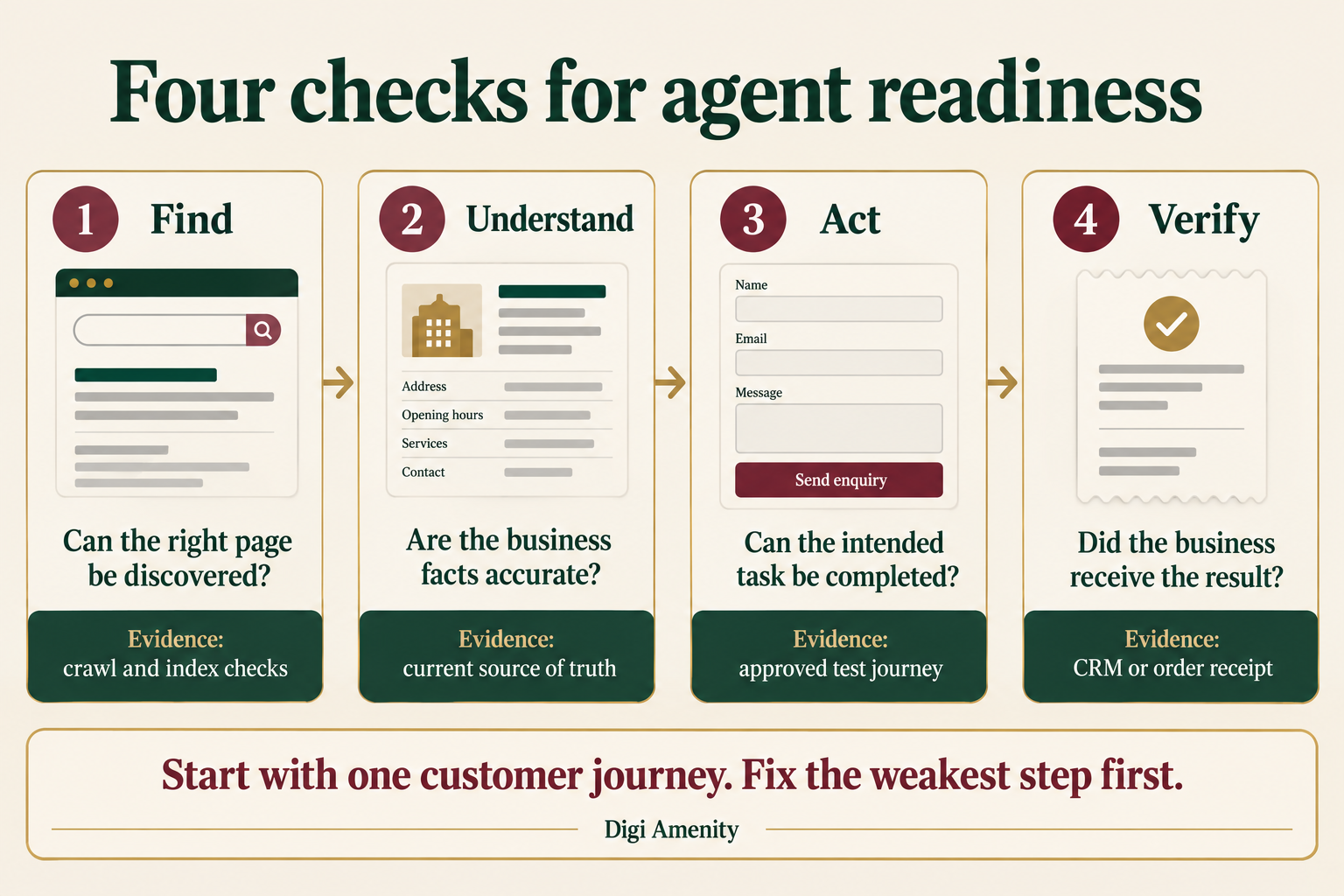
| Check | Business question | Evidence to collect | Typical owner |
|---|---|---|---|
| Find | Can the appropriate page be discovered? | Working URL, internal links, crawl and index checks | SEO and developer |
| Understand | Are your offer and constraints unambiguous? | Approved facts, dated policies, consistent product or service details | Business or catalogue owner |
| Act | Can a permitted next step actually work? | Mobile journey, clear fields, validation and approval tests | Developer and operations |
| Verify | Did the intended result reach the business? | CRM record, booking confirmation or order receipt | Sales, support and analytics |
A page can pass the first two checks and fail the last two. A beautifully written service page with a broken form is still a weak acquisition system. Equally, a technically excellent checkout cannot compensate for inconsistent prices that make the customer’s comparison unreliable.
What technical SEO work still matters?
Google’s guidance says its normal SEO foundations remain relevant to AI Overviews and AI Mode. Supporting pages must be indexed and eligible for a search snippet; no special AI schema or new AI text file is required. Eligibility does not guarantee inclusion. Source: Google Search Central.
For your priority journey, inspect the actual public page rather than relying only on a plugin score. Confirm that the main offer appears as readable text, navigation reaches it, the preferred URL is consistent, and essential content is not hidden behind an unnecessary login. Investigate accidental indexing restrictions, server errors and broken destinations before expanding content.
On WordPress, review the rendered page after any theme, cache or builder change. On an online store, check the selected product variant and its destination, not just the collection page. Keep existing useful URLs unless there is a specific reason to change them; a new folder name containing “AI” is not a readiness strategy.
Should you allow every AI crawler?
Set a deliberate policy by purpose. OpenAI distinguishes OAI-SearchBot for search, GPTBot for potential model-training use, and ChatGPT-User for certain user-initiated visits. Search and training preferences can be controlled independently. A user-agent label alone is not proof of identity; use the provider’s current verification information. Source: OpenAI crawler documentation.
Have the website owner decide the desired access and ask the developer to check both site rules and hosting protections. Do not remove authentication or disable security controls to make an agent visit succeed. Public discovery and access to confidential customer information are different decisions.
How do you make business information reliable enough to compare?
Build a small source-of-truth register for the facts a prospect needs. Give each fact an owner and a review date. The register is an internal operating aid; it does not need to become another public file.
For a service business, record what is included, what is excluded, industries or customers served, actual service areas, delivery approach, pricing method and the information needed for a proposal. If pricing depends on scope, explain the variables. “Contact us” alone does not help a customer understand whether the service is suitable.
For a product business, record variant identifiers, dimensions, materials, compatibility, stock source, price, delivery conditions, returns and warranty. Distinguish a dispatch estimate from an arrival estimate. Explain exceptions where they matter, rather than placing every qualification in a distant policy page.
Then compare the website, relevant business listings, product feeds and enquiry responses. A mismatch is an operational issue, even if no AI system has noticed it. Use structured data appropriate to the real page and keep it consistent with visible information; do not add invented ratings, credentials or availability.
What content earns trust beyond generic summaries?
Publish information a buyer can use to make a decision: a documented process, a scope checklist, a genuine comparison, a troubleshooting explanation or an accurately described case study with permission. Name the author or responsible team where appropriate and distinguish measured evidence from an illustrative scenario.
For Digi Amenity’s mix of SEO, advertising and development services, this means explaining dependencies. Poor lead quality can arise from search intent, the offer, form design or follow-up. Content that explains how those parts are examined is more useful than a claim that one channel solves every problem. Do not fabricate client work to make that explanation sound experienced.
What should a service business change in its enquiry journey?
Make the next step specific. “Request a website review” communicates a different commitment from “Book a paid consultation.” Tell visitors what they are requesting, which information is required, and what happens after submission. Only promise a response time the team can reliably meet.
Use persistent field labels, useful service options, clear required fields and understandable validation errors. Ensure the form works with a mobile keyboard and that an error does not silently erase the whole enquiry. Retain a reasonable human contact route for people who cannot complete the preferred flow.
A successful-looking page is not enough. With authorised test data, check that the server accepts the form, a record arrives in the intended system, the correct team can see it, and the confirmation accurately describes what happened. A WhatsApp click shows intent to open a conversation; it does not prove an enquiry was sent or qualified.
Hypothetical example: a Mumbai B2B supplier offers installation within a defined service area. A customer asks an assistant to find a supplier for a particular site. If the website explains the installation scope, area limits and quotation inputs, the assistant can prepare a more relevant enquiry. If the form only offers unrelated service choices or sales cannot identify the requested location, the journey fails after discovery. Fix those facts and fields before commissioning a custom agent integration.
These are practical website development and conversion improvements as well as preparation for agent-assisted visitors. Preserve the existing tracking setup while changing the interface, and validate the resulting events instead of assuming they still work.
What changes for ecommerce and agentic commerce?
Follow the whole buying sequence: discovery → product → variant → delivery and offer → checkout → payment → fulfilment → support. At each step, identify which system holds the current truth and what happens when the information changes.
A product feed can describe an item accurately at one moment while stock changes before checkout. Recheck stock, price and deliverability at the transaction stage. Make failed payments, unavailable variants and unsupported addresses understandable. A retry must not accidentally create a second order or payment.
Hypothetical example: an Indian homeware store sells a lamp in two finishes. A customer wants one finish delivered to a particular postcode. The useful readiness test is whether the correct variant, stock, total cost and delivery conditions remain consistent through checkout. A generic product description mentioning “fast delivery” does not answer that task. No sales uplift is assumed from this example.
Which agentic shopping features can Indian merchants use?
Separate where the merchant is based from where the customer is located. Also separate product discovery from checkout inside an AI interface. As checked on 25 October 2026:
- Shopify’s ChatGPT channel: eligible stores must sell to US customers, though the business can be based outside the US. It is a discovery/referral route; purchases finish at the store’s checkout through an in-app browser or a new tab. Product eligibility, policies and supplemental terms apply. Shopify’s ChatGPT requirements.
- Shopify’s Google AI Mode and Gemini direct checkout: rollout and eligibility apply. The documented customer markets are the US, Canada and Australia; the store can be based elsewhere. This is not evidence that direct checkout is available for domestic Indian customers. Some products and checkout features are unsupported. Shopify’s Google channel requirements.
An Indian exporter may therefore have a relevant opportunity that an India-only store does not yet have through the same channel. Verify the actual account, products, destination markets, required terms and checkout behaviour before spending on implementation. These channel-specific restrictions do not mean an Indian website is generally excluded from AI search or web discovery.
Do you need MCP, WebMCP or a commerce protocol?
These names describe different connection problems. None is a blanket requirement for ordinary SEO.
- MCP: a standard for connecting AI applications with external data, tools and workflows. It can support a controlled business integration; it is not a search ranking submission. Official MCP introduction.
- WebMCP: a proposed web standard for exposing structured tools through webpages, including JavaScript and annotated forms. Chrome’s documentation, updated 7 October 2026, describes an origin trial from Chrome 149. Treat it as an evolving, optional enhancement, not universal browser support. Chrome’s WebMCP documentation.
- UCP: Google’s Universal Commerce Protocol addresses commerce interactions. Integration does not remove merchant responsibilities such as current inventory and shipping-address validation. Protocol support alone is not proof of market or account eligibility. Google’s UCP FAQ.
Choose an integration only after identifying a supported task, a user benefit, a maintenance owner and a way to verify success. A small service company with a working quotation process may gain more from clearer service details and faster follow-up than from building a tool server. A retailer with a supported commerce channel and reliable catalogue operations may have a stronger integration case.
What permissions and failure handling should be designed first?
Define the difference between reading information, preparing a request and committing an action. For example, an assistant might compare delivery options without approval, but the customer should review the address, chosen item and final amount before a purchase is committed.
Keep business rules in the system that processes the action. A model’s confident sentence is not evidence of an available appointment or accepted payment. Return a clear success or failure response, preserve a transaction or enquiry reference, and make duplicate retries recognisable. Let the user correct information or reach a person when the task cannot finish.
For private integrations, grant only the access required for the chosen task. Keep secrets and customer records out of public pages and testing prompts. Treat instructions found in external content as untrusted input. A product description should not be able to override the customer’s budget or permission to purchase.
Before launch, test at least a valid path, invalid input, unavailable item or slot, interrupted request, duplicate retry and cancellation. Use a staging environment or an explicitly approved test mode. Do not create real customer enquiries or payments merely to demonstrate an agent.
How can you assess readiness without giving an AI tool private data?
Start with a read-only exercise using public pages and a synthetic customer brief. This suggested prompt is a planning aid, not a demonstration we have executed:
Using only these public URLs, compare whether this business can meet the following hypothetical requirement: [requirement]. List each relevant fact with its source URL and date checked. Separate confirmed facts, contradictions and missing information. Do not assume prices, availability, service coverage or qualifications. Identify the next customer step and what remains unclear. Do not submit forms, contact anyone, sign in or make purchases.
Have the business owner check the output against the actual offer. Record omitted facts, incorrect conclusions and broken destinations. Correct the underlying source where appropriate; do not simply rewrite the prompt until it produces praise. If the tool cannot access a page, record that limitation rather than interpreting it as evidence that the business cannot provide the service.
Repeat a small, fixed set of realistic tasks after material changes. Record the product used, date, account context, inputs and outputs. A handful of checks can expose friction, but it cannot establish a universal visibility score or predict how every assistant will behave.
How should you measure progress?
Keep discovery, website behaviour and business outcomes separate. Google reports traffic from its AI search features within Search Console’s Web performance reporting; that aggregate is not a dedicated agent-conversion report. Google’s measurement guidance.
For your business, use four evidence groups:
- Search and referral evidence: indexed priority pages, relevant query/page trends and identifiable AI referral sessions. Missing referrer information remains unknown; do not rename all direct traffic as AI traffic.
- Journey evidence: successful form or checkout tests, validation failures and abandoned steps. Keep synthetic tests identifiable and outside normal sales reporting where possible.
- Commercial evidence: accepted enquiries, qualified opportunities, confirmed orders, cancellations, returns and margin where available. A click or apparent success message is not a qualified lead.
- Operational evidence: accurate records reaching the team, response time, fulfilment exceptions and repeated or failed requests.
Compare equal-length complete periods with the same filters, and annotate changes to campaigns, offers and tracking. Avoid attributing every improvement to agent readiness when several things changed at once.
There is also a channel-specific measurement trap: Shopify states that Google Analytics and custom browser pixels do not fire in its Google AI Mode/Gemini direct checkout. Reconcile supported platform/order records rather than expecting the ordinary website purchase event there. Shopify’s direct-checkout limitations. For the underlying distinction, see our browser-side and server-side tracking guide.
What should your team do over the next 30 days?
Use the following as a practical sequence, not a promise that an integration can always be launched in a month. Assign one accountable owner per item and retain evidence of completion.
| Period | Action | Proof of completion |
|---|---|---|
| Days 1–7 | Choose one revenue-relevant journey. Audit priority URLs, business facts and current lead/order definitions. Record a baseline. | Named owner, source-of-truth register, issue list and approved outcome definition. |
| Days 8–14 | Resolve material contradictions and technical blockers. Clarify scope, delivery, pricing method and next-step language. | Reviewed public pages, consistent supporting data and documented changes. |
| Days 15–21 | Test mobile form/checkout and failure paths. Verify records reach operations. Assess one optional integration against actual eligibility. | Test receipts, corrected errors, approval boundary and a go/no-go decision. |
| Days 22–30 | Repeat the public-page assessment. Reconcile metrics with real enquiries/orders. Set the next review and maintenance owner. | Dated comparison, unresolved issues, next actions and responsible people. |
Prioritise a broken journey or materially wrong price ahead of cosmetic content changes. Then address information gaps that prevent a qualified decision. Experiments with new protocols come after the basic route is reliable and the business has a reason to maintain them.
Need a prioritised starting point? Digi Amenity can review your search visibility, business information, mobile enquiry or checkout journey, and measurement together. Our SEO services can help identify which fixes should come first before you invest in optional agent integrations.
Frequently asked questions
1. Will the agentic web replace SEO?
Do not plan on SEO becoming irrelevant. Discovery still needs accessible, useful information, while agent-assisted journeys add questions about accuracy and task completion. Allocate effort according to observed customer behaviour and outcomes rather than a prediction that every visitor will become an agent.
2. Is agentic web SEO the same as GEO or AEO?
The terms overlap, but their practical focus differs. GEO and AEO commonly discuss visibility in generated answers. Agentic web preparation also examines whether an authorised next step works and reaches the business. Using AI to automate SEO audits is another separate workflow.
3. Do I need an llms.txt file or special AI schema?
Do not make a new file your first priority. Google does not require a special AI file or schema for its AI search features. Other tools may have their own documentation conventions; assess those for a specific use case. A file cannot compensate for inaccurate services, inaccessible pages or broken forms.
4. Can an Indian Shopify store sell through agentic channels?
Check the individual channel and customer market. Current Shopify documentation allows merchants based outside the supported customer countries in the channels described above, subject to other requirements. This does not establish domestic India direct-checkout availability. Confirm the actual store’s eligibility before changing its operating plan.
5. Does a service business need an API or MCP server?
Not automatically. A clear public offer, accessible contact route and dependable intake process may be the appropriate first stage. Consider a specialist integration when a supported recurring task needs structured access and the business can maintain permissions, current data, error handling and outcome records.
6. Can I block AI training while allowing search discovery?
Some providers separate these purposes. OpenAI documents distinct controls for its search crawler and training crawler. Review each provider’s current rules and your hosting configuration; do not assume one directive controls every company or every user-initiated visit. Sensitive information should remain protected by access controls.
7. What is a sensible first success metric?
Choose one verified business outcome, such as an accepted quotation enquiry or a confirmed order, and define it precisely. Pair it with journey evidence so you can diagnose failures. More mentions in sampled AI answers can be interesting, but they are not a substitute for qualified enquiries or profitable sales.
8. What should a business with a small budget do first?
Choose one important service or product journey. Correct its facts, repair its mobile next step, verify the record reaches the right person and assign an owner to keep it current. These improvements have a practical customer benefit even when a new agentic channel is unavailable or contributes little traffic.
