
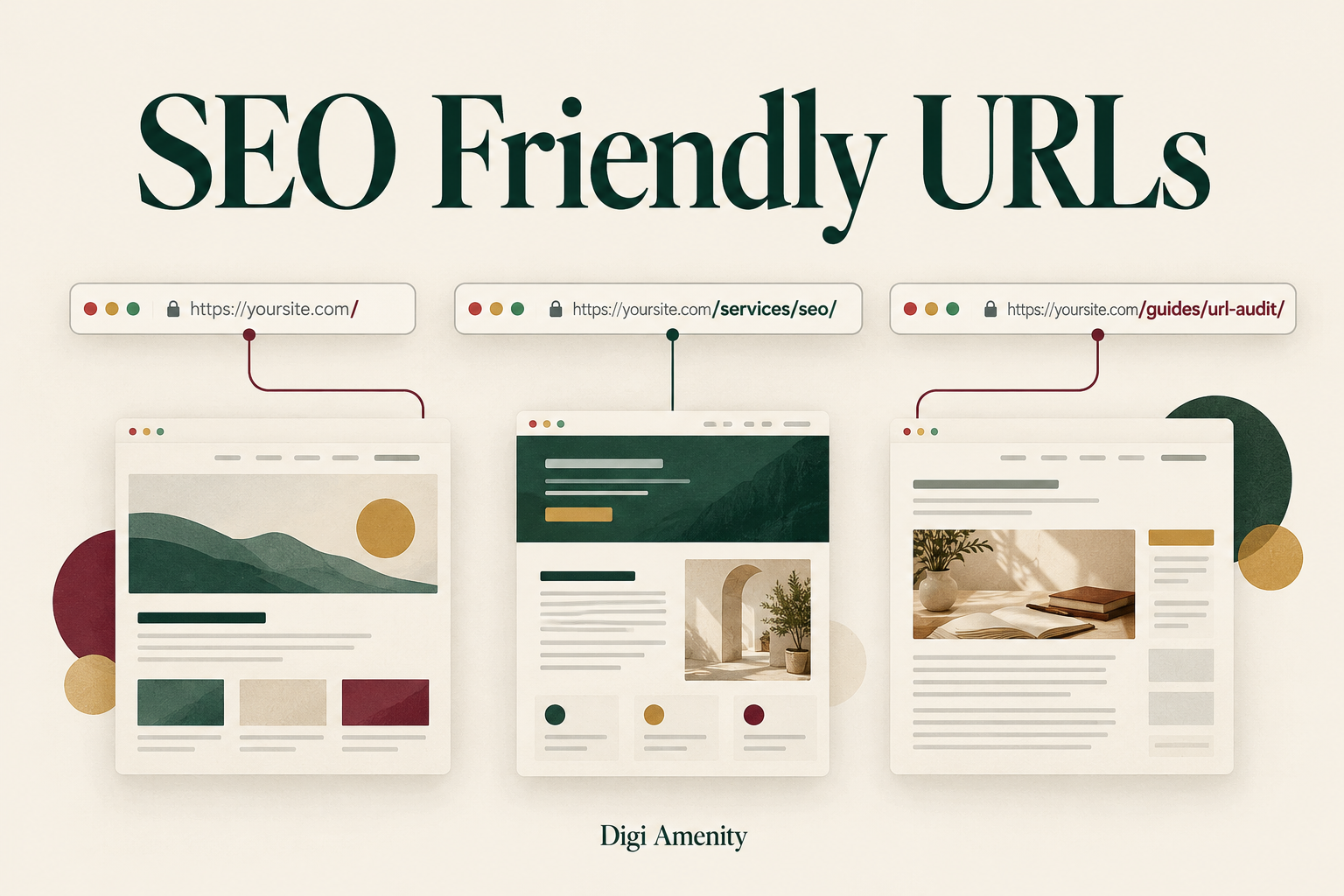
SEO friendly URLs are clear, stable web addresses that describe the destination and work consistently. Choose sensible slugs before publishing new pages. For an existing page that already attracts visitors or enquiries, change its address only when you can name the problem the change solves—and prepare the redirect, link and tracking checks first.
A shorter address is not a substitute for a useful page. The practical question is whether a URL change improves the customer journey enough to justify the work and disruption involved.
What did Google clarify about URLs in October 2026?
On 23 October 2026, Google updated its documentation to clarify word separation using hyphens versus underscores. The update log says the wording was synchronised with its video series. It describes a documentation clarification, not a new ranking-system launch or a deadline to rename existing pages. Checked on 24 October 2026. Source: Google Search documentation updates.
For a business owner, the useful response is to establish a consistent rule for future pages and review genuine URL problems. A mass rewrite of working addresses would be a separate project requiring its own justification.
What is the difference between a URL, a path and a slug?
In the hypothetical address https://example.com/services/website-maintenance/, the full string is the URL, example.com is the domain, and /services/website-maintenance/ is the path. In this example, website-maintenance is the final slug.
This distinction matters when briefing a developer. “Change the slug on one unpublished service page” is a narrow request. “Change the permalink structure” can affect a whole group of addresses. “Move the website to a new domain” is a much larger change.
Write down which of these you intend before approving an SEO URL structure proposal. Otherwise, a small readability task can become an avoidable migration.
How should you create SEO friendly URLs for new pages?
Google recommends readable words, a logical structure, the audience’s language and hyphens to separate words. Its explanation is that hyphens mark word boundaries, while underscores have historically been used to keep concepts together. URLs also need valid encoding; non-ASCII characters require appropriate percent encoding in links. Google generally does not support fragments for changing page content. Source: Google’s URL structure guidance.
Turn that guidance into a short editorial standard:
- Name the page’s actual job. A maintenance-service page needs a recognisable service label, not a list of every keyword your agency wants to rank for.
- Keep enough detail to distinguish the destination. “Maintenance” might be ambiguous on a business that maintains both buildings and websites. Removing the useful word “website” would make the address shorter but less clear.
- Use a consistent lowercase convention for new slugs. Ask the developer to test how existing uppercase variants behave before standardising live addresses.
- Avoid details that will become wrong. A recurring service usually does not need this year’s campaign slogan in its permanent address. A genuinely year-specific report is a different case.
- Give one person final ownership. The content editor, paid-media manager and developer should not each create a different preferred address.
These are practical naming conventions, not a formula for guaranteed rankings. An SEO tool’s preferred character count should not override clarity or force you to remove the word that distinguishes one product from another.
Should you keep an existing URL or change it?
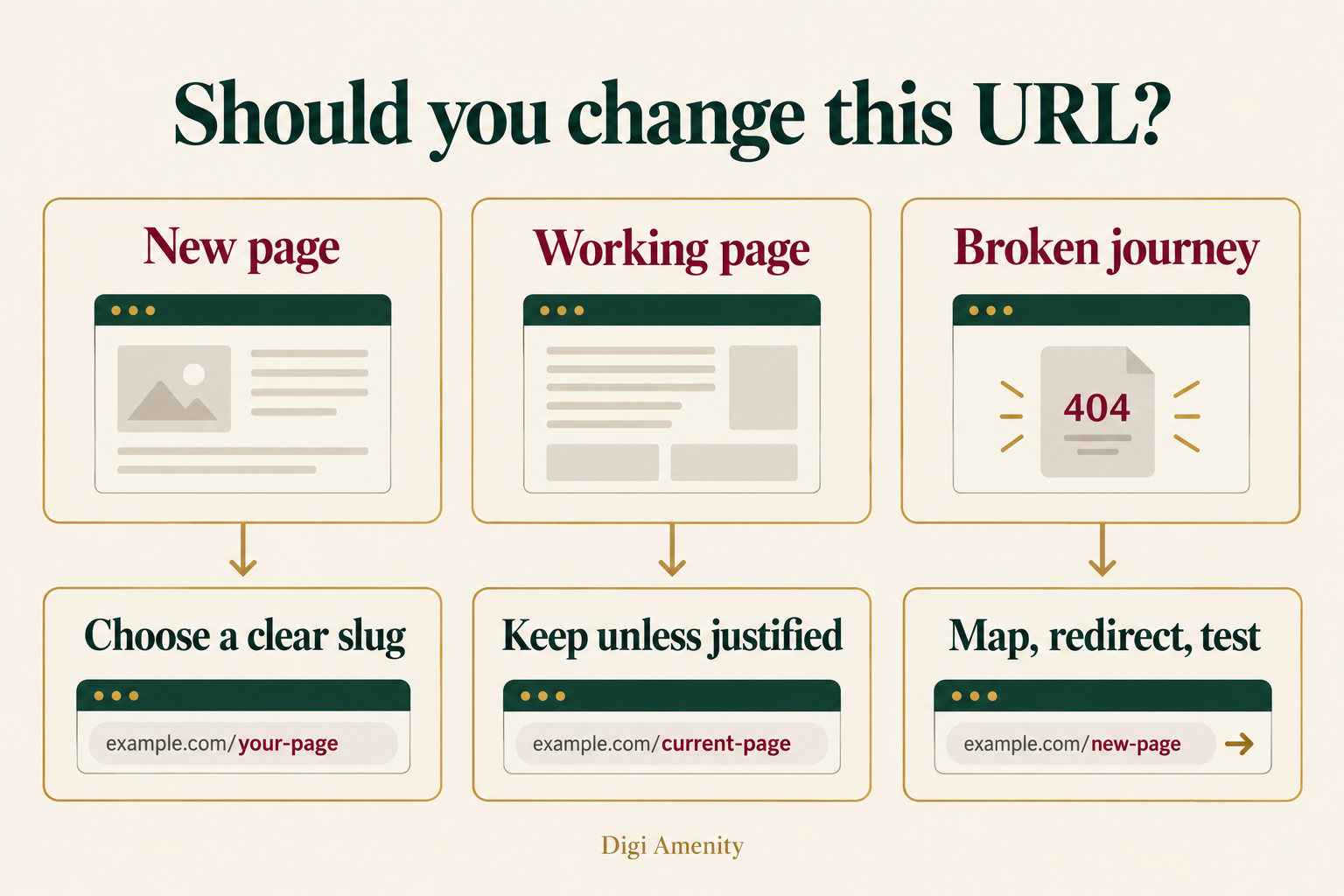
Start with the consequence for the visitor. Does the address reach the intended page? Does that page match the promise of the link or ad? Can the visitor complete the next step?
| Situation | Starting decision | Evidence to collect |
|---|---|---|
| New, unpublished page | Choose a clear slug now | Page purpose, intended audience and existing naming pattern |
| Working page; proposed change is purely cosmetic | Keep unless there is a stronger reason | Search visits, enquiries, links, bookmarks and campaign dependencies |
| Several addresses represent the same intended destination | Plan a consistency review | What each URL serves, internal links and canonical signals |
| Important link reaches a missing or incorrect page | Investigate and fix the broken journey | Original promise, relevant replacement and downstream form or checkout |
| Necessary service, platform or domain restructure | Plan a controlled change | Approved mapping, rollback owner, validation and monitoring |
Hypothetical Mumbai example: a consultancy has a working /website_design_mumbai/ page that receives enquiries. Its marketer prefers /website-design-mumbai/. The new form is a sensible convention for a fresh page, but punctuation alone does not tell the team whether the existing page should move. First list the ads, proposal documents, profile links and enquiry-tracking rules that depend on the current address. If no meaningful problem is found, keep it and apply the convention to future pages.
In a different hypothetical case, an old paid-ad link reaches a deleted consultation page. That is a real journey failure. The priority is an appropriate destination and a tested enquiry path, rather than debating the ideal number of words in its slug.
Which URL examples help a business make the decision?
These are invented examples, not audited client URLs or measured results:
/services/wordpress-maintenance/identifies a service more clearly than/services/package-17/./guides/choosing-office-furniture/describes an evergreen guide without an unnecessary annual rename./reports/2026-customer-survey/can reasonably retain its year because the year identifies the report./products/linen-cushion-cover/distinguishes a cover from a filled cushion. Removing “cover” for brevity could confuse buyers.
Do not judge discoverability by counting slashes alone. Ask how a visitor reaches the page from relevant navigation and other useful content. A tidy address can still be hard to find if nothing links to it. The internal linking guide explains that separate architecture decision.
What changes between WordPress and Shopify?
In WordPress, the site-wide permalink choices are under Settings → Permalinks. The documentation distinguishes the structure from the post slug and explains how structure tags build addresses. Inspect the current setup before editing that screen; changing a whole structure is not the same as naming one draft. Source: WordPress permalink documentation.
For an established WordPress site, ask whoever maintains it which layer owns redirects: the server, a plugin or another service. Test the actual result instead of assuming WordPress or a plugin will handle every old address correctly. Take a recoverable backup and agree who can restore it before a broad restructure.
Shopify has platform constraints. Its native redirect documentation says redirects work from broken URLs, not addresses that still serve valid pages, and lists reserved paths. The documented route is Content → Menus → View URL Redirects → Create URL redirect, followed by the old and new destinations. Query strings may need extra testing. Source: Shopify redirect guidance.
Do not rebuild a functioning store merely to remove a platform’s normal path segment. Start with the handle you control and verify that product discovery, variants, cart and checkout still work. For either platform, a website implementation review should cover the destination’s behaviour as well as its address.
Is a canonical tag the same as a redirect?
No. A redirect sends a visitor to another URL. A canonical declaration indicates a preferred representative among duplicate or very similar pages; it does not send the visitor elsewhere. Google treats redirects and canonical annotations as strong canonicalisation signals, while sitemap inclusion is a weaker signal. These signals do not give you absolute control over Google’s selection. Source: Google canonicalisation guidance.
Use the symptom to choose the investigation. A customer landing on a missing service page needs a working journey. Several live variants displaying equivalent content need a consistent indexing strategy. Adding a canonical tag alone is not a repair for a broken enquiry link.
Keep tracking separate from this decision. Do not instruct a developer to delete every query parameter because a “clean URL” looks better. Classify parameters by purpose—campaign attribution, click identifiers, product selection, sorting or another function—and test what each proposed change affects.
What should your URL redirect checklist include?
Google’s migration guidance recommends mapping old addresses to their appropriate replacements, using permanent server-side redirects for permanent moves, avoiding redirect chains, updating internal links and monitoring both old and new URLs. It also recommends keeping redirects for at least a year; keeping useful redirects longer can continue helping visitors. Its Change of Address tool is not for a path-only change. Search visibility can fluctuate while changes are processed. Source: Google site-move guidance.
For implementation handoff, give your team one row per proposed change. Use this original worksheet:
- Decision: current URL, proposed destination, business reason and person approving the change.
- Dependencies: links in ads, emails, navigation, related articles, proposals and business profiles that your team controls.
- Acceptance checks: old URL reaches the intended destination, page displays the correct offer, and the enquiry or checkout journey works.
- Measurement checks: relevant campaign parameters survive as intended, page events remain attributable, and a successful enquiry is not confused with a button click.
- Responsibility: developer, marketing reviewer, launch time, rollback procedure and date to review the result.
The worksheet is useful even for one service page. A “redirect added” message closes only the developer’s routing task. It does not confirm that a campaign now lands on the right offer or that the sales team receives the enquiry.
On mobile, check the destination from the actual link, then review headings, pricing or service scope, buttons, validation messages and the footer. Use an agreed test process that keeps test enquiries separate from real leads. Do not submit customer details merely to prove a form exists.
How should you measure a URL change?
Define the outcome before launch. For a broken link, the first success criterion is that the affected journey now works. For a necessary restructure, establish whether visitors continue reaching the correct pages and completing genuine business actions.
Maintain an old-to-new reporting group so that a transfer between addresses is not mistaken for a loss of all traffic. Compare equal-length complete periods with the same country, device and channel filters. Record campaign pauses, offer changes and seasonality alongside the migration date.
Use search clicks and impressions to understand visibility, landing sessions to understand visits, and confirmed enquiry or purchase records to understand outcomes. Do not label a phone-button tap as a qualified lead. If volumes are small or tracking changed at the same time, report that limitation instead of attributing every movement to URL slug optimization.
Frequently asked questions
Should I replace every underscore in existing URLs?
No automatic bulk change follows from Google’s clarification. Use hyphens for new slugs, then assess existing pages individually. A working address with campaign and customer dependencies needs a documented reason and change plan before it moves.
Is there a perfect URL length for SEO?
There is no magic length established by the Google guidance cited here. Prefer a recognisable, durable address. Do not remove meaningful product or service distinctions simply to satisfy a tool’s score, and do not promise that shortening a URL will increase rankings.
Can URLs contain Hindi or other Indian-language words?
Google’s guidance supports audience-language words and transliteration, with correct encoding. Choose a convention your customers and publishing team can use consistently. Test copied links and actual destinations; an English-only slug rule is an editorial choice, not a universal requirement.
Are query parameters bad for SEO?
Not inherently. Parameters can serve useful functions. The practical issue is what each variant does and whether your system creates confusing or excessive alternatives. Review functional and attribution needs before removing parameters; a clean-looking address is not evidence that tracking is correct.
Should a deleted page always redirect to the homepage?
No. First identify the visitor’s original intent and whether a genuinely relevant replacement exists. Sending every old URL to a generic homepage can leave that intent unanswered. The action should reflect the content and user journey, not a blanket desire to hide every missing page.
Will a better slug fix an underperforming service page?
Not by itself. Review search intent, the offer, page clarity, internal links, mobile usability and enquiry follow-up. If visitors arrive but do not enquire, the address may be a much lower priority than an unclear service description or a failing form.
What should I ask a developer before approving a URL restructure?
Ask for the reason, affected URL list, relevant replacement for each page, test plan, tracking checks and rollback owner. Require evidence from the completed journey, not only a screenshot of a redirect setting. Keep the change record for later troubleshooting.
Need to review your website’s URL structure?
If a redesign or SEO audit proposes changing your page addresses, Digi Amenity can review the URL inventory, redirects, internal links and enquiry tracking before implementation. The aim is to identify changes that solve a real problem and preserve the journeys already bringing you business.