
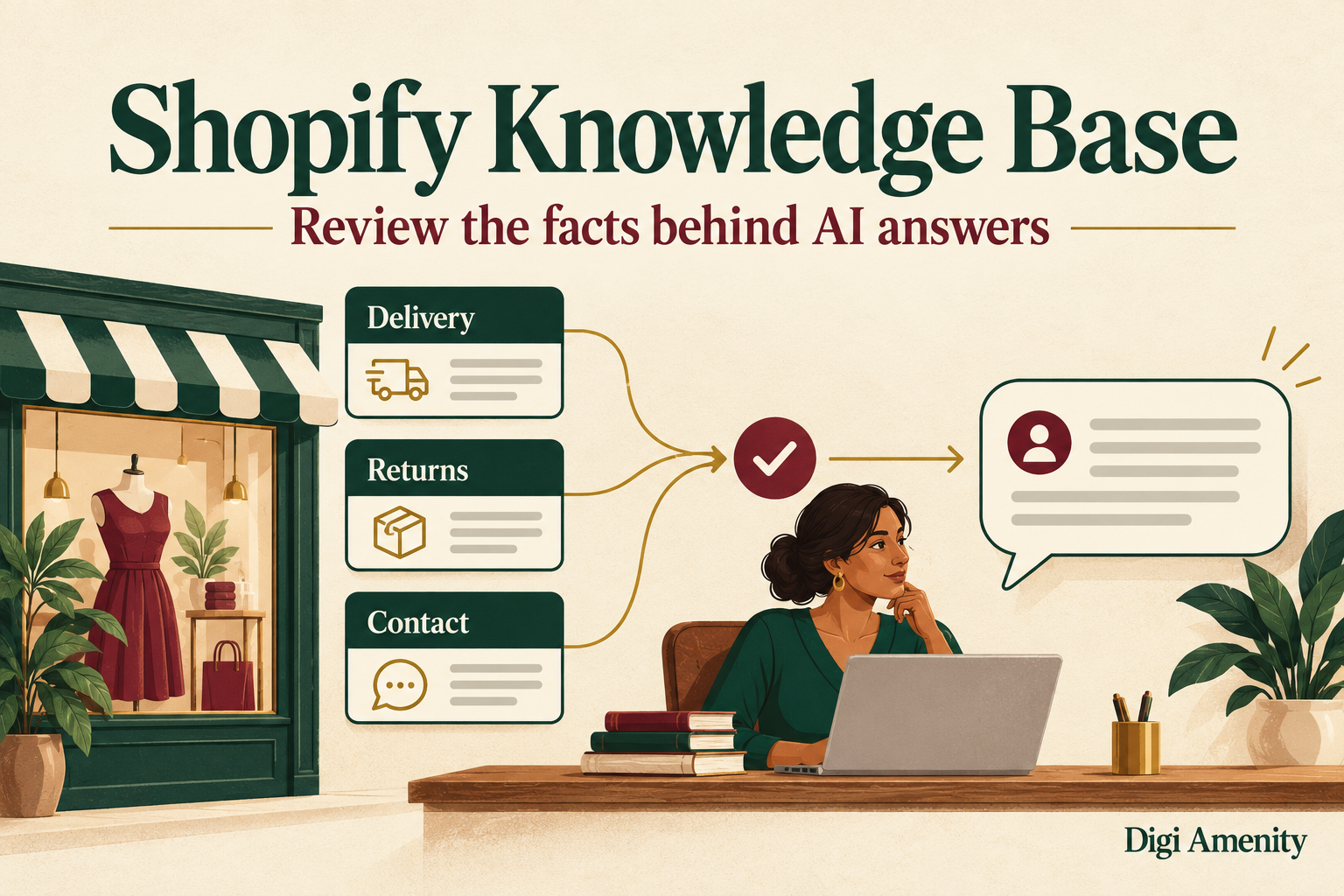
Shopify Knowledge Base helps you manage the store information AI shopping assistants can use when answering buyer questions. Start by checking what is already published, comparing it with your live policies and correcting conflicting promises. Adding more facts is useful only when those facts are accurate, specific and maintained.
For an Indian ecommerce business, the practical questions are familiar: where do you deliver, is cash on delivery available, can a personalised item be returned, and will a gift arrive before an event? A confident answer that omits an exception can create a disappointed buyer before your support team even enters the conversation.
This guide explains the October 2026 change and provides an audit process you can adapt to your store. Platform documentation checked on 28 October 2026. Examples and suggested targets are hypothetical; they are not client results or claims from an executed store test.
What changed with Shopify Knowledge Base in October 2026?
Shopify’s 26 October announcement moved Knowledge Base into Sales channels → Agentic → Knowledge base. The standalone app is due to become unavailable after 15 January 2027. Newly scanned storefront facts wait for publication, while existing app users need to check what migrated. This is a product change, not evidence that search demand or sales have increased. Read Shopify’s announcement.
The detailed migration notice says stores with 1,000 or fewer facts have their merchant-created additions and overrides transferred and published. Above that threshold, merchants must re-add the information they want to retain before the retirement date. Shopify’s migration notice.
Do not assume the move is complete simply because the new screen opens. Compare your old high-priority answers with the current facts, especially cancellation exceptions, custom-product conditions and seasonal deadlines. If you are close to the threshold, confirm the count and migration status with Shopify Support: the announcement and detailed documentation use slightly different wording around the limit.
Is this a replacement for SEO, product pages or a support centre?
No. Shopify describes Knowledge Base as the store’s non-product information layer. Product discovery uses separate catalog and channel mechanisms. Preparing an answer about returns does not correct a variant’s stock, price or specifications. Shopify agentic storefronts overview.
Treat your store as three connected responsibilities:
| Responsibility | What your team should maintain | Example question |
|---|---|---|
| Product information | Accurate variants, dimensions, materials, images and availability | “Will this fit a 120 cm desk?” |
| Business and service information | Clear shipping, payment, returns and support conditions | “Can I return it after assembling it?” |
| Purchase journey | Working selection, checkout, payment and confirmation | “Can I actually order the eligible variant?” |
A buyer can receive a correct policy answer and still abandon a confusing product page. Equally, a good checkout cannot compensate for a delivery promise your operations team cannot meet. Use the Shopify product-page optimisation guide to review the first part of that journey.
The earlier Shopify overview explicitly distinguishes answer accuracy from how frequently a store appears in AI results. Do not sell Knowledge Base work internally as guaranteed placement, a ranking shortcut or a forecast of incremental revenue. Its immediate value is a more reliable representation of your business. For the wider discovery-to-action plan, see our agentic-web readiness guide.
What should an Indian store check before making changes?
Begin with access, current state and ownership. Ask the store owner to confirm that the Agentic section is available to the person doing the work. Record the store, market, language, date and reviewer. If the interface differs from a tutorial, check current documentation and permissions before trying to install the old app.
The current Help Center distinguishes three important conditions: scanned facts start unpublished; admin-linked details such as policies and contact information can be published when created; published information is public. It lists a 1,000-fact total limit, and notes restrictions for custom storefronts, Agentic-plan stores and password-protected stores. Current Knowledge Base documentation.
Therefore, audit published facts first, then useful unpublished material. The most damaging statement may already be live.
Keep these checks separate:
- Feature access: can your authorised team review the store’s facts?
- Channel eligibility: is the relevant AI shopping channel available for your store and target buyers?
- Commercial capability: does your checkout actually support the payment, delivery or service being described?
Access to a facts screen does not prove that every AI platform supports discovery or checkout for every Indian merchant. This guide does not make that availability claim. Confirm channel-specific requirements before building a campaign around them.
Which store facts deserve attention first?
Prioritise an incorrect promise by its likely consequence, not by how easy it is to rewrite. A wrong returns exception can matter more than an imperfect brand description.
Use this practical review order:
| Topic | Question to resolve | Evidence to compare | Suggested owner |
|---|---|---|---|
| Delivery | Is the promise dispatch time or arrival time? Which locations qualify? | Shipping policy, delivery rules, operational commitments | Operations |
| Returns | What starts the return window, and which products are excluded? | Published policy and support procedure | Support |
| Cancellation | Can an order be changed after production or dispatch starts? | Order workflow and cancellation policy | Operations |
| Payments | Is COD conditional on postcode, order value or product? | Payment configuration and customer-facing terms | Commerce manager |
| Gifting | Are gift wrapping, message cards and gift receipts actually offered? | Product options and packing process | Fulfilment |
| Contact | Which channel is monitored, and during which hours? | Contact page and support rota | Support lead |
These are review prompts, not suggested policies. Do not invent COD eligibility, a return window or a customer-service commitment to fill an empty field.
For Mumbai businesses serving both local and national buyers, location qualifiers are particularly useful. “Delivery available in Mumbai” does not necessarily mean same-day delivery across every postcode. A local pickup service also needs its own address, timing and collection conditions; it should not be inferred from a warehouse address.
How do you audit Shopify Knowledge Base without creating conflicting answers?
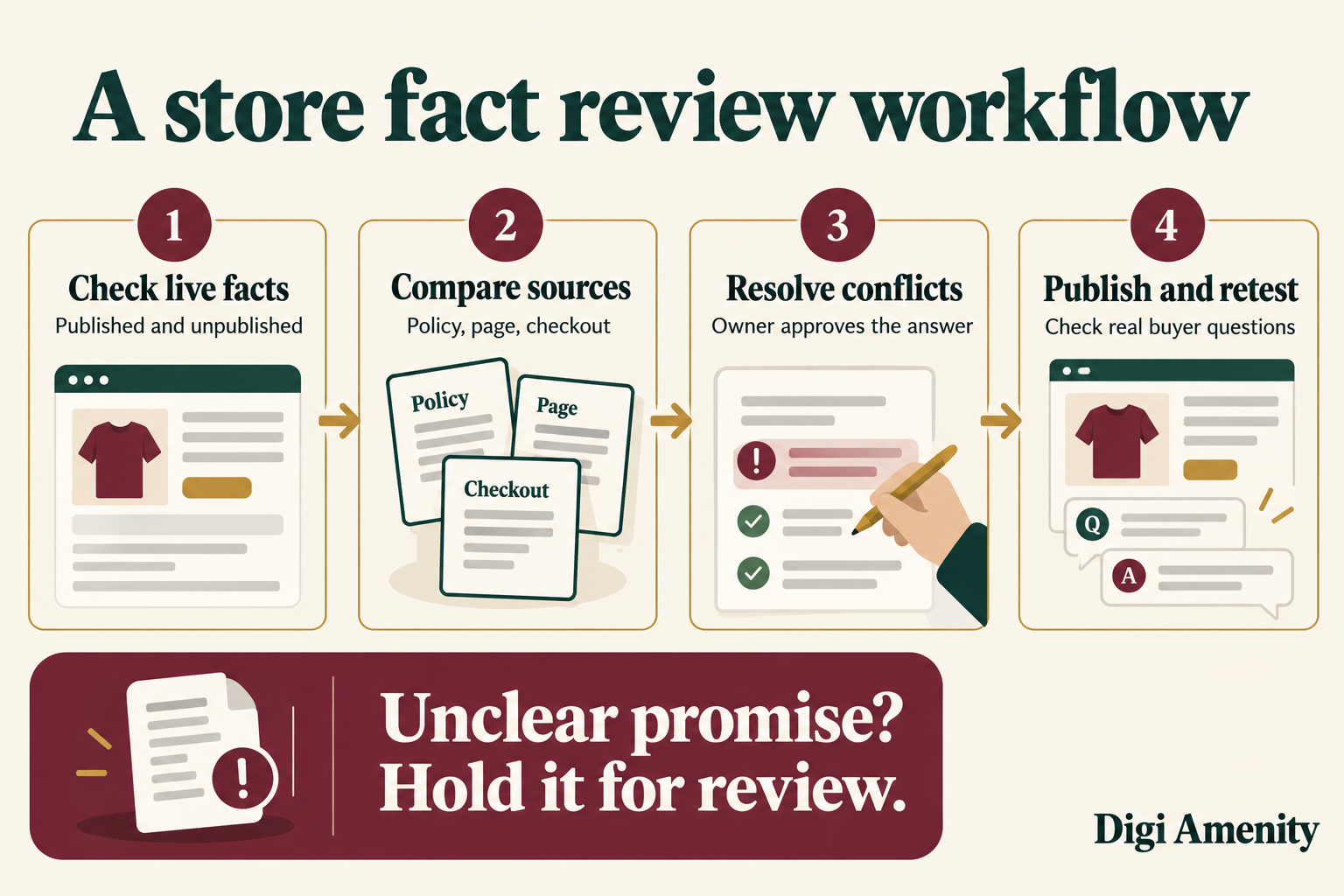
Use the following process as an editorial and operations checklist. It is a proposed workflow, not a report of changes made to a client store.
1. Record the existing state
Create a small register before editing. Give each important fact an ID, question, current answer, publication state, source URL, owner and review date. Preserve the original wording locally so you can explain what changed.
Start with the questions that could block a purchase or create a refund dispute. Ten carefully checked answers are a better first batch than hundreds of generic variations. That is a workflow recommendation, not a Shopify limit or an SEO benchmark.
2. Compare the answer with the actual business process
Read the referenced public page, then ask the operational owner whether the promise is still true. Compare any visible offer banners and checkout messages too.
If a policy says one thing and the support team does another, the writer cannot resolve the conflict by choosing the more attractive answer. The owner must decide the correct policy and approve the customer-facing wording. Keep the fact under review until that decision is made.
3. Correct the source before multiplying answers
A local correction inside a facts tool should not leave a contradictory policy on the website. Otherwise the same buyer may hear two different versions depending on where the question is asked.
Maintain a change list that names every affected destination: policy page, product exception, support response and knowledge-base fact. Assign one person to confirm consistency after implementation. If a page edit requires separate approval, retain that approval step rather than treating the facts audit as permission for a wider redesign.
4. Keep conditions beside the promise
Write the answer so the main rule and its most material qualification can be understood together. Separate dispatch from transit. Specify whether a deadline means calendar days or working days. Avoid “all orders”, “everywhere” and “guaranteed” unless the business can support those words.
For long policies, the short answer should identify the relevant rule and direct the buyer to the detailed public terms. Do not paste customer records, private discounts, supplier arrangements or internal escalation notes into public store facts.
5. Review the current controls, then verify the saved state
In the current interface, inspect a field’s source and reference links. Shopify supports manual sources and additional facts, plus field-level publication controls. Changing a source can affect references, so check them again afterwards. Suggested scan updates require review; a rescan can take up to 48 hours and may miss changes. Shopify’s review and editing instructions.
For your first batch, avoid approving everything together. Reopen each important answer after saving and record the observed state. Verification should show the intended answer, relevant source and correct publication status—not merely that someone clicked Save.
6. Test the question and the awkward follow-up
A useful question set includes both the easy case and the exception. For a delivery answer, ask about a supported postcode, an unsupported location, an urgent deadline and a mixed basket containing a made-to-order item.
Keep the question wording, country, language and expected answer in your register. When a supported testing surface is available, record the returned answer and its reference. If no suitable test surface is available, mark that item not tested. A manual source check is valuable, but it is not proof of what an external assistant will say.
Older app tutorials describe query logs and a “Test your knowledge base” screen. Do not assume those controls survived unchanged in the new admin. Shopify’s developer documentation now describes an Ask MCP tool, ask_business, for policy and service answers, with a draft capability and store-dependent discovery. Technical teams should follow that documentation; an owner does not need to implement an API just to begin the content audit. Ask MCP documentation.
What does a better answer look like in practice?
Hypothetical example: a Mumbai homeware store. Suppose the operations team confirms that stocked items usually dispatch within two working days, while made-to-order products follow the lead time on their product page. Delivery time depends on the destination and shipping service.
A weak answer would be:
We deliver all orders in two days across India.
A more useful answer would be:
Stocked items usually dispatch within two working days. Made-to-order items follow the lead time shown on their product page. Arrival time depends on the destination and shipping service; check the shipping policy and the estimate available for your order.
The second answer does not promise an outcome the hypothetical business has not confirmed. It distinguishes processing from delivery and directs the buyer to the right exception.
Now test the follow-up: “If I order a custom lamp tonight, will it reach Pune by Friday?” A trustworthy response must retain the made-to-order qualification. If it collapses the answer back to “two days”, the test has exposed a meaningful problem even if the initial question looked correct.
Do not reuse these timelines for your store. Replace them with approved operational facts and verified public references.
Can you use a simple fact-review worksheet?
Yes. Copy this structure into your team’s existing spreadsheet or task system. The example row is hypothetical.
| Field | Example or instruction |
|---|---|
| Fact ID and buyer question | DEL-01: When will my order arrive? |
| Current answer and state | Save the exact wording; record published or unpublished |
| Approved source | The relevant public shipping-policy URL |
| Scope and exceptions | Market, product type, postcode and processing conditions |
| Conflict found | Dispatch timeline incorrectly described as arrival time |
| Decision | Correct source; review fact; hold unsupported promise |
| Owner and due date | Operations manager; agreed completion date |
| Verification | Saved wording, references, publication state and test result |
| Next review trigger | Courier, policy, production or seasonal-offer change |
A fact is ready for approval only when its owner can answer: “Is this true, where can the buyer verify it, and what condition would make it false?” This creates a useful handoff between marketing and operations without pretending that a content score proves accuracy.
How should you measure whether the work helped?
Separate content quality, observed answers and business outcomes.
For content quality, track the number of priority facts reviewed, unresolved contradictions and facts awaiting an owner. For observed answers, keep a fixed question set and classify responses as correct, partly correct, wrong or unavailable. Define those categories before comparing runs.
A simple internal measure is:
Answer accuracy for the test set = fully correct answers ÷ questions with an observed answer.
Also report unanswered or untestable questions separately. Otherwise a small set of easy responses can make the accuracy percentage look reassuring while important questions remain unresolved. Always show the numerator, denominator, date and test conditions. This is an internal QA measure, not an industry benchmark or a platform ranking metric.
For commercial results, monitor relevant referral sessions, completed orders and policy-related support enquiries where your existing analytics can identify them reliably. A change after an audit does not prove the audit caused it. Promotions, product availability, creative, pricing and tracking changes may also affect the result. Do not label every direct visit as AI traffic or every policy query as a sale.
What should you do during the first seven days?
Days 1–2: establish access, record existing publication states and select the highest-risk questions. Check migration completeness if the old app was used.
Days 3–4: resolve policy conflicts with the relevant owners. Prepare corrected answers and source updates together. Keep unresolved commercial promises out of the approved batch.
Day 5: have a second reviewer check conditions, links and privacy. Apply only approved changes and verify the saved state.
Days 6–7: run the same question set where testing is supported, record limitations and assign the next review triggers. Feed recurring uncertainty back into product pages, policies and support instructions.
This is a planning template, not a guaranteed seven-day implementation. A store with inconsistent policies or a large migration may need longer.
Frequently asked questions
Do I still need to install the Shopify Knowledge Base app?
Follow the new admin route described above. Current Shopify help says the standalone app is no longer available for new installation. Older search results and the app listing can still show legacy wording, so use the migration notice and your current admin rather than an old installation tutorial.
Are all facts unpublished until I approve them?
No. Check existing published records as well as new suggestions. The distinction between scanned, admin-linked and migrated facts matters. Make publication-state review the first item in your audit instead of assuming the new screen contains only drafts.
Will completing Knowledge Base increase my Google rankings?
It is not a ranking guarantee. Keep normal SEO, accurate product information and a usable purchase journey in place. Evaluate this work first on whether buyers receive supportable answers, then measure business outcomes without attributing every change to the feature.
Should I put every product specification into store facts?
Maintain product-specific information in the appropriate product and catalog sources. Use store facts for the business-level questions they are intended to answer. If a policy varies by product, state the exception and provide the relevant destination rather than creating an ambiguous store-wide claim.
How should I handle cash-on-delivery questions?
Ask the commerce owner to verify the actual conditions, including any postcode, basket-value or product restrictions. Write only what the checkout and published terms support. A simple “COD available” can mislead buyers when eligibility is conditional.
Can I publish internal support instructions here?
Treat published facts as customer-facing information. Keep personal customer details, credentials, unpublished offers and internal escalation rules out. Provide the public process a buyer should follow, with an appropriate support destination.
How often should the facts be reviewed?
Use operational changes as the main trigger: new shipping services, returns terms, payment restrictions, gift services or seasonal deadlines. Add a recurring review suited to your store’s change rate. A date on a spreadsheet is useful only if someone owns the check.
What if I cannot verify an AI assistant’s answer?
Record the source review as completed and the answer test as not tested. Do not turn missing evidence into a pass. Keep the expected question and answer ready for a supported test, and resolve any known contradiction on the storefront in the meantime.
Need help aligning your store’s answers with its purchase journey?
If your policies, product pages and AI-facing store facts give different answers, Digi Amenity can review them together with the checkout journey and measurement setup. Start with the promises most likely to affect a purchase or an enquiry, then prioritise the fixes through our website and ecommerce development services.
