
The Meta Brand Building Summit 2026 introduced new ways to buy brand exposure and assess short-form video attention. For Indian advertisers, the immediate task is to check eligibility, campaign readiness and measurement before committing budget. A new placement can improve the opportunity to be seen; it cannot make an unclear message memorable or turn a broken customer journey into sales.
This guide separates Meta’s announcement from Digi Amenity’s practical recommendations. It explains the product changes, questions to ask before booking, creative preparation and how to evaluate awareness alongside enquiries and purchases.
Announcement dated 15 October 2026; reviewed 21 October 2026. Availability can vary by market and account. Examples below are hypothetical, not client results or product trials.
What changed at the Meta Brand Building Summit 2026?
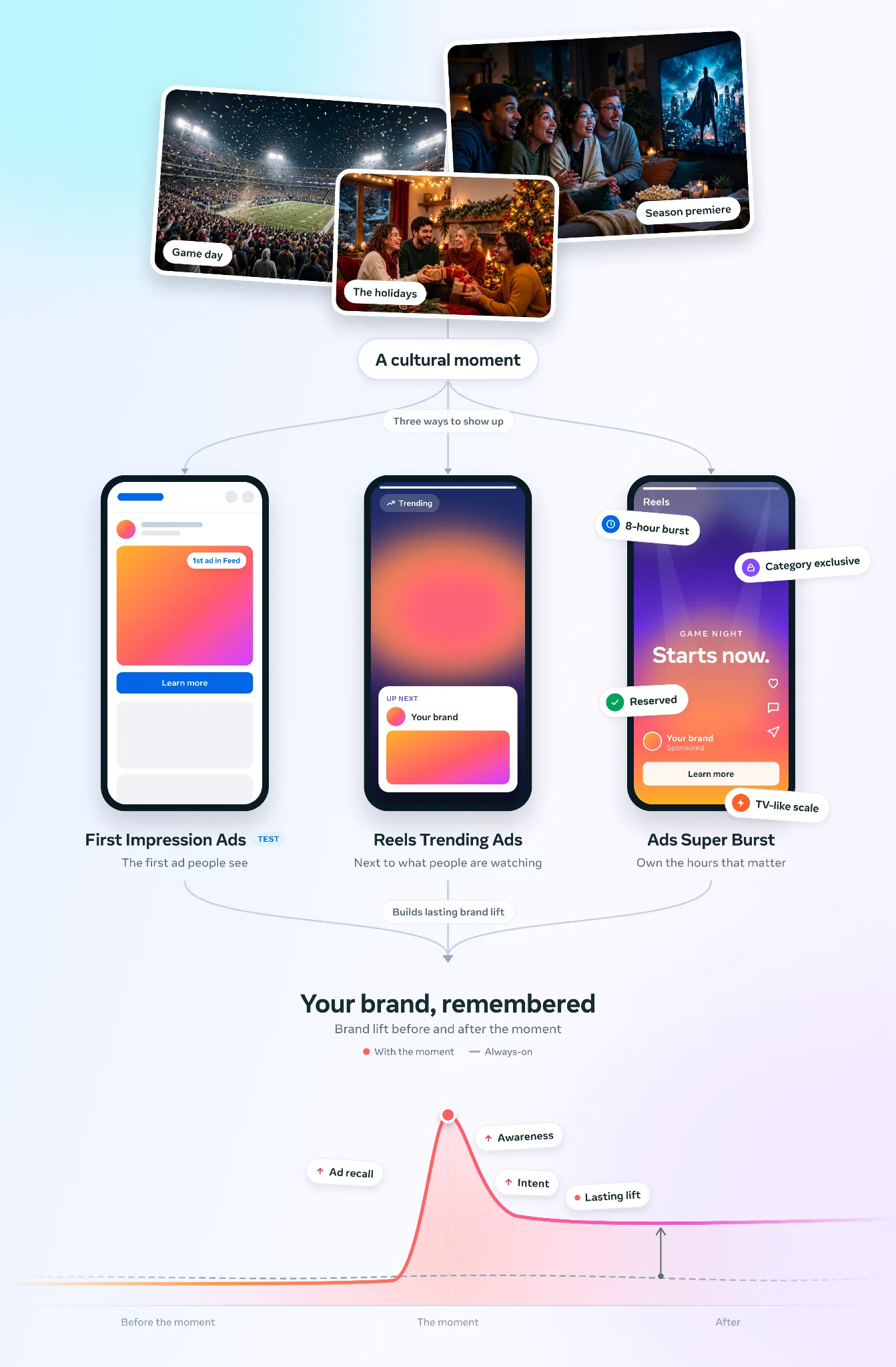
Meta’s official announcement covers four developments:
| Product | What Meta announced | Stage described on 15 October |
|---|---|---|
| Ads Super Burst | Reserved 3–24-hour campaigns, with optional category exclusivity. Reach Planner supplies reach and price estimates, with delivery guarantees tied to those estimates. | Phased general availability during October. |
| First Impression Ads | The first ad in Facebook Feed when someone opens it; one brand per day in the test. | Early United States test. |
| Reels Trending Ads | Ads following popular Reels; 15 standard topics, including Home & Garden and Spanish-language content, plus seasonal lineups. | Expanded offering; custom audience exclusions planned later in 2026. |
| Aggregated View Time | Measurement and optimisation around accumulated brand viewing time across a week. | Alpha testing. |
These are different release stages. A planned capability should not appear in a client proposal as a feature already available to their account. Delivery commitments also concern the agreed media delivery, not a guaranteed number of customers.
Are these products available to businesses in India?
The announcement does not establish access for every Indian advertiser, a universal minimum budget or a rupee rate card. Confirm the buying route and eligible market for the specific account before planning around a product. A globally worded announcement is insufficient evidence of local access.
Ask the platform representative or buying partner to confirm:
- The advertiser account, target country and product eligibility.
- Available dates, inventory, placements and creative specifications.
- The complete quote, taxes, payment terms and cancellation conditions.
- What any delivery commitment covers, how it is measured and how shortfalls are handled.
- Whether exclusivity is included, how the category is defined and what inventory the agreement covers.
- Which reporting fields, audience controls and studies are actually available.
Retain the dated answer with the media plan. Do not infer that category exclusivity removes competitors from every surface a person might visit. The agreed scope matters. If access is unavailable, continue evaluating the options already supported in the account; there is no need to pause useful marketing while waiting for a launch.
When does a concentrated brand campaign make business sense?
Start with the business moment. There should be a reason that reaching the intended audience during a particular window matters more than spreading the same activity across ordinary weeks.
A product release, a major retail launch or a genuinely relevant cultural occasion might justify evaluation. A routine offer with no deadline may not. Even a meaningful launch can be a poor candidate when stock, creative or customer support is not ready.
Write a one-sentence objective before comparing placements: “Help the eligible audience recognise the new range and understand why it is relevant.” Then write the separate commercial question: “Does that activity contribute to profitable demand?” The first describes the communication task; the second requires business evidence.
Protect the budget needed for existing commitments. There is no universal percentage to move from lead generation or sales campaigns into brand activity. Compare the proposed spend with the learning it can produce, the business’s cash constraints and the opportunity cost of the campaigns it would displace.
How should you prepare for Meta Ads Super Burst or another reserved buy?
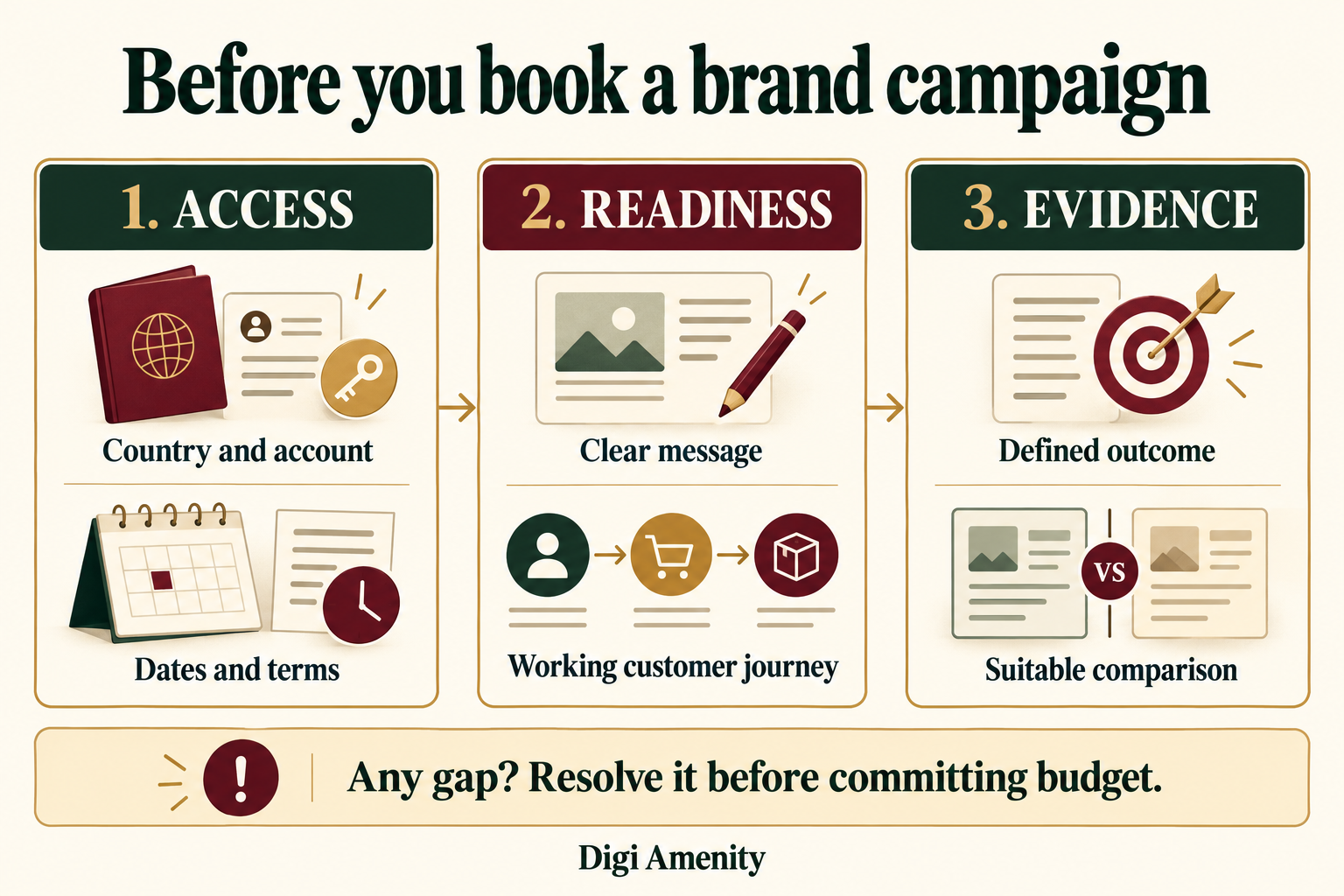
Use a booking brief that joins media planning with operations. This is Digi Amenity’s proposed worksheet, not a Meta eligibility checklist.
| Decision | Evidence to record | Hold the commitment when… |
|---|---|---|
| Audience and occasion | Who needs the message and why the timing matters. | The only rationale is that the product is new. |
| Access and contract | Account approval, written quote, dates, delivery definitions and relevant terms. | Availability or the agreement is still assumed. |
| Creative readiness | Approved message, substantiated claims, rights and placement-compatible assets. | The brand or offer is unclear in the actual creative. |
| Customer journey | Working mobile destination, stock or service capacity, forms and follow-up ownership. | The visitor cannot complete the intended next step. |
| Measurement | Primary question, baseline, comparison method, outcome definitions and reporting owner. | The team plans to declare success using whichever metric improves. |
Give each row an owner and a pass, revise or hold decision. Avoid averaging away a critical failure: a ready video does not compensate for an uncertain booking or a checkout that cannot accept payments.
What should your creative communicate?
Build around one recognisable idea, then develop variations that add information. A useful sequence might introduce the problem, demonstrate the product or service, answer an objection and offer a relevant next step. This is a creative planning sequence; it is not a claim that every person will receive the ads in that order.
Make each asset understandable on its own. Use consistent product identification, brand name, visual cues and language. Do not make understanding depend on a viewer having watched the previous video. Review the opening frame, on-screen text, audio, subtitles and final action in the actual placement preview.
For contextual placements, ask whether the audience moment and the brand story fit. Choosing a topic merely because it attracts attention can produce a placement that feels disconnected from the product. The occasion should strengthen the message, not replace it.
Separate creative variation from random change. If one version explains a use case and another provides proof, record those roles. Changing the offer, destination and audience at the same time makes it harder to explain the difference in results. Our Meta Ads creative performance analysis guide provides a more detailed framework for reviewing creative against the customer journey.
How should you interpret the new focus on viewing time?
Attention is useful diagnostic evidence, but it is not a complete business result. More viewing might mean that a creative is understandable or interesting; it does not establish that the viewer remembered the advertiser, preferred the offer or purchased because of the campaign.
Do not invent a substitute platform metric by adding unrelated video-report totals. A business-built calculation must state its unit, denominator, period and treatment of repeat exposure. If you cannot establish whether a report is person-level, impression-level or video-level, keep it out of a decision that depends on that distinction.
Use available attention measures to identify questions for creative review. For example, a video might retain attention while failing to explain the product. Review the asset and the customer response before deciding that longer viewing is the objective.
Which metrics should a brand campaign report include?
Use four separate layers. They can inform one another, but they are not interchangeable.
| Layer | Question | Evidence and limitation |
|---|---|---|
| Delivery | Did the booked activity reach the intended audience? | Agreed delivery reports, reach, impressions and frequency. These do not prove recall or sales. |
| Attention and brand response | Was the message noticed and remembered? | Available video diagnostics and suitable brand research. Watch time alone cannot answer brand preference. |
| Customer journey | Could interested people complete a useful action? | Landing-page behaviour, verified forms and purchases. Tracking coverage and attribution affect interpretation. |
| Incremental business impact | What happened because of the advertising? | A suitable experiment or carefully designed evaluation. Before/after movement alone is not proof of causation. |
Meta’s measurement overview distinguishes campaign reporting from experiments such as Conversion Lift, which assess outcomes attributable to advertising rather than outcomes that would have happened anyway. Tool access and study requirements must be checked for the account.
Choose the evaluation method before the campaign. If a properly designed experiment is feasible, agree the comparison, outcome and analysis window in advance. If it is not feasible, label the findings observational. Do not rename an ordinary sales comparison a lift study.
Keep attributed ROAS separate from incremental return. A platform-attributed purchase can be useful for reporting without proving that the campaign created an additional purchase. Equally, a brand campaign should not be declared ineffective solely because its short-window click-based report is modest. The measurement must fit the question.
How should ecommerce and service businesses apply this differently?
Hypothetical ecommerce example: a new homeware collection
Imagine an Indian homeware brand introducing a collection with a fixed release date. Its team first confirms inventory, serviceable locations, delivery promises and mobile checkout. The creative demonstrates how the range is used, while the destination shows the same products and conditions.
Before considering a reserved campaign, the team validates purchase events against confirmed orders, documents cancellations and returns, and checks customer-support capacity. It records the promotion calendar so a discount or marketplace sale is not mistaken for a media effect.
The decision is to evaluate the format only if eligibility, economics and the measurement plan support it. This is an invented planning example, not evidence that the product is available to this business or that the campaign would improve ROAS.
Hypothetical service example: a Mumbai commercial design firm
A design firm wants awareness for a new showroom. A large exposure total is of limited value if the audience cannot use its service. The team defines coverage, project suitability and appointment capacity, then makes those details clear in the destination and enquiry process.
It separates form submissions from qualified projects. A qualified enquiry might require a relevant commercial property, a serviceable location and a genuine project requirement; the owner must approve the definition. Appointment bookings and later sales are recorded separately.
If the business mainly needs a small number of near-term enquiries and cannot justify a brand study or launch commitment, its next action may be to improve the existing lead journey. A new inventory product does not automatically solve that problem.
What should you fix before buying more exposure?
Follow the route a prospective customer would take. Does the creative promise match the page? Can someone understand the offer on mobile? Does the form validate correctly? Does a confirmed enquiry reach the right person? Is the response process ready for the planned campaign period?
For ecommerce, include product availability, delivery information, payment confirmation and order tracking. For services, include service selection, qualification and follow-up ownership. Test success, failure and repeat actions; a button click is not sufficient evidence of a completed enquiry or order.
Address these issues through the website and landing-page journey before increasing exposure. A campaign can amplify an existing operational weakness as easily as it can introduce the offer to new people.
How can you turn the announcement into a 30-day action plan?
- Days 1–5: establish fit. Write the business objective and audience need. Verify account access, obtain terms where relevant and decide whether the idea deserves further work.
- Days 6–12: prepare the message. Develop a clear creative brief, review claims and rights, and build assets that work independently as well as together.
- Days 13–20: validate the journey. Check mobile pages, forms or checkout, event definitions and operational capacity. Fix critical failures before booking.
- Days 21–30: approve the learning plan. Agree the comparison method, reporting owner and stop/revise/continue criteria. Proceed only when eligibility and readiness are confirmed.
This is a preparation schedule, not a guaranteed launch date or a promise of results within a month. Inventory lead times, approvals and the time required for a meaningful evaluation may extend beyond it.
Frequently asked questions
Is this the same as Meta Connect or the Agency Summit?
No. Those names appear in search results but refer to different events. This guide addresses the brand-ad announcement dated 15 October, using the linked Meta business article as its primary source.
Can I activate every announced product in Ads Manager today?
Do not assume that. Use the dated status table, then confirm access for your account and market. Avoid promising a client a setup procedure before the relevant buying controls or representative confirmation are available.
Should a small business move its lead-generation budget into brand advertising?
Only after assessing the business objective, opportunity cost and ability to measure the result. A small team with an unclear offer or poor enquiry follow-up may get more useful progress from fixing those issues first.
Does a delivery guarantee mean guaranteed sales?
No. Read the actual terms. Media delivery, brand response, enquiries and sales are separate outcomes. The creative, offer, customer journey and business operations still influence commercial results.
Is Aggregated View Time a replacement for purchase or lead measurement?
No. Viewing evidence and business outcomes answer different questions. Continue validating genuine enquiries and confirmed purchases, and avoid treating a custom watch-time calculation as an official product report.
Can Meta’s reported study results predict my campaign?
No. Ask about the sample, geography, comparison group, time period and metric definition before using any study in planning. Results from another population are context, not a forecast or guarantee for an Indian business.
What can I do while waiting for eligibility confirmation?
Prepare the message, repair the destination, validate measurement and document customer-response capacity. Keep the plan flexible and use only the products and controls actually available in the account.
Plan the campaign around the business outcome
If you are considering a brand launch on Facebook or Instagram, Digi Amenity can review the creative brief, offer, landing-page journey, tracking and follow-up before recommending a media commitment. Explore our Meta Ads services to discuss a plan with clear eligibility checks and measurable business questions.