
A Meta Ads agency account is a loosely used term for an agency’s advertising setup—not one universal account upgrade that every business can buy. It may mean a business portfolio managing client accounts, eligibility for an agency programme, access to monthly invoicing, or a provider’s offer to supply account access. These arrangements have different ownership, qualification and policy implications.
For most businesses hiring an agency, the sensible starting point is a business-owned ad account with authorised partner access. Before paying for anything described as an “agency account,” establish what you receive, who owns the assets, which official eligibility rules apply and what happens when the relationship ends.
Official documentation checked on 3 November 2026. Programme benefits and billing availability can depend on the business and account.
What does “Meta Ads agency account” actually mean?
There are four separate concepts behind the phrase. An offer becomes easier to evaluate when the seller identifies which one it concerns.
On smaller screens, swipe the table sideways to view all columns.
| Term people use | What it actually concerns | What to verify |
|---|---|---|
| Agency business portfolio | Organising people and access to advertising assets. | Which business owns each asset and which permissions the agency receives. |
| Meta agency programme | Conditional resources and benefits for eligible agencies. | The specific programme, current eligibility and benefits shown to that business. |
| Monthly invoicing | A billing arrangement with a credit limit. | Eligibility notification, approved limit, responsible legal entity and payment terms. |
| “Buy” or “rent” an agency account | A provider’s commercial offer, sometimes involving provider-owned access. | Whether the service complies with Meta’s rules; a provider’s promise is not Meta approval. |
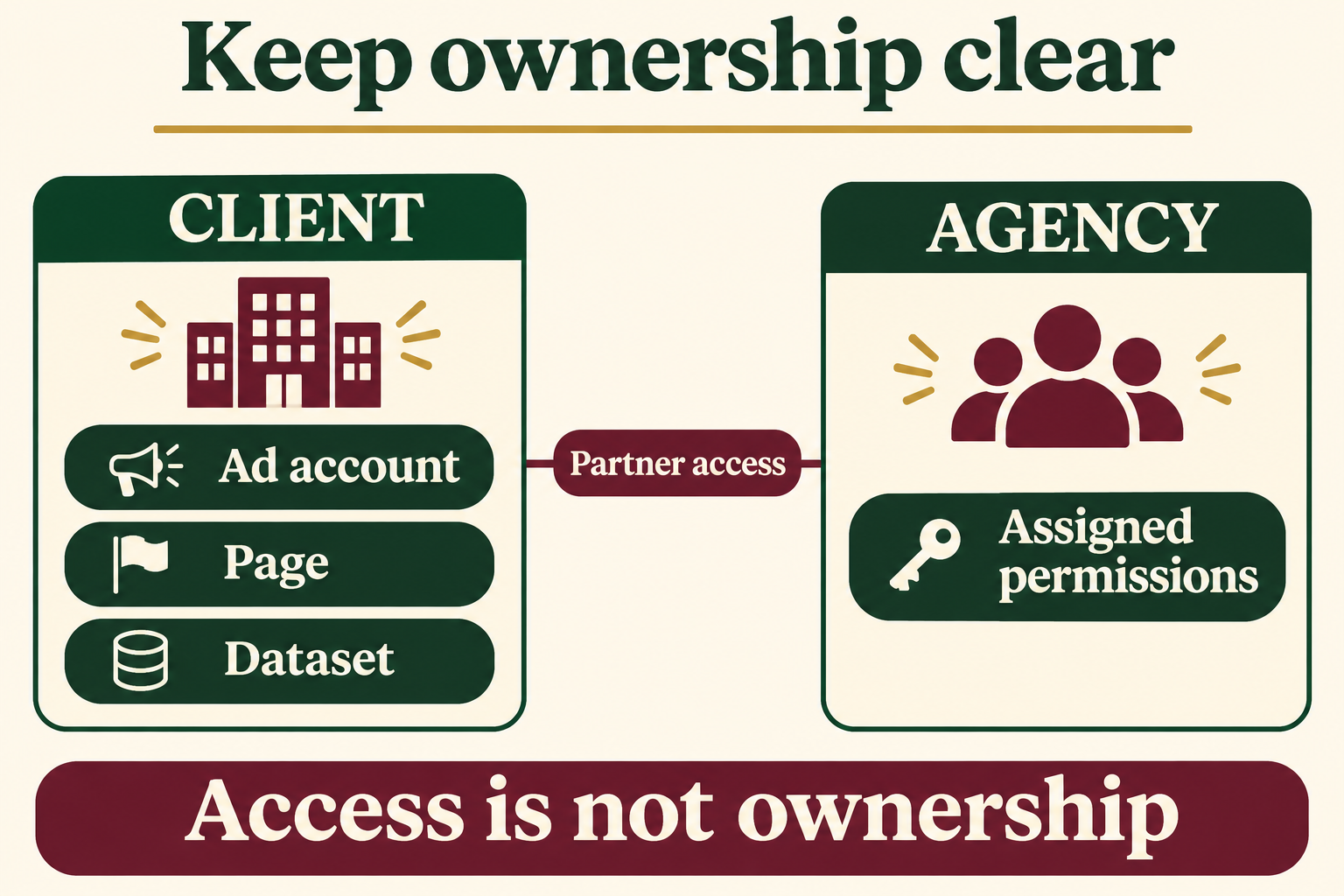
Meta’s ad-account guidance distinguishes creating an account, claiming an existing account and requesting shared access. For an agency serving a client, shared access allows the account to remain in the client’s portfolio. Claiming an account and requesting access are different actions.
This distinction matters commercially. The person who can launch a campaign is not necessarily the business that controls the account. A good onboarding conversation separates ownership, working permissions and financial responsibility before anyone starts spending.
How do you apply for a Meta Ads agency account?
Choose the route that matches your actual requirement. There is no single application that simultaneously grants client-management access, agency benefits and credit.
Route 1: Set up authorised client-account management
- Identify the owner. Record the client’s business portfolio and ad-account IDs. Confirm who can approve access.
- Use the agency’s own business portfolio. Keep agency staff access organised rather than sharing one person’s login.
- Request shared access to the client account. Follow the current account-sharing flow in Business Suite settings. The client’s authorised administrator should review and approve the request.
- Assign the necessary assets and permissions. Ad-account access alone may not cover the Page, Instagram account, dataset, catalogue or leads needed for the agreed work.
- Separate campaign work from finance. Give financial access only to people who need to reconcile or manage payments.
- Check the handover. Verify that the intended people can see the correct assets and reports, and that unrelated client assets are not exposed.
Menu labels can change. The objective remains a documented owner and approved working access. Do not select a claim or ownership action merely because it appears beside the sharing option.
Route 2: Explore Meta’s agency programme
Meta’s current agency benefits page describes Meta Performance Accelerator for agencies and directs agencies to Partnership Home. It says benefits eligibility is determined after enrolment. It describes education, rewards and support opportunities, with conditions attached to individual benefits.
Start from the official Agency Success Centre, follow the programme entry point and inspect the requirements presented to your business. Record the programme name, date, applicable geography and benefit conditions. A provider’s logo or screenshot is not enough to prove your business will receive the same benefits.
Do not equate programme participation with a transferable account, automatic certification or guaranteed account management. Confirm the specific benefit you need rather than treating “partner” as an all-purpose entitlement.
Route 3: Apply for monthly invoicing when eligible
Meta’s monthly-invoicing application guidance says eligible businesses receive a banner or notification in Business Suite or Billing and payments. If it is absent, continue with the existing payment method.
The application requires the relevant portfolio control and finance permissions. Prepare accurate legal-entity, address and billing information, along with business documentation if requested. Review the selected accounts and terms before submitting. An application may be approved or require further review; submitting it does not establish approval.
For an Indian business, inspect the options available to its actual legal entity and account. Do not assume that a foreign agency’s credit arrangement, payment method or programme benefit is available in India.
After how much spend does an agency account become available?
We could not verify one universal published spend threshold that unlocks a “Meta Ads agency account” from the official sources inspected. That does not mean every programme has no requirements. It means the question needs a named programme or billing product before a number can be meaningful.
A claim such as “spend this amount and get an agency account” should come with the current official requirement, its measurement period and the benefit it actually unlocks. Spend managed across clients is also different from spend by one advertiser.
On smaller screens, swipe the table sideways to view all columns.
| Requirement | Correct check |
|---|---|
| Managing a client’s existing account | Authorised sharing and permissions; not an assumed spend-based upgrade. |
| Agency programme benefits | Current eligibility in the official programme for that business. |
| Monthly invoicing | Eligibility notification, application and approval in the account. |
| Provider minimum deposit or monthly spend | A commercial condition imposed by that provider; not automatically a Meta qualification rule. |
Ask whether any quoted threshold means billed spend or delivered spend, gross or net of taxes, one account or a portfolio, and one month or a rolling period. If the provider cannot identify the underlying official requirement, treat the number as unverified.
How many clients are required, and who is eligible?
No universal minimum client count was established by the official pages reviewed. Ordinary authorised account management, agency-programme qualification and invoicing eligibility are different checks.
An agency should be able to document legitimate client relationships and the authority to manage their advertising. If a programme asks for a client count, verify how it defines an active client and which period it measures. Do not confuse the number of ad accounts with the number of independent clients.
A brand advertising its own products does not need to describe itself as an agency merely to work with an agency. Equally, a new agency should not manufacture client relationships or buy access to meet a supposed qualification target. Build the correct operating setup first and pursue relevant programme benefits through official channels.
Can you purchase or rent a Meta Ads agency account?
Buying professional campaign-management services is different from buying account privileges. Meta’s Advertising Standards prohibit trading site privileges, including administrative access to assets, and prohibit helping others evade enforcement. The same policy requires separate ad accounts for separate advertisers rather than changing the client associated with an established account.
Consequently, an offer advertised as a rented account deserves scrutiny. A contract with a provider does not override platform rules. Neither an old account nor a claimed partner relationship makes prohibited access trading acceptable.
If your intention is to hire an agency, purchase a defined service: campaign planning, creative production, measurement, optimisation and reporting. Require an authorised access arrangement and clear ownership. Avoid offers whose main product is an aged profile, transferred credentials, a replacement identity or a way around an existing restriction.
What should the purchasing process look like?
- Write down the operational problem: campaign expertise, staff access, reconciliation, creative capacity or measurement.
- Request a scope and itemised quote for the services that address that problem.
- Confirm the provider’s legal identity, invoicing details, working team and references it has permission to share.
- Review asset ownership, access permissions, payment responsibility and offboarding in writing.
- Verify any claimed Meta programme status through the relevant official route.
- Approve services only after policy compliance and financial responsibilities are clear.
This process helps avoid paying a premium for an account label when the real requirement is an experienced media buyer or better finance administration.
What benefits can an agency setup genuinely provide?
The strongest reasons are operational. A well-managed setup can make it easier to assign work, separate client access, track responsibilities and maintain continuity when team members change. Those benefits come from the operating process, not the phrase printed on a sales page.
An agency can also contribute useful expertise: choosing the right conversion objective, improving an offer, briefing creative, checking event quality and reviewing lead outcomes. These are services to evaluate through evidence and scope, rather than automatic properties of an account.
Conditional programme benefits are a separate layer. Meta’s current programme page describes training, support and reward opportunities. Availability must be checked for the agency and benefit concerned. Monthly invoicing, where approved, can simplify reconciliation; it also introduces payment obligations.
None of this establishes guaranteed lower CPM, higher ROAS, faster approvals or immunity from restrictions. If a provider claims a delivery advantage, ask for comparable evidence that separates account arrangements from changes to creative, budget, audience, offer and measurement.
Does “unlimited spend” mean unlimited advertising capacity?
No. First establish which limit the provider means. Several different controls are often bundled into that phrase.
- Campaign budget: the amount allocated to a campaign or ad set under its budget settings.
- Account spending limit: a separate account-level spending control when configured.
- Billing threshold: a trigger for charging an automatic-payment account; it is not a promise about daily delivery.
- Monthly-invoicing credit limit: the maximum unpaid balance permitted under that arrangement.
Meta’s credit-limit guidance explains that the limit concerns unpaid spend and does not improve advertising performance. Ads can pause when the available limit is exhausted. Sharing access to a credit line does not remove the owner’s payment responsibility.
Before increasing budget, finance and the campaign team should agree on funding, reconciliation and escalation. An approved credit arrangement is not evidence that a larger budget will produce profitable customers.
What are the costs and negative points?
Extra fees can be difficult to compare
Ask for media spend, agency retainer, creative fees, software fees, payment processing, foreign exchange charges and taxes to be shown separately where applicable. Clarify whether a percentage fee applies to the actual advertising spend or to the money deposited.
Hypothetical fee example—not a provider quote or market benchmark: suppose a proposal includes ₹3,00,000 of media spend, a ₹20,000 management fee and an additional 3% service fee on media spend. The percentage fee is ₹9,000, bringing the illustrated total to ₹3,29,000 before applicable taxes and any other agreed charges. The commercial question is what the extra ₹9,000 buys and whether it duplicates the retainer.
Ownership and exit can become a dependency
If the provider controls essential assets, a disagreement may interrupt access, reporting or campaign work. Do not assume account ownership, audiences or historical activity can simply be transferred when you leave. Write down what remains with the client, what can be exported and what needs to be rebuilt.
Prepayments create counterparty exposure
When you pay a provider before media is delivered, you depend on its reconciliation and refund process. Obtain the unused-balance rules, refund time, disputed-charge procedure and evidence showing how spend is accounted for. A balance in a provider dashboard is not, by itself, proof of spend delivered by Meta.
Support promises may exceed the service actually supplied
A provider’s support desk is different from direct Meta support. Ask who responds, during which hours, what the escalation route covers and whether a response target is contractual. A promise to resolve every restriction is not a credible guarantee.
An account change may distract from the real performance problem
A new arrangement will not automatically repair a weak product page, poor conversion tracking or slow sales follow-up. It can also create unnecessary migration work. Diagnose the failure before moving the advertising operation.
Which guidelines should agencies and clients follow?
Meta’s current standards apply to the advertiser, its assets and the ads—including their destinations. An agency relationship does not create a policy exemption. If an asset is mistakenly restricted, use the official review route rather than treating another account as a workaround.
For day-to-day governance, use this operating baseline:
- Maintain an asset register listing the owner, business ID, account ID, working permissions and billing contact.
- Use individual staff access, two-factor authentication and the least privilege necessary for each role.
- Separate clients’ assets and data; review connected tools and remove obsolete access when people leave.
- Keep business identity, payment information, advertised offers and destination pages accurate.
- Check product-specific and geography-specific restrictions before planning campaigns in sensitive categories.
- Agree who can raise budgets, change payment settings, approve creative and handle a restriction.
- Document an exit plan before onboarding, including reporting handover and access removal.
These controls should be maintained as an operating routine. A one-time onboarding checklist becomes stale when staff, vendors or business entities change.
Who should use an agency setup—and who should not?
On smaller screens, swipe the table sideways to view all columns.
| Situation | Practical choice |
|---|---|
| Agency managing several legitimate clients | Use a structured portfolio and authorised access, with separate client accounts and clear responsibilities. |
| Brand hiring an external campaign team | Start with client-owned assets and documented partner permissions. |
| Finance team struggling with payment reconciliation | Review available billing options; check monthly invoicing only through the eligible account route. |
| Established agency seeking education or programme support | Inspect current official programme eligibility and the benefits relevant to its work. |
| Small business seeking cheaper clicks from an account label | Prioritise the offer, creative, conversion journey and measurement before buying extra services. |
| Advertiser seeking to evade a restriction | Resolve the underlying issue and use the official review process; do not purchase workaround access. |
The decision should follow the bottleneck. More permissions do not create better strategy, and a bigger credit limit does not establish a profitable unit economy.
How should eCommerce and lead-generation businesses evaluate an agency?
For eCommerce: connect access to commercial performance
Hypothetical example: an apparel brand wants to grow sales. Its checklist should cover access to the right catalogue and dataset, the accuracy of purchase values, product availability, creative production and the checkout journey. Reporting should make cancellations, returns and contribution margin visible alongside platform-reported revenue.
If creative fatigue is the concern, ask for a concept-development plan. Our guide to Meta creative diversification explains how a team can develop meaningfully different messages and executions. Account access is an enabling requirement; it is not the creative strategy.
For lead generation: connect enquiries to sales outcomes
Hypothetical example: a Mumbai office-fitout business receives many enquiries but few suitable projects. The review should cover service-area fit, qualification questions, lead routing, response ownership and how sales outcomes return to reporting.
Ask the agency to define a qualified lead before agreeing to a cost-per-lead target. Track whether sales can reach the person, whether the requirement fits, and whether a meeting or quotation follows. Paying more for account access will not repair an unattended CRM queue.
What should you check before signing?
Use the following worksheet in a provider meeting. For every answer, record the evidence, responsible person and unresolved action.
- What exactly is supplied: management services, programme participation, billing administration or access?
- Who owns each ad account, Page, Instagram account, dataset and catalogue?
- Is any part of the offer a sale or rental of administrative privileges?
- What official evidence supports claimed Meta status or eligibility?
- Which permissions are necessary, and who approves changes?
- Who owes Meta money, and who receives the invoice?
- How are media, service charges, deposits and taxes separated?
- What does a quoted spending “limit” actually measure?
- Can the client inspect spend and performance in the appropriate account?
- What happens after a rejected ad, payment failure or asset restriction?
- Who controls reporting, integrations and lead access during offboarding?
- What are the cancellation, refund and handover terms?
Do not score a missing ownership answer as a minor paperwork issue. Resolve it before committing budget. Where programme benefits are unconfirmed, evaluate the service without assuming those benefits will arrive.
Frequently asked questions
Is a Meta Ads agency account an official premium account type?
The phrase is used for several arrangements. Identify whether it means client-management access, an agency programme or billing. An account advertised by a provider is not proof of a universal Meta premium product.
Can a new agency manage its first client without a large spend history?
For ordinary client-account management, focus on legitimate authorisation and available sharing permissions. The reviewed help page does not state a universal managed-spend qualification for that access. Programme benefits and account creation limits are separate matters.
Does spending ₹10 lakh automatically qualify a business?
No automatic entitlement at that figure was established by the official sources reviewed. Ask which named programme or product the claim refers to and request the current official criteria for the relevant country and measurement period.
Are five or ten clients mandatory?
No universal client minimum was verified. A specific programme may use its own criteria, so check the current requirements presented to the business instead of treating a seller’s number as a platform-wide rule.
Should I pay someone to rent an ad account?
Do not treat renting access as equivalent to hiring an agency. The policy boundary explained above applies. Prefer a clearly scoped management service using authorised access, with ownership and responsibilities documented before payment.
Will an agency account prevent bans or improve ROAS?
Neither outcome is guaranteed by the label. Compliance issues can still arise, and performance depends on factors including offer, creative, measurement and the conversion journey. Ask for evidence of the agency’s work rather than promises of immunity.
Is monthly invoicing the same as an agency account?
No. It is a billing arrangement with its own eligibility, approval and payment obligations. Check the eligibility notification and actual terms in Billing and payments; agency access does not automatically grant it.
What should I keep when changing agencies?
Plan to retain business ownership of essential assets and continuity of reporting. Before onboarding, document access, data, integrations and financial responsibilities. At exit, reconcile outstanding work and charges, confirm the handover and remove access that is no longer needed.
Choose the operating model before paying for the label
A useful agency arrangement makes ownership clearer, work more accountable and performance easier to assess. Start with the problem you need solved, then verify the permissions, services and billing required to solve it.
If you are evaluating a Meta Ads agency arrangement, Digi Amenity can review account access, tracking, creative requirements and the lead or purchase journey before you commit more budget. Explore our Meta Ads management services to discuss the scope your business needs.