
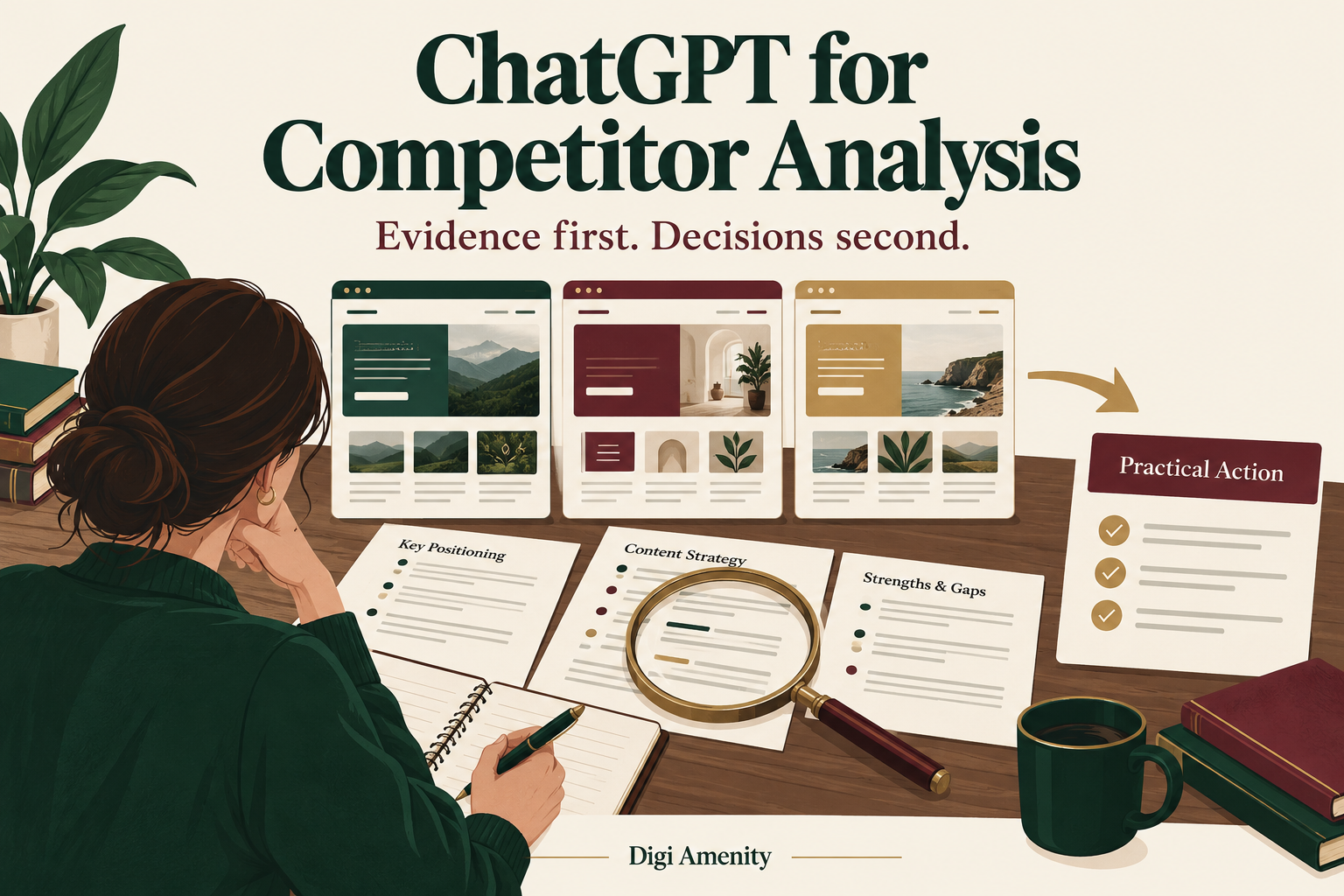
ChatGPT for competitor analysis works best when you give it a specific business decision, current public evidence and rules for handling missing information. Use it to organise what competitors say, compare their offers and identify questions your own website leaves unanswered. Then verify the findings and choose one measurable change. Do not treat a confident AI summary as proof of a competitor’s traffic, ad spend, lead quality or revenue.
For an Indian business owner, the useful output is often a small, checked comparison that helps improve a service page, product offer or enquiry journey—not a long presentation full of unsupported SWOT statements.
What can ChatGPT actually help you analyse?
It can help structure public website information, compare messages, group buyer questions and draft a test brief. For current research, ask it to use web search and provide sources. OpenAI’s web-search documentation explains that search results and citations appear when search is used; workspace settings can restrict access. A link pasted into a chat is not, by itself, evidence that the page was successfully read.
Use the capabilities available in your account. Product features can vary by plan, platform, region, rollout and workspace settings. This workflow does not require a particular paid plan, API integration or external connector: you can manually collect short, permitted public excerpts if a page cannot be opened. If using Deep research, first check that it is available in your workspace. Do not assume it can access every source. For help selecting a research assistant, see our AI chatbot comparison for research and business work; assess citation quality and account capabilities before choosing.
Keep three kinds of information separate:
| Evidence type | Example | Safe interpretation |
|---|---|---|
| Direct observation | A service page displays a starting price and a list of inclusions | The business publicly offers those terms on the checked date |
| Competitor’s own claim | A page says its service improves enquiries | This is a marketing claim unless supporting evidence is available |
| Your inference | Clear inclusions may reduce uncertainty before an enquiry | A hypothesis to test, not a demonstrated conversion improvement |
Private results remain unknown unless a credible, relevant disclosure establishes them. Public follower counts, visible ads and attractive websites do not establish profitability.
Which business question should you start with?
Choose the decision before choosing the competitors. “Analyse our competition” is too broad. Better questions include:
- Which buyer questions should our website redesign page answer before asking for a quotation?
- Are our product bundles easy to compare on quantity, delivery and returns?
- Does our ad promise match the information on the landing page?
- Which service inclusions can we explain more clearly without changing our actual offer?
Write a short scope: product or service, buyer, geography, price context, decision and review date. For a Mumbai service business, location can affect delivery, site visits or support. For software sold nationally, a random list of Mumbai competitors may be less useful than businesses serving the same customer type across India.
Start with a manageable set, such as three direct competitors and one alternative a buyer might choose. This is a practical starting point, not a research rule. Separate direct rivals from publishers that compete for search attention and large brands you are studying only for inspiration.
How do you build a trustworthy competitor evidence pack?
Collect comparable pages: the relevant service or product page, pricing or quotation information, FAQs, delivery or support terms and the next step in the buying journey. Use the same checklist for your own website.
Record the exact URL, date checked and context for each finding. A homepage description does not necessarily describe every product. A promotional price may apply only to the first month. A testimonial may describe a different service from the one you are comparing.
For Indian pricing comparisons, check currency, whether GST is included or unspecified, one-time versus recurring fees, minimum quantities, commitment period, add-ons and renewal terms. Do not rank an all-inclusive package against a basic starting price as though they were equivalent. If pricing is quotation-only, record that. Do not ask AI to fill the gap with a plausible number.
For public reviews, note the platform, dates and sample you examined. A handful of selected complaints is not representative proof of the entire customer experience. Remove unnecessary personal details before using excerpts, and follow the source’s access and reuse conditions.
Keep private CRM exports, customer names, unpublished plans, credentials and confidential analytics out of a public-source exercise. Do not connect an internal system merely to make this workflow more convenient.
Copy this competitor analysis template
Use one row per finding, rather than one large paragraph per competitor. Copy these fields into your own spreadsheet or document:
| Field | What to record |
|---|---|
| Business and page | Competitor name, exact URL and relevant service/product |
| Checked date and context | Date, country/currency, offer term and any access limitation |
| Evidence | Brief factual note or short excerpt with its location on the page |
| Classification | Observed fact, competitor claim, inference or unknown |
| Verification | What you checked, contradictions and remaining uncertainty |
| Buyer implication | The question this could help a customer answer |
| Proposed test | One change to your own offer, page or process |
| Owner and measurement | Responsible person, baseline, success metric and review date |
A useful rule: a citation is a route to verification, not a substitute for it. Open the source and confirm that it supports the specific claim, with the same scope and date. OpenAI’s guidance on reviewing ChatGPT results recommends checking important claims, current source material, missing information and unsupported assumptions.
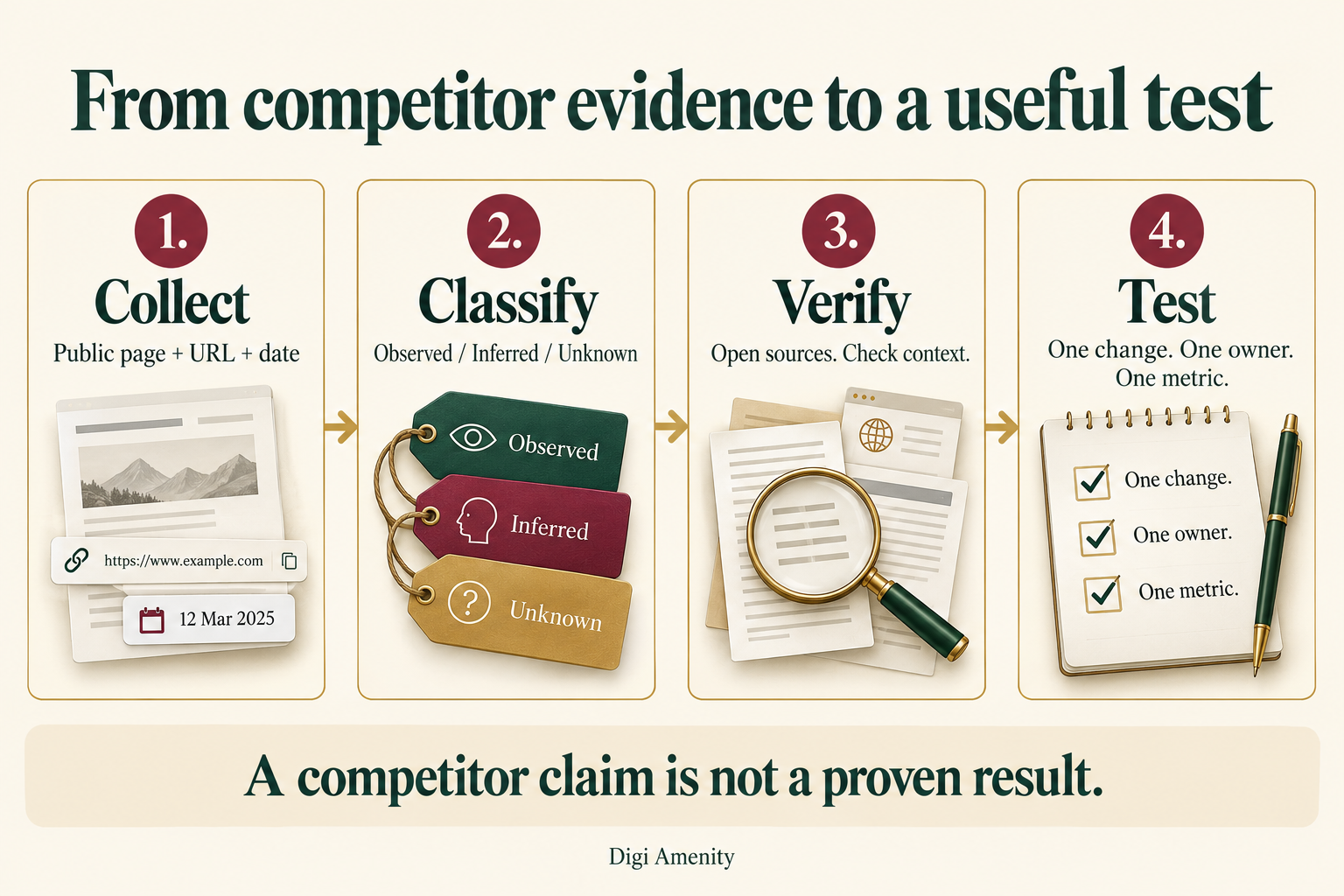
Conceptual workflow illustration. The document and date shown are illustrative, not a real competitor observation.
Which ChatGPT competitor analysis prompts should you use?
The following are proposed prompts, not results from a tested client project. Replace the placeholders and review every output. Work in stages so that an unsupported assumption does not quietly become the foundation of the next answer.
Prompt 1: Extract evidence without adding a strategy story
I am comparing [service/product] for [buyer] in [market]. The decision is [specific decision]. Use only the public source notes below. For each finding, return: business, URL, checked date, exact observation, classification and unresolved question. Classify each item as observed fact, competitor claim, inference or unknown. Preserve prices, currency, billing period and exclusions exactly. If a source is missing or unreadable, say so. Do not invent traffic, budgets, revenue, rankings, customers or conversion rates. Do not infer that a feature is absent merely because it is not in these notes. Source notes: [paste checked public notes].
Expected output: an evidence table you can compare with your original notes. Reject rows that introduce unsupported numbers, change conditions or turn a seller’s promise into an established result.
Prompt 2: Find meaningful differences and contradictions
Compare only the verified rows in this evidence table. Group differences under buyer fit, offer scope, proof, price conditions and enquiry/purchase journey. Cite the row IDs behind each statement. Separate a communication gap from a confirmed product/service gap. Identify contradictions and the additional page or question needed to resolve each one. Explain where the comparison is not like-for-like. Give no universal winner and make no claim that an observed tactic caused better performance.
Expected output: a short comparison with clear limits. “We did not find maintenance terms on the three pages checked” is defensible. “This competitor provides no maintenance” is not, unless the evidence actually establishes that.
Prompt 3: Turn one finding into an owned test
Using the checked comparison, propose up to three changes to our own website or process. For each, state the buyer problem, supporting evidence row IDs, what remains uncertain, implementation effort and possible downside. Select one reversible test. Define the owner, exact change, baseline period, primary outcome, lead-quality guardrail, review date and conditions for stopping or revising the test. Use placeholders where our analytics or business targets are unavailable. Do not copy competitor wording or promise an uplift.
Expected output: a test brief that a marketer and business owner can approve together. A large list of recommendations without evidence, ownership or measurement is unfinished work.
What would this look like for a Mumbai service business?
Hypothetical example—not a Digi Amenity client result or an executed AI test: a Mumbai business selling website redesign services wants more suitable enquiries. Its page lists design features but leaves ownership, maintenance and content responsibilities unclear.
In a synthetic comparison, Competitor A’s page lists who supplies content; Competitor B states what ongoing support includes; Competitor C uses “contact for pricing” without a public package breakdown. These are invented teaching examples, not claims about real businesses.
The useful conclusion is not “copy A’s design” or “B must convert better.” It is that a prospective customer may need clearer scope information before enquiring. The business should first confirm its own delivery process, then test a short section explaining content responsibilities, handover, support boundaries and how a quotation is prepared.
The CTA might ask the buyer to describe the current website and intended outcome. Track whether enquiries fit the service, not just whether the button receives more clicks. Clearer scope could reduce total submissions while improving suitability; it could also discourage suitable buyers if the wording sounds restrictive. Both possibilities belong in the test brief.
This connects competitor research with website development and enquiry journeys. The page, offer, tracking and follow-up need to support the same customer decision.
How should you use the findings across SEO, ads and conversion work?
For SEO, compare the questions and intent served by relevant pages. Check whether the result is a service page, product page, guide or comparison. Do not assume you need a longer article because a competitor has one. A useful next step is to answer an important buyer question accurately and connect it to the relevant service page. A structured SEO review should also check crawlability, indexing and internal links; content comparison alone cannot diagnose visibility problems.
For advertising, examine the observable promise and the landing-page journey. An ad’s presence does not prove that the campaign is profitable, that its budget is large or that its targeting suits your business. Develop your own message from verified capabilities and buyer needs. Before increasing spend, check the conversion action and downstream lead quality as part of Google Ads campaign analysis.
For website conversion, review the mobile journey yourself. Is the next step understandable? Can a buyer find terms, compare scope and use the form? Text analysis cannot establish that a form submits successfully, a checkout works or a phone number is answered. Those need separate, authorised functional checks. Do not submit fake enquiries to competitors as part of a desk-research exercise.
How do you know the analysis was useful?
Measure the quality of the research and the effect of the change separately.
For research quality, track how many decision-relevant claims have a checked source, how many contradictions remain unresolved and how many recommendations can be traced back to evidence. Use these as process measures, not a made-up “AI accuracy score.” An evidence gap is a finding to investigate, not an empty cell to disguise.
For the business test, define a baseline before changing the page. Keep channel, device, location and period filters consistent. Record campaign, offer, pricing and seasonality changes that could affect the comparison. A simple before/after difference can suggest a direction; it does not by itself prove causation. Where traffic permits, use a properly designed experiment.
For lead generation, a useful definition is:
Qualified enquiry rate = enquiries meeting your agreed qualification criteria ÷ eligible landing-page sessions.
Define the criteria first—for example, service fit, geography and a genuine project requirement—and use the same attribution and time window. Connect enquiries to sessions only where your tracking supports that comparison. If it does not, report the counts separately and fix measurement before presenting a rate. Treat a WhatsApp click or form start as an interaction, not automatically a qualified lead.
For ecommerce, examine purchase behaviour and commercial outcomes with consistent attribution, including returns or cancellations where relevant. Avoid declaring success from add-to-cart activity alone. With small samples, extend observation and keep uncertainty visible rather than naming an early winner.
What should you check before sharing the report?
- Every important factual statement has a source and checked date.
- Seller claims, observations and your interpretations are distinguishable.
- Prices are comparable or explicitly marked as non-comparable.
- Missing information is not presented as proof of absence.
- No private metrics, invented results or unsupported competitor accusations appear.
- Proposed copy is original and reflects what your business can actually deliver.
- One practical action has an owner, baseline, guardrail and review date.
Refresh the evidence when a decision is due or a material offer changes. Choose a review rhythm your team can maintain; a narrow, checked update can be more useful than repeatedly regenerating a comprehensive report.
Frequently asked questions
Can ChatGPT do competitor analysis on its own?
It can assist with research and comparison, but someone must define the market, check sources and judge whether the comparison is fair. A complete-looking answer can still miss a local competitor, a pricing condition or an important buyer requirement. Keep a human owner for the final decision.
Can it find competitors’ website traffic or ad budgets?
Do not treat AI-generated numbers as verified private metrics. A third-party research tool may provide estimates, while a company may publish selected figures. Label the source, date, methodology and limitations. Without credible evidence, record traffic, spend, revenue and conversion performance as unknown.
Do I need a paid ChatGPT plan?
The evidence-led method can use manually collected public notes. Check the features and limits available in your account before planning web searches, uploads or Deep research. This guide does not depend on a specific subscription, model or universal India rollout of an advanced feature.
What if ChatGPT cannot open a competitor’s website?
Record the access limitation. You can inspect the public page yourself and provide a short permitted excerpt with its URL and date, or leave the finding unresolved. Do not bypass a login, paywall or access restriction, and do not treat a search snippet as a full page review.
How many competitors should a small business compare?
Begin with a few that serve a genuinely similar buyer and problem. Three direct rivals and one alternative is a manageable example, not a required number. Expand only if important segments or buyer choices are missing. Comparable evidence matters more than a large list.
Is competitor analysis the same as copying successful content?
No. The purpose is to understand buyer questions, differences and trade-offs. Use that understanding to explain your own offer more clearly and develop original content. A competitor’s visibility or design does not prove that its wording or tactic will work for your audience.
What should the final deliverable contain?
A short scope, a dated evidence table, a comparison that exposes uncertainty, and one prioritised test with an owner and measurement plan. Keep raw source notes available so another person can challenge the conclusions. A SWOT slide alone is usually not enough to guide implementation.
Turn the comparison into a better customer journey
If your competitor research produces plenty of observations but no clear next action, Digi Amenity can review your search intent, offer, landing-page message and enquiry journey together. The aim is to identify a practical change your team can deliver and measure before committing more budget.
