

To improve ChatGPT brand visibility in 2026, make your public website accessible to search retrieval, explain your business with verifiable facts, publish useful answers to buying questions, and check how your brand appears across a consistent set of prompts. Measure mentions, citations, visits and qualified enquiries separately. None of these actions guarantees a recommendation.
The first decision is where to focus. A business with broken service pages needs a different fix from one that appears regularly but is described incorrectly. A brand receiving visits but no suitable enquiries may have an offer or landing-page problem rather than a discovery problem.
This guide gives Indian business owners a way to diagnose those situations, assign practical work and assess the result. The recommendations are an operating approach, not a published formula for ChatGPT’s ranking or selection systems. Platform documentation was checked on 29 October 2026.
What does ChatGPT brand visibility actually mean?
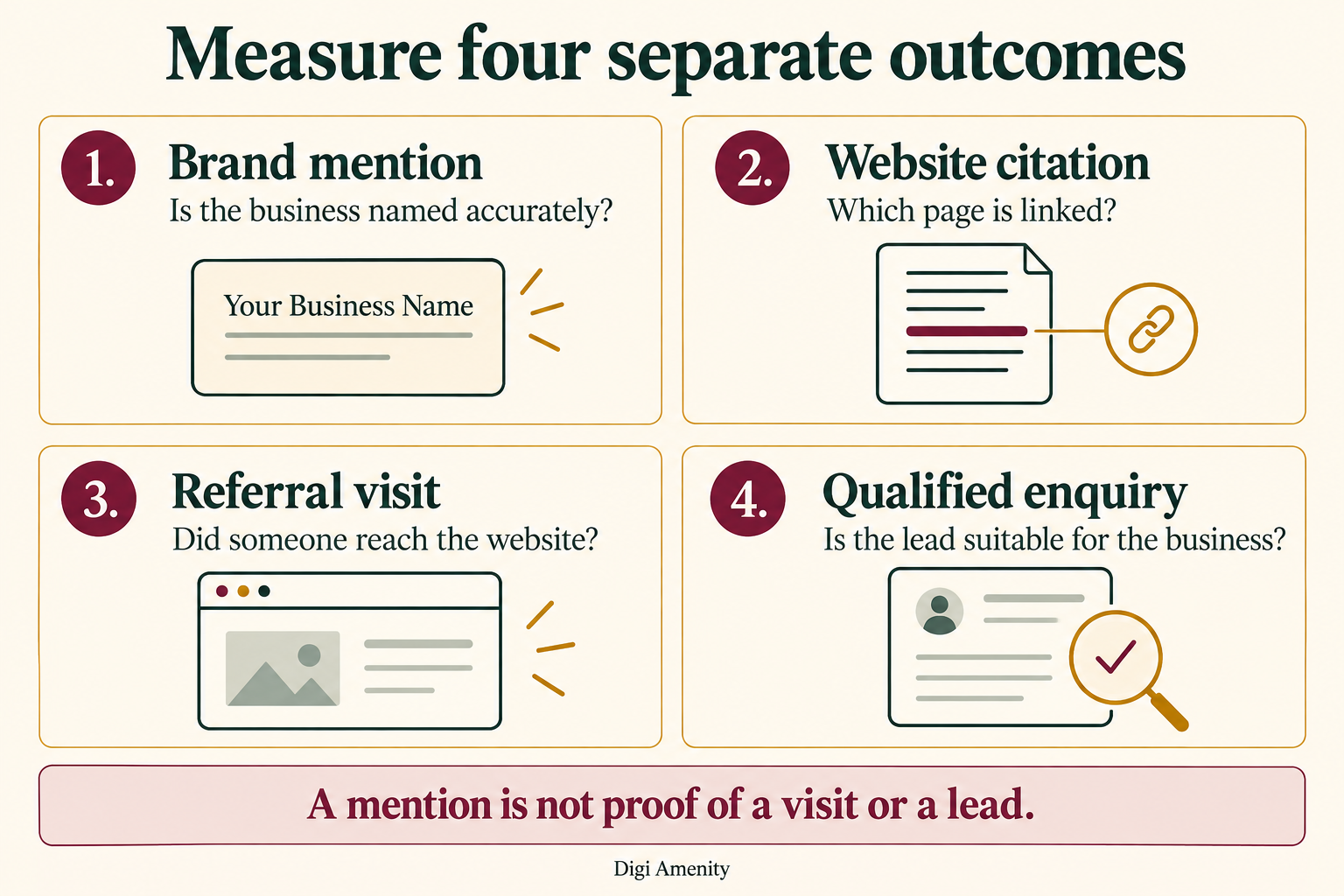
Use four separate measurements instead of one headline “AI visibility score”.
| Outcome | What to record | What it does not prove |
|---|---|---|
| Brand mention | Your business is named in the answer; record whether the description is accurate and relevant | That your website was used, linked or visited |
| Website citation | A source link points to your domain; save the exact URL and surrounding claim | That the answer recommends your business or endorses every claim on the page |
| Referral visit | An identifiable visit arrives from ChatGPT in your analytics | The total number of people who encountered your brand |
| Qualified outcome | A suitable enquiry, sales opportunity or purchase can be linked to the visit or a recorded customer statement | That every recorded lead was caused solely by ChatGPT |
A useful report might say, “Our delivery-policy page was cited, but our brand was not recommended.” That is more actionable than “We rank in ChatGPT”. It identifies the page being used and the outcome that remains missing.
Keep ads and organic answer observations in different reports. Also separate answers with visible web-search evidence from answers where search use is not observed. Do not infer the assistant’s internal retrieval process solely from whether the answer contains a link.
OpenAI’s web-search documentation explains that ChatGPT can search the web and display sources when it uses search. Workspace settings can restrict availability. Record the actual interface and search behaviour you observe rather than assuming every account produces the same experience.
Can ChatGPT access the pages that explain your business?
Start with the pages that matter commercially: your homepage, main service or product pages, About page, contact information and supporting evidence. An inaccessible page cannot provide a useful public reference through that access route.
OpenAI distinguishes these user agents:
| User agent | Documented purpose |
|---|---|
| OAI-SearchBot | Discovering content for ChatGPT search results |
| GPTBot | Crawling content that may be used for foundation-model training |
| ChatGPT-User | Certain user-initiated page visits and actions; it does not determine search inclusion |
Search and training controls are independent. OpenAI recommends allowing OAI-SearchBot and its published IP ranges for search access; allowing GPTBot is a separate decision. Its documentation says sites opting out of OAI-SearchBot are excluded from search answers, although navigational links may still appear. These controls do not promise that an allowed page will be selected. See the official crawler documentation.
Ask your developer or hosting team for a small evidence pack:
- The final HTTP status and URL for each important page, including redirects.
- The effective robots.txt rules for the intended search crawler.
- Whether a CDN, firewall, login screen or bot challenge prevents retrieval.
- Whether the main facts are available in readable page content rather than only an image or an interactive widget.
- The page’s canonical URL, index directives and internal links, with any accidental conflicts explained.
These are access and website-quality checks, not a list of confirmed ChatGPT ranking factors. A normal browser opening a page is useful evidence for visitors; it does not prove that a crawler can access it. Conversely, an empty crawler log does not prove a block.
Have the developer verify crawler identity against the provider’s published guidance before changing firewall rules. Avoid globally disabling bot protection just to make one test pass. Record the exact restriction, the narrow change and the follow-up observation.
Does your website provide a clear, consistent account of the business?
Create one reliable public page for each core service or product category. It should answer what you offer, who it suits, where you operate, how the work is delivered and what a buyer needs to decide next.
For a service business, review these facts together:
| Buyer question | Evidence your page should provide |
|---|---|
| Is this the right company? | Consistent business name, official domain and contact details |
| Does it solve my problem? | Specific deliverables, process and relevant use cases |
| Can it serve my location? | Actual service coverage and delivery model |
| What will I need to provide? | Access requirements, inputs, responsibilities and exclusions |
| What should I budget for? | Verified pricing, or an explanation of the factors behind a quote |
| Why should I trust the claims? | Named expertise and permissioned examples with scope and limitations |
Hypothetical example: a Mumbai packaging supplier’s homepage says “custom packaging”, its directory profile says “printing services”, and its product page never states minimum order quantities. The practical repair is to clarify the actual offer and buying conditions across those pages. Adding “best packaging company” repeatedly would not resolve the buyer’s uncertainty.
Use Mumbai or another location when it describes real service coverage. Do not manufacture office addresses or create near-identical area pages to suggest a presence the business does not have.
Structured data should reflect the visible page accurately. Google’s structured-data quality guidelines require relevant, truthful markup. That is Google guidance, not evidence of a ChatGPT ranking benefit. Use appropriate markup as part of website maintenance; do not sell a schema installation as guaranteed AI inclusion.
What content should you publish to support relevant discovery?
Work backwards from an actual buying decision. “We provide excellent solutions” gives a reader little to evaluate. A page explaining what is included in a tracking audit, what access is needed and how the findings are prioritised is more useful.
Choose a small group of questions your business can answer with evidence:
- What does the service include, and what is outside its scope?
- Which approach fits a particular business constraint?
- What does implementation require from the customer?
- What can go wrong, and how can the buyer assess the risk?
- How should success be measured after the work is complete?
For each answer, add something a generic summary would miss: a decision table, a worked calculation with stated assumptions, a checklist, a real process diagram or an approved example. Label hypothetical scenarios. If you have no verified client result, explain the method instead of inventing a success story.
Put the answer near the beginning of the relevant section. Then explain the conditions, evidence and limitations. Use descriptive headings, readable tables and links to supporting sources. The purpose is to make the answer understandable and checkable; no particular paragraph length guarantees a citation.
Keep updates meaningful. Change a date when the content has been reviewed or revised, and explain material changes where useful. Publishing large numbers of overlapping pages can make ownership and maintenance harder without answering any new buyer question.
Our broader agentic-web readiness guide covers the next stage: preparing a business for discovery, evaluation and actions across connected systems. Here, the narrower objective is accurate brand representation and evidence you can measure.
How should you approach reviews and third-party mentions?
Audit the places where customers already evaluate your business: relevant directories, professional profiles, trade publications, partner pages and genuine reviews. Correct outdated contact information, broken links and inaccurate service descriptions where you have permission to do so.
Then consider what you could contribute that merits independent coverage. A useful technical explanation, an original dataset with a transparent method or an informed interview gives an editor something to assess. A request to insert your company into a “best brands” list without evidence does not.
Treat frequently cited third-party pages in your prompt audit as research leads. Read them, assess whether they are relevant and identify factual gaps. Their presence in a sampled answer is not proof that buying a placement will improve future visibility.
Do not manufacture reviews, impersonate customers, seed disguised recommendations or promise a citation in exchange for a paid link. Record sponsorships honestly. Independent corroboration should help a buyer verify the business; the process should remain useful even if ChatGPT never cites that source.
How can you audit ChatGPT brand visibility without buying a tool?
Create a small, repeatable prompt panel. For a manageable pilot, use 12 prompts across three buyer situations and repeat them on three separate dates. This is a proposed workload, not a statistically representative sample of all ChatGPT users.
Separate unbranded discovery from branded accuracy checks. “Which supplier can help with this requirement?” tests discovery. “What does [business name] offer?” tests how the named business is described. Combining them would make visibility look stronger simply because you supplied the name.
Examples to adapt, not executed tests:
| Prompt group | Hypothetical prompt | What to inspect |
|---|---|---|
| Problem-led discovery | “Our Indian B2B website receives enquiries, but most are irrelevant. What should we investigate, and what type of specialist could help?” | Whether the answer identifies a suitable service and relevant providers |
| Supplier evaluation | “How should a Mumbai manufacturer evaluate an agency for technical SEO and lead measurement?” | Selection criteria, named businesses and supporting sources |
| Constraint-led comparison | “For a small service business with a limited marketing team, when is an SEO audit more useful than publishing more articles?” | Whether the explanation is accurate and commercially relevant |
| Branded accuracy, reported separately | “What services does [business name] offer? Use current public sources and identify anything you cannot verify.” | Incorrect facts, stale pages and unsupported statements |
For every run, save the exact prompt, date, interface, visible model label if available, language, intended market, login/personalisation conditions and full answer. Record whether search activity or citations were observed. Do not assume a new chat removes all account-level personalisation.
Use the same wording and conditions for comparisons. If you add Hindi or Marathi prompts, treat them as separate cohorts rather than silently mixing them with English. Changes in wording, interface or model belong in the change log.
How should the worksheet calculate results?
Use one row per completed answer. For the unbranded panel:
Sample mention rate = completed answers naming your brand ÷ all completed answers in that panel × 100.
Sample owned-domain citation rate = completed answers linking to your domain ÷ all completed answers in that panel × 100.
Count each outcome once per answer, even if the brand or link appears repeatedly. Keep failed runs in a separate column and show completed versus attempted totals. A failed request is missing evidence, not an answer with no mention. If a restricted cohort only includes search-observed answers, label that denominator explicitly.
Hypothetical calculation: 12 prompts repeated on three dates create 36 planned runs. If two fail, the denominator is 34 completed answers. Seven answers naming the brand give a sample mention rate of 20.6%; four answers linking to its website give an owned-domain citation rate of 11.8%. These are illustrative numbers, not Digi Amenity results or market benchmarks.
Do not call either percentage your share of all ChatGPT searches. You do not know that population from this exercise. Read the answers too: a higher mention rate is not progress if the business is repeatedly described incorrectly.
What should you fix when the audit finds a problem?
Use this diagnostic matrix to turn observations into work. Investigate the cause rather than assuming every absence is a technical block.
| Observation | Evidence to inspect | First action and owner | Completion check |
|---|---|---|---|
| Relevant page cannot be retrieved | Status, redirects, robots rules and edge logs | Developer resolves the demonstrated access problem | Intended public content is accessible through the tested route |
| Brand description is wrong | Exact answer, cited URLs and current business facts | Content owner corrects the authoritative page; requests corrections elsewhere if warranted | Public facts agree; repeat prompt observations retained |
| Competitors appear but your brand does not | Buyer intent, cited pages and gaps in your own evidence | Marketing owner strengthens one relevant service page or evidence asset | Page answers the missing buying question; later observations compared |
| Website is cited for an unrelated topic | Exact cited passage and landing page | Editor checks topic focus and business relevance | Clearer scope and relevant onward journey |
| Referrals arrive but enquiries are weak | Landing page, offer, form, source data and lead disposition | Web and sales owners review the conversion journey | Form works and sales can distinguish suitable from unsuitable leads |
| A score changes sharply | Prompt list, completed runs, interface and model changes | Analyst checks comparability before proposing content changes | Comparable periods or an explicitly reset baseline |
A completed fix proves that the underlying defect was addressed. It does not prove that the fix caused a subsequent change in ChatGPT answers. Keep those two statements separate in management reporting.
How do you connect visibility to traffic and qualified enquiries?
Inspect your analytics acquisition reports for identifiable ChatGPT source and referral values. Build filters from the values actually present in your property, and keep the date range and attribution scope consistent. Use a test visit to check whether your setup records the expected source; do not assume it does.
Add landing-page context. A visit to an educational article and a visit to a service enquiry page represent different stages. Review the next step, form starts, successful submissions and sales qualification where those events are actually implemented and verified.
Define a qualified enquiry with the sales team. For example, a service business might require a relevant service need, a workable location and a genuine contact who wants to discuss a project. A WhatsApp click alone does not establish any of those conditions.
An optional “How did you hear about us?” field or sales note can capture self-reported ChatGPT discovery. Keep this separate from analytics attribution: people may remember incompletely, use several channels or discover the brand without clicking a link. Missing referral evidence is not proof of zero influence.
At Digi Amenity, the useful planning question is how SEO, content, tracking, the landing page and follow-up fit together. If the visit reaches a confusing or broken form, more visibility will not repair the journey. Include mobile form checks in the website development and conversion work, rather than reporting citations in isolation.
Does the approach change for ecommerce businesses?
The same distinction between observation and proof applies, but product accuracy deserves extra attention. Check that the product page, visible price, stock information, variants, shipping terms and return policy agree with the feeds or integrations your business actually uses.
Do not interpret a brand mention as proof that a particular product can be purchased through ChatGPT. Product discovery, merchant eligibility and checkout capability are separate questions. Confirm the current programme, market and account requirements directly before investing in an integration.
For a local service business, prioritise real service coverage, contact details, scope and enquiry handling. For an ecommerce store, prioritise accurate product and buying information. Neither needs a fictional “AI certification” or an unsupported claim that one plugin ensures inclusion.
What should your first 30 days look like?
| Period | Work to complete | Deliverable |
|---|---|---|
| Days 1–5 | Define the buyer situations, prompt panel, commercial pages and qualified-lead definition | Baseline worksheet with actual observations or clearly marked blanks |
| Days 6–12 | Resolve evidenced access problems and conflicting business facts | Change log with owner, affected URL and verification |
| Days 13–20 | Improve the most relevant service page and create one practical evidence asset | Reviewed content with sources, limits and a clear next step |
| Days 21–26 | Correct legitimate third-party profiles and inspect mobile conversion paths | Correction record and form/analytics test evidence |
| Days 27–30 | Repeat the comparable prompt panel and review referrals and lead quality | Keep, improve or investigate decision for each change |
This is an implementation schedule, not a promise of results within a month. If observations remain too sparse, keep collecting comparable evidence. If your pages are accurate and accessible but absent from answers, broaden the investigation into relevance and independent evidence rather than endlessly changing robots.txt.
Frequently asked questions
How do I get my business to appear in ChatGPT?
Start with accessible public pages that accurately describe the business and answer relevant buying questions. Check source consistency, useful evidence and the customer journey. Then observe a repeatable set of unbranded prompts. You can improve the information available, but you cannot require ChatGPT to select or recommend your business.
Is ChatGPT SEO the same as Google SEO?
They overlap in practical website work, such as clear content and sound technical maintenance. Their outputs and measurement are different. A Google ranking, a ChatGPT brand mention and a citation are separate observations; success in one should not be presented as proof of success in another.
Must I allow GPTBot to appear in ChatGPT search?
OpenAI documents search and training crawler controls separately. Review OAI-SearchBot for search access and make the GPTBot training decision independently. Have a developer check the effective rules and edge restrictions; changing a robots.txt line alone does not verify the complete access path.
Will schema markup or llms.txt guarantee citations?
No guarantee is established by the official documentation checked for this guide. Keep structured data accurate and consistent with the visible page. Treat a proposed llms.txt project as an experiment with a specific purpose and evidence requirement, not a substitute for useful public pages or a contract for inclusion.
Can a small Indian business improve its visibility without a paid monitoring tool?
It can start with a manual prompt panel, a spreadsheet and a focused website review. The limitation is coverage: a small sample cannot represent every user, language or buying situation. A tool may reduce collection effort, but its methodology, interface, geographic assumptions and underlying answers still need scrutiny.
Why does ChatGPT name my brand in one answer but not another?
A single answer is only one observation. Compare the exact prompt, date, interface, visible settings and sources before drawing a conclusion. Record differences and repeat under comparable conditions. Do not diagnose a penalty or invent an algorithm change from one missing mention.
How long does it take to improve ChatGPT brand visibility?
There is no reliable universal timeline established for the outcome described here. Access repairs and factual corrections can be verified as tasks, while answer selection remains outside the business’s control. Use the 30-day plan to complete and review work, then continue measurement rather than promising a fixed inclusion date.
Can I pay for guaranteed organic recommendations?
Do not accept a guarantee without a verifiable basis. Paid advertising, sponsored coverage and organic answer selection should be treated separately. When evaluating an agency, ask for the exact deliverables, reporting method, retained answer evidence and limitations, rather than a promise to make ChatGPT recommend you.
What is the most useful next step?
Choose one important buyer question and one page that should answer it. Check access, facts, supporting evidence and the next step for a visitor. Then record a baseline before making changes.
If your business is missing from relevant answers or being described inaccurately, Digi Amenity can review your public content, technical access, source consistency and enquiry journey through a focused SEO review. The output should be a prioritised fix list and a measurement plan, with clear limits on what can be controlled.