
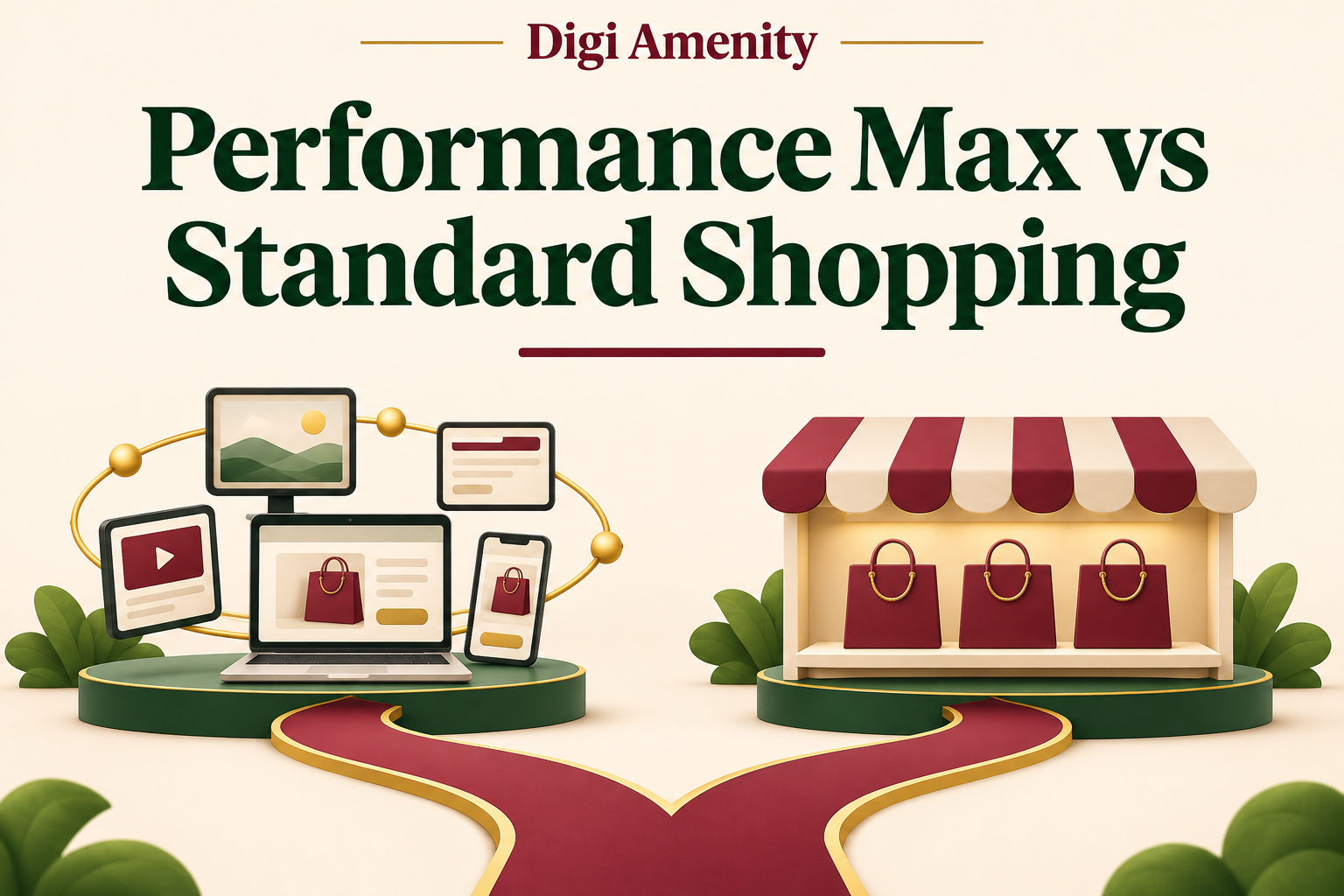
Choose between Performance Max and Standard Shopping according to the control you need, the quality of your conversion data and the economics of your catalogue. Standard Shopping can suit a focused product-advertising strategy with product-group bidding and query exclusions. Performance Max can suit broader reach across Google’s inventory using automated bidding and creative assets. Neither is automatically better for every ecommerce business.
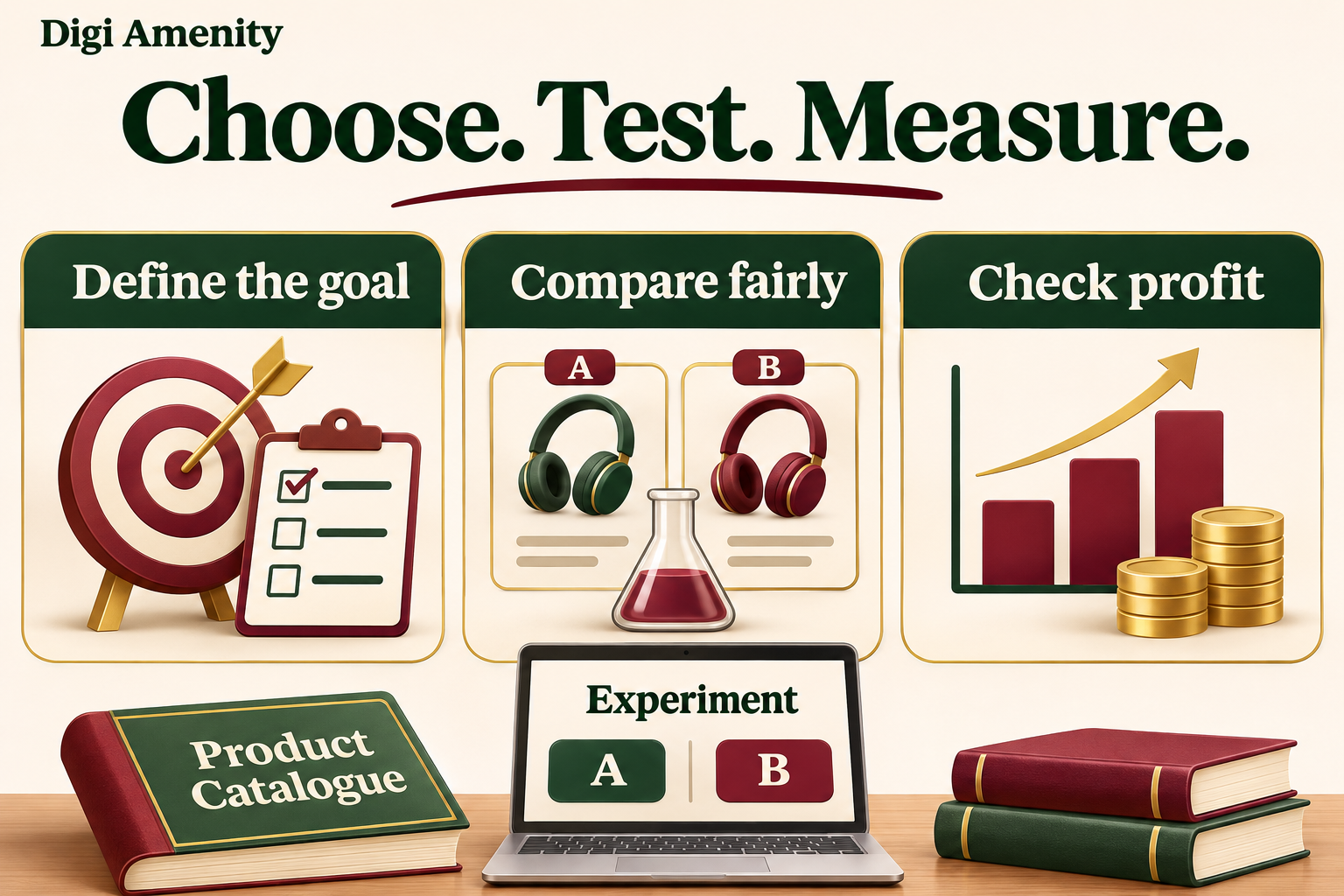
A sensible decision starts with eligible product data, accurate purchase measurement and a clear profit objective. Then compare the campaign types through a controlled experiment where available, rather than judging them by headline ROAS from different products or seasons.
What is the difference between Performance Max and Standard Shopping?
Shopping ads use Merchant Center product information to match products with relevant opportunities. You do not build their targeting by adding a list of positive keywords in the same way as a Search campaign. Product titles, attributes, prices, availability and landing-page consistency therefore matter before campaign selection.
Performance Max is a goal-based campaign type that can use a Merchant Center feed alongside other assets to serve across multiple Google channels. Standard Shopping is a more focused way to organise and advertise that inventory. Google explains the distinction in its Shopping ads overview.
On a phone, swipe the table horizontally to view all columns.
| Decision area | Standard Shopping | Performance Max |
|---|---|---|
| Primary role | Focused product-ad campaign management | Goal-based delivery across multiple Google channels |
| Inputs | Merchant Center product data and campaign settings | Product data for retail plus campaign goals, assets and other inputs |
| Bidding approach | Options include manual CPC and supported automated strategies | Automated bidding toward conversion or value goals |
| Product control | Product groups and bids where the strategy permits | Listing-group inclusion/exclusion; no manual CPC bid per listing group |
| Creative work | Product data and imagery are central | Review product data plus text, image, video and generated assets |
| Key evaluation risk | Granular control mistaken for guaranteed efficiency | Attributed value mistaken for incremental profit |
Features and reporting evolve. Avoid relying on old claims that Performance Max has no controls or Standard Shopping reveals every possible query. Inspect the current account options and reporting limitations before designing your operating process.
When is Standard Shopping a reasonable starting point?
Consider it when the business needs a focused product test, tighter manual bidding decisions or clear separation of product economics. A small catalogue with sharply different margins may benefit from deliberate product-group management instead of one blended revenue target.
It can also be useful when the team is still learning which searches and products generate suitable orders. However, choosing manual CPC does not remove the need for valid measurement. You still need to know whether traffic becomes paid, fulfilled and retained revenue.
Product groups help organise bidding and exclusions. They do not automatically create a separate hard spending cap for each SKU. If separate budget control is essential, design the campaign structure carefully and weigh that control against the cost of fragmentation.
A low budget is not proof that Standard Shopping will win. It is a reason to reduce unnecessary complexity and make the test answer a narrow question. Likewise, a large budget does not make Performance Max obligatory.
When should an ecommerce brand consider Performance Max?
Consider it when the business can supply reliable purchase values, maintain a healthy feed, review creative assets and evaluate results across a wider customer journey. The opportunity is broader delivery with automated optimisation; the responsibility is to provide useful inputs and verify what the reported outcomes mean.
Do not treat a feed connection as the end of setup. Review the destinations, asset groups, product inclusion, brand settings and available exclusions. Check any automatically created assets rather than assuming generated content accurately represents your products or offer.
If you use a setup commonly described as “feed-only,” do not assume the name guarantees a Shopping-only campaign or eliminates all automated asset behaviour. Inspect actual settings and delivery reports. The campaign type and the assets you provide are related but not identical concepts.
A retailer with misleading prices, broken checkout or unreliable revenue events is not ready to solve those problems through campaign automation. Improve the input and purchase journey first. The product-page optimisation guide helps connect paid traffic with the buying experience.
Can you run both campaign types for the same products?
They can overlap, but two live campaigns are not automatically a fair A/B test. Their settings, bidding and eligibility affect which opportunities they receive. Google’s current campaign-interaction documentation describes normal auction interactions and Ad Rank, with specific exceptions such as certain Search keyword matches. Do not use the older blanket claim that Performance Max always takes priority over Standard Shopping.
Running both can make operational sense when each has a defined role. For example, separate product groups may have different margin requirements or testing objectives. Document why each group exists and ensure exclusions match the plan. Random duplication makes attribution and budget interpretation harder.
Separating products avoids direct overlap, but different product sets can still have different baseline demand, margin and seasonality. A product-set comparison is not automatically causal evidence that one campaign type is better. Match cohorts carefully and state the remaining limitations.
What must be correct before either campaign launches?
- Product eligibility: review Merchant Center issues and confirm that intended products are eligible to advertise.
- Feed consistency: titles, prices, availability, variants and landing pages should agree.
- Identifiers: use valid product identifiers where required; do not invent GTINs to silence an error.
- Purchase measurement: verify a successful order, value, currency and duplicate handling.
- Commercial economics: record margins, delivery subsidies, discounts, cancellations and returns.
- Customer experience: test the product page, shipping information, payment flow and order confirmation on mobile.
The GTIN guide for Google Shopping covers a common feed issue. A campaign-type change does not repair incorrect identifiers, misleading availability or an unusable checkout.
For Indian stores with material cash-on-delivery activity, distinguish placed orders from delivered orders and account for return-to-origin costs. If advertising receives revenue at order placement while the business recognises value only after delivery, explain that gap in reporting and use supported adjustments where appropriate.
How do you set up a comparison that can answer the question?
Google supports a Standard Shopping versus Performance Max experiment for eligible setups. Its experiment setup instructions describe selecting the Shopping campaign, a new or existing Performance Max campaign, the metric, traffic split and dates. Availability and the exact interface depend on the account.
Before launching, write a one-page test plan:
- Question: what improvement would justify a change?
- Primary outcome: purchase value, acquisition cost or another supported metric, with a separate business-profit check.
- Comparable settings: geography, product eligibility, measurement definitions and relevant campaign goals.
- Budget and risk: total authorised spend and conditions for stopping because of technical or commercial failure.
- Observation period: enough time for the normal conversion delay and meaningful volume, not an arbitrary overnight verdict.
- Confounders: promotions, stockouts, price changes, site releases and other campaigns.
- Decision: keep the control, adopt the test, revise or record an inconclusive result.
Review the comparable-campaign selections the experiment uses. Google notes that these can affect the evaluation and may be selected automatically if you do not choose them. Record the settings before interpreting the result.
Launching and applying an experiment are different actions. Google’s experiment overview says that applying a migration/replacement experiment such as Shopping versus Performance Max can pause the original control and give the Performance Max campaign all the traffic. Review that consequence before applying a result.
How should you measure profit rather than just ROAS?
ROAS divides attributed revenue by ad spend. It does not deduct product costs, delivery, discounts, payment charges or returns. Two campaigns can show different ROAS while producing the opposite ranking on contribution.
Hypothetical example: both campaigns spend ₹20,000. Campaign A reports ₹1,00,000 revenue at a 25% contribution margin before advertising. Campaign B reports ₹80,000 at a 40% margin. Assume the values already reflect the same return and cancellation treatment.
On a phone, swipe the table horizontally to view all columns.
| Metric | Campaign A | Campaign B |
|---|---|---|
| Revenue | ₹1,00,000 | ₹80,000 |
| Ad spend | ₹20,000 | ₹20,000 |
| Revenue ROAS | 5.0× | 4.0× |
| Contribution before ads | ₹25,000 | ₹32,000 |
| Contribution after ads | ₹5,000 | ₹12,000 |
Campaign B produces more contribution after advertising despite lower revenue ROAS. This example is not a test result or a claim about which campaign type wins. It illustrates why a revenue-only score can reward the wrong product mix. Other fixed and acquisition costs still need to be covered.
Also inspect new versus returning customers, branded demand and total business outcomes where the data supports it. A platform attributing a sale does not prove that the sale would not have happened without the campaign. Use experiments and consistent definitions to investigate incremental value; do not label all attributed revenue incremental.
What if the experiment is unavailable or volume is too low?
Do not invent certainty. You can run a smaller operational pilot to validate eligibility, tracking and workflow without claiming it proves a winner. A before-and-after comparison is vulnerable to seasonality, promotions, stock and competitor changes.
If using matched product or geographic cohorts, document baseline differences and possible spillover. These designs require care and may still be inconclusive. If the business cannot afford enough observation to distinguish outcomes, choose the simpler controllable setup that meets current needs and revisit when data improves.
There is no universal conversion count or account-spend figure in this guide that makes Performance Max automatically appropriate. Practical data sufficiency and platform eligibility are different questions. Verify account-specific requirements in the interface and official documentation.
What should the weekly review contain?
Review product eligibility, spend, conversion definitions, mature purchase outcomes and major changes. Compare product groups by economics, not just aggregate campaign totals. Check whether a promotion or stockout changed the mix before attributing movement to the campaign algorithm.
Use a decision log with the date, observation, evidence, proposed action, owner and next review. If customers add to cart but fail to complete checkout, the checkout-recovery guide may be more relevant than another campaign restructure.
If you need to choose or test a Shopping campaign setup, Digi Amenity’s Google Ads services can review the feed, purchase measurement, product margins and experiment design before recommending where to allocate the budget.
Frequently asked questions
Is Performance Max always better than Standard Shopping?
No. The answer depends on the catalogue, control requirements, measurement, creative inputs and business economics. Use comparable evidence from your store rather than a platform-wide winner claim.
Does Standard Shopping still exist?
Yes. Google’s current documentation describes both Shopping campaigns and Performance Max, including experiments comparing them. Do not confuse Standard Shopping with older campaign products that were migrated or replaced.
Can the same products run in both?
They can be eligible in overlapping campaigns, but delivery is affected by campaign interactions and auction conditions. Simply running both does not create a balanced experiment. Use a defined role or a supported experiment rather than assuming equal opportunity.
Is a feed-only Performance Max campaign identical to Standard Shopping?
No. Providing fewer assets does not change the campaign type into Standard Shopping. Review actual asset-generation settings, inventory and reporting rather than assuming the informal feed-only label guarantees a particular channel mix.
Which is better for a small budget?
Neither has a universal advantage based only on budget size. Focus on a coherent product set, accurate measurement and an affordable test. Avoid splitting a small allowance across many campaigns without a clear reason.
Why does a high ROAS campaign still lose money?
ROAS measures revenue relative to ad spend, not profit. Low margins, returns, fulfilment costs and other acquisition expenses can consume the apparent return. Reconcile revenue and costs using the same order cohort.
Should I apply a winning experiment immediately?
First review outcome maturity, business-profit checks and what applying it will change. For migration experiments, applying can pause the control campaign. A statistically or commercially inconclusive result should remain inconclusive rather than becoming a forced migration.
