
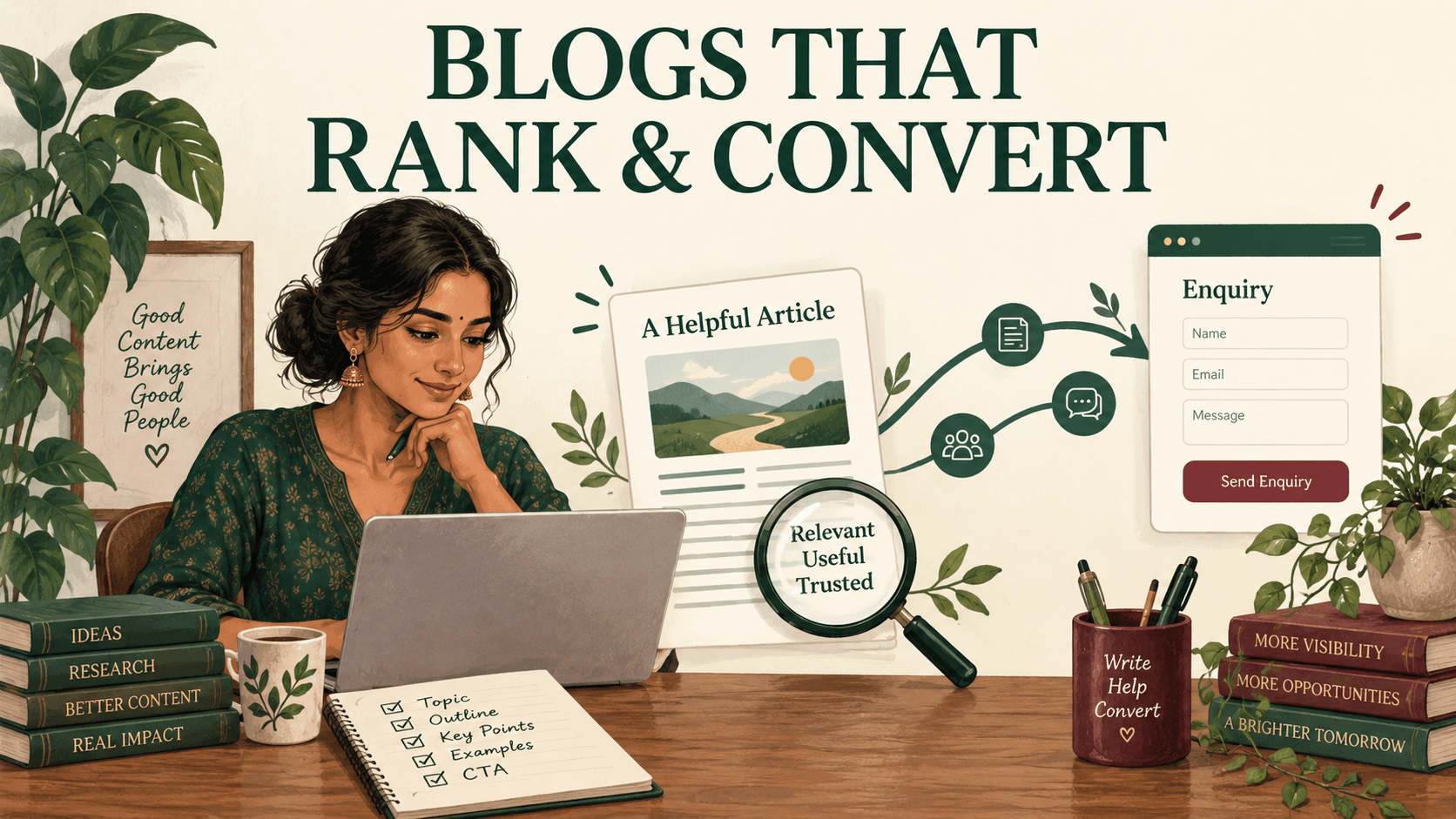
Updated: 3 October 2026
How to write blogs that rank and convert starts with understanding the reader’s task. A helpful blog answers the search accurately, adds something useful beyond a generic summary and gives the reader a relevant next step. Rankings and conversions depend on competition, site quality and the offer as well as the writing.
This 2026 workflow helps you research, draft, optimise and maintain a business blog. Use the checklist and sample brief to produce a page that deserves attention without filling it with keywords or unsupported claims.
1. Choose a topic connected to a customer need
Start with questions from sales, support, customer interviews and Search Console. Ask whether answering the question will help the customer choose, use or understand what you offer. Search volume alone is a poor reason to publish a topic unrelated to the business.
For example, a business offering Google Ads support can explain campaign setup, budget controls or lead quality. A broad celebrity-trend article may attract visitors but does little to help suitable customers.
2. Research search intent and the current results
Search the primary topic and review the leading organic results. Record the dominant format: tutorial, definition, comparison, troubleshooting list or commercial page. Notice the questions readers ask, the depth needed and whether images or demonstrations help explain the task.
Use that research to understand expectations, then create your own structure and examples. Do not copy headings and paraphrase competitors paragraph by paragraph. Check fast-changing claims against official sources.
A query such as “WordPress vs Shopify” needs a clear comparison and trade-offs. “How to run Google Ads in India” needs a setup workflow, budget explanation and troubleshooting. Match the article to the decision the reader is trying to make.
3. Write a brief before a draft
| Brief field | Example for an India Google Ads guide |
|---|---|
| Reader | A small-business owner setting up a first Search campaign |
| Primary task | Launch a relevant campaign with tested conversion tracking and controlled spend |
| Primary topic | How to run Google Ads in India |
| Supporting questions | Billing, INR budgets, keyword match types, landing pages, bidding and lead quality |
| Content format | Step-by-step guide, settings table, example and FAQs |
| Original value | A worked budget calculation and a launch/troubleshooting checklist |
| Evidence | Current Google Ads documentation and clearly labelled illustrative numbers |
| Next step | Related lead-quality guide or a relevant service enquiry |
| Success measure | Relevant search traffic plus qualified next-step actions |
Give the writer one main purpose. If the brief includes several unrelated purposes, split the topic into useful supporting pages and link them.
4. Answer early, then build the explanation
Use the opening paragraph to give the direct answer and scope. Follow it with a logical sequence of headings. Each section should solve a specific question or advance the task.
Weak opening: “In today’s ever-changing digital world, marketing is more important than ever.”
More useful opening: “To launch a Google Search campaign in India, define the conversion, set up billing and tracking, choose relevant keywords and locations, write ads, then test the landing page before spending.”
The second version tells the reader what they will learn. Use short paragraphs, descriptive headings and lists for genuinely parallel steps. Add a table when readers need to compare options.
5. Add evidence and original practical value
Useful additions include a tested process, a worked example, a checklist, an honest comparison or a diagram that makes the relationship clear. Use genuine business experience only when it is available and verifiable. Label hypothetical examples so readers do not mistake them for client results.
Link to primary sources for changing facts. State when prices or product instructions were checked. Explain limitations rather than claiming one tactic works for every business. If an article needs expert review, obtain it before attributing a reviewer or specialist credential.
6. Optimise the title, headings and snippet
- Title: make the topic and benefit specific. Include a year only when the content is meaningfully current and the date helps the reader.
- Main heading: align it with the title and actual article.
- Description: accurately preview the answer and useful details in a concise sentence or two.
- URL: keep a clear, stable slug. Changing an established URL requires redirects and a good reason.
- Subheadings: use questions or actions that reflect the explanation, not repeated keyword variations.
There is no exact character count that guarantees a title or description will display in full. Google may create a different title or snippet. Focus on clarity and relevance instead of chasing a plugin score.
7. Use internal links and images with a purpose
Link to related explanations and the relevant service or product when they help the reader continue. Use descriptive anchor text. A tutorial may need a process diagram; a comparison may need a table. Decorative images should not push the answer far down the page.
Use appropriately sized images, dimensions that reserve layout space and descriptive alt text when the image conveys information. Never label an AI illustration as a screenshot of a real campaign or a client result.
For an example of intent-matched comparison structure, see our WordPress vs Shopify guide. For stage-specific calls to action, use our marketing funnel template.
8. Make the next action fit the reader
A person learning a definition may want another explanation. Someone comparing providers may be ready to discuss requirements. Offer a next step that matches that readiness, rather than interrupting every section with the same sales pitch.
Describe what happens after an enquiry and avoid promising a free audit, download or result unless the business actually offers it. A working contact path and prompt response matter as much as the call-to-action wording.
9. Review AI-assisted content before publishing
AI can help organise a brief or draft, but verify facts, calculations and sources. Google’s AI content guidance, updated on 1 October 2026, reinforces accuracy and added value, including metadata and image descriptions. Mass-producing pages without useful value can create search-quality problems.
FAQs remain useful for readers. Google discontinued FAQ rich results in May 2026, so do not add questions solely to obtain that retired search display. There is also no special markup that guarantees inclusion in AI responses.
10. Publish, measure and maintain
Before publishing, check facts, headings, links, mobile layout, images and forms. Confirm that the public page is indexable and has appropriate canonical and metadata signals. Submit an updated URL or sitemap through Search Console when appropriate, then allow time for processing.
Measure relevant impressions and clicks, reader actions and lead quality. Separate a blog visit from a service enquiry and a paying customer. Use consistent campaign or analytics definitions and document when the article changed.
Review a post when the topic changes, links break or reader needs are not met. Do not change the date alone to make an unchanged article look fresh.
A pre-publication checklist
- The opening answers the task and defines scope.
- The article adds accurate examples, evidence or a useful tool.
- Claims and changing product details have been verified.
- Title, description, excerpt and cover match the content.
- Related links and a relevant next action work.
- Images and tables are usable on mobile.
- FAQs answer real follow-up questions.
- Tracking and a future review trigger are documented.
Discuss your content requirements with Digi Amenity. If existing articles underperform, use our SEO mistakes checklist to distinguish a writing problem from an indexing or website problem.
Frequently asked questions
How many words should a blog have to rank?
There is no universal ideal length. Use enough detail to complete the reader’s task accurately, with useful examples where needed. Remove repetition and padding.
How often should a business publish blogs?
Choose a pace that allows research, review and maintenance. Publishing frequency alone is not a ranking guarantee; a smaller number of useful pages can be more valuable than repetitive posts.
Can an AI-written blog rank?
AI assistance does not remove the need for useful, accurate and original value. Verify the output and avoid scaled content that exists mainly to manipulate search visibility.
How do I choose a focus keyword?
Choose the main question or topic the page answers, then use related terms naturally where needed. Avoid targeting several unrelated intents on one page.
How do I measure whether a blog converts?
Track the relevant next step, such as a service-page visit or qualified enquiry, and connect it to customer outcomes where possible. Page views and time on page alone do not prove commercial value.