
Updated: 3 October 2026
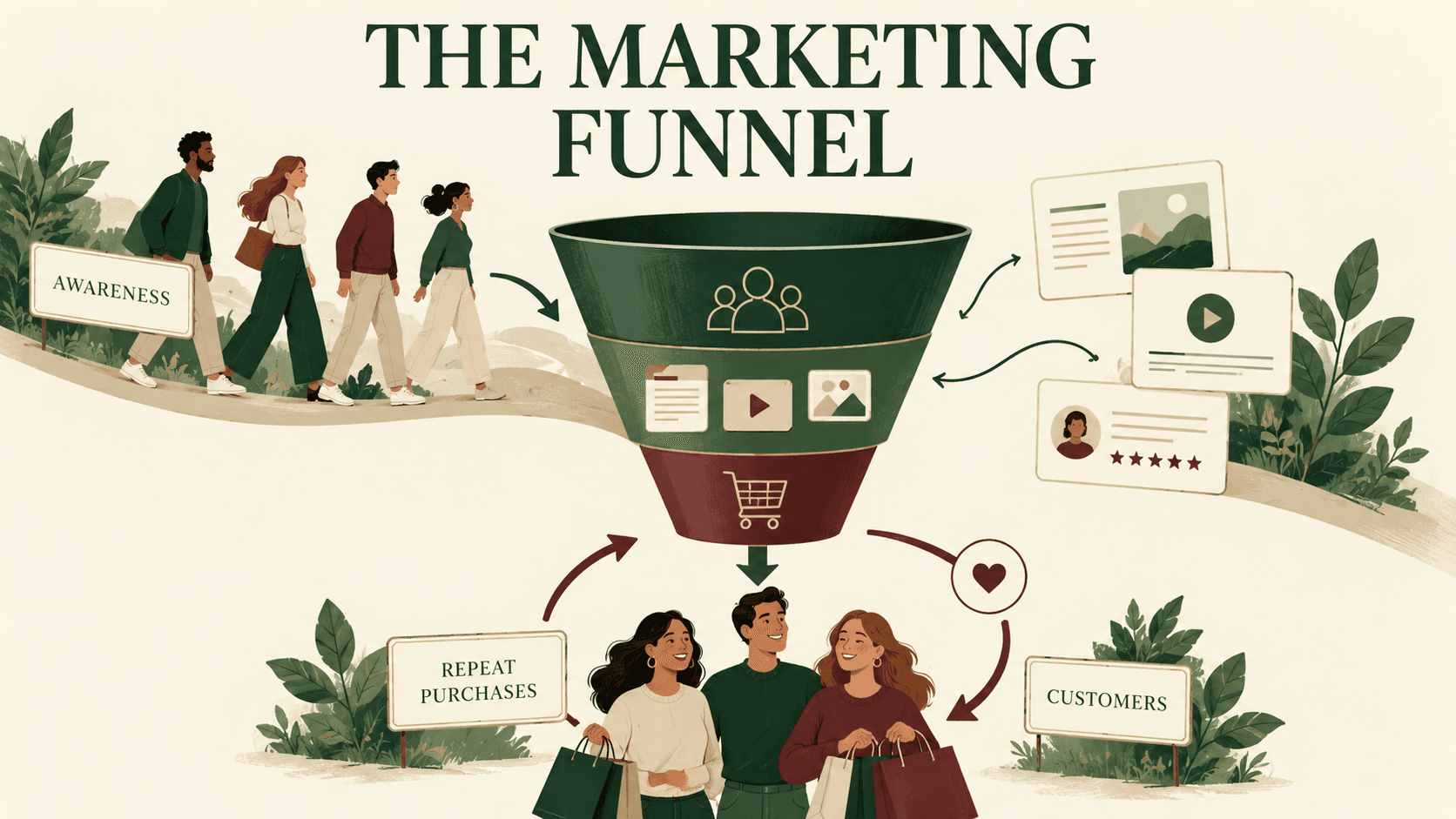
A marketing funnel is a framework for understanding how people move from discovering your business to evaluating an offer, becoming customers and buying again. It helps you choose useful content, define the next action and measure where the journey breaks down.
A funnel is a planning model, not a rule that every customer follows in order. Someone may see a video, search for reviews, speak to a salesperson and return weeks later. This guide explains the stages, a practical template and how to build a measurable funnel in 2026.
Marketing funnel vs sales funnel vs customer journey
A marketing funnel focuses on creating awareness, helping evaluation and generating demand. A sales funnel usually describes the progression from a lead or opportunity to a purchase. A customer journey maps actual touchpoints, including what happens after the sale. The labels overlap; agree on definitions so marketing and sales report the same outcomes.
TOFU, MOFU and BOFU are shorthand for top, middle and bottom of the funnel. AIDA—attention, interest, desire and action—is another way to describe progression. Use either model if it helps your team, and include retention rather than stopping at the first transaction.
The marketing funnel stages
| Stage | Customer question | Useful content or activity | Next action | Measure |
|---|---|---|---|---|
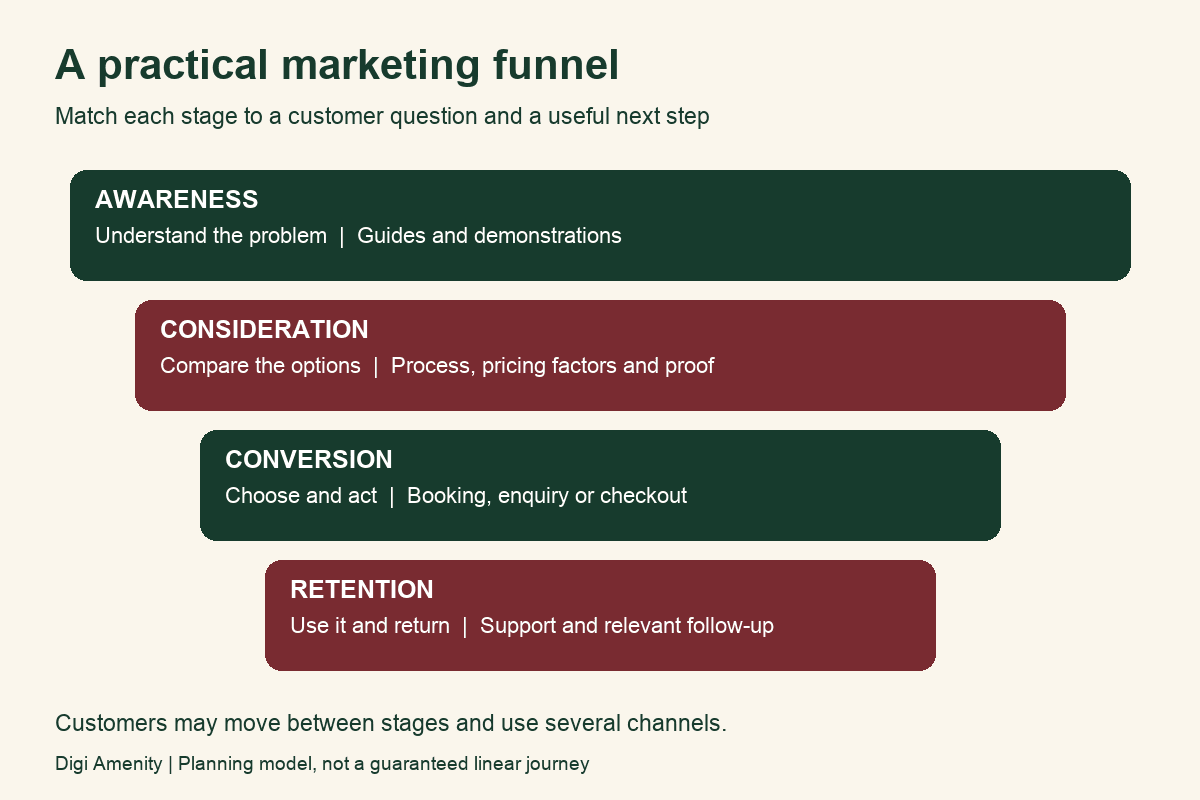
| Awareness / TOFU | “What is this problem and who can help?” | Educational guides, short demonstrations, relevant search or social discovery | Read, watch or explore a relevant page | Relevant reach, engaged visits and useful discovery queries |
| Consideration / MOFU | “Which approach or provider suits me?” | Comparisons, process explanations, pricing factors and genuine proof | View a service/product or request information | Qualified enquiries, product engagement and evaluation actions |
| Conversion / BOFU | “Can I trust this offer and buy now?” | Clear landing page, booking or checkout, specific offer and objections answered | Book, enquire or purchase | Qualified conversion rate, customer acquisition cost and sales |
| Retention | “Was it useful and what should I do next?” | Onboarding, support, relevant reminders and permission-based follow-up | Use the service, renew or buy again | Repeat rate, retention, customer value and satisfaction |
One piece of content can serve more than one stage. A clear comparison may introduce your business to a new reader and help an existing prospect make a decision.
How to build a marketing funnel in seven steps
1. Choose one audience and one offer
Define who you help, their situation and what they can buy. “Everyone in Mumbai” is too broad for a useful brief. “Small retailers needing a working online catalogue and checkout” gives you a clearer customer problem.
2. Define a valuable conversion
A form submission is not automatically a qualified lead. Write the criteria: relevant service need, serviceable location, realistic timeline and a way to contact the person. For ecommerce, define a completed order and account for cancellations and refunds.
3. Collect real customer questions
Use sales conversations, support requests, onsite search and Search Console queries. Group questions by discovery, evaluation and purchase. Avoid creating content only because a keyword tool shows volume.
4. Match content to each question
Build an explanation for awareness, a comparison or proof page for evaluation, and a clear transaction page for conversion. Include a relevant next step. Read our blog writing guide for an editorial workflow.
5. Connect the pages and follow-up
Link a guide to the related offer. Link an enquiry confirmation to useful next-step information. Assign who contacts new leads and what happens when someone is not ready. Permission-based email or messaging can help; repeated unsolicited messages can damage trust.
6. Test tracking and the customer experience
Complete the journey yourself on a phone. Check forms, notification emails, booking availability, checkout and analytics events. Ensure one action is not counted multiple times. Use campaign parameters consistently and reconcile analytics with CRM or order records.
7. Improve the weakest meaningful transition
Low traffic, low enquiry rate and poor sales qualification need different fixes. Change one important variable at a time where possible, record the change and judge it after enough relevant outcomes and conversion lag.
A practical marketing funnel example
Illustrative example: a Mumbai home-service provider wants booked jobs in areas it actually serves.
- Awareness: a useful maintenance guide answers a common problem and links to the relevant service.
- Consideration: the service page explains coverage, process, price factors and genuine work examples.
- Conversion: a short enquiry form asks for location and the issue; the team confirms availability and a quote.
- Retention: after completing the job, the business offers a relevant reminder with consent and requests honest feedback.
If the team receives unsuitable locations, make coverage clearer. If enquiries qualify but appointments are missed, fix scheduling and follow-up. More top-of-funnel traffic will not solve either problem.
Copy this funnel planning template
| Planning field | Fill in for your business |
|---|---|
| Audience and problem | Who needs the offer, in what situation, and why now? |
| Offer and qualification | What do you sell, who is a fit and what disqualifies a lead? |
| Awareness asset | One useful guide, demonstration or discovery campaign |
| Consideration asset | One comparison, service/product page or evidence resource |
| Conversion destination | A tested booking, enquiry or checkout path |
| Follow-up owner | Person, response process and CRM status definitions |
| Retention activity | Onboarding or permission-based reminder that adds value |
| Measurement | Primary conversion, qualified outcome, budget and review date |
This is an on-page template you can copy into your planning document. Start with one complete journey before buying a complex automation stack.
Measure funnel performance correctly
Stage conversion rate = people completing the next defined step ÷ people eligible at the previous step × 100. Use a consistent period and account for customers who convert later.
Illustrative numbers: 1,000 landing-page visits produce 50 enquiries, of which 20 qualify and five become customers. The visit-to-enquiry rate is 5%; the qualified-lead-to-customer rate is 25%. If the media spend is ₹10,000, enquiry CPL is ₹200, qualified CPL is ₹500 and media-only CAC is ₹2,000.
Those numbers are an explanation, not an industry benchmark. Margin, fulfilment costs, sales lag and repeat purchases determine whether the funnel makes business sense.
Tools and the 2026 measurement reality
A simple website, analytics and a lead spreadsheet may be enough to start. Add a CRM when lead volume, ownership and follow-up require it. Ecommerce teams can use order records, while booking businesses should reconcile appointments and completed work.
AI-assisted platforms can optimise delivery, but they need meaningful conversion definitions. Cross-device behaviour, consent choices and attribution models mean platforms may disagree. Review customer records alongside campaign reports. See our 2026 performance marketing guide for measurement priorities.
A 30-day build plan
- Week 1: define audience, offer, qualification and baseline numbers.
- Week 2: create or improve the key content and conversion page.
- Week 3: test tracking, notifications and follow-up, then launch one acquisition activity.
- Week 4: review qualified outcomes and the weakest transition; plan the next controlled test.
Common funnel mistakes
Avoid identical content at every stage, treating downloads as customers, optimising for spam leads, pushing every visitor straight to a sales call, and adding tools before the process works. Choose a relevant call to action that matches the reader’s readiness.
Discuss your marketing funnel with Digi Amenity if you need help connecting content, landing pages and campaign measurement.
Frequently asked questions
What are the main marketing funnel stages?
A useful model is awareness, consideration, conversion and retention. Some teams use more stages; the important part is agreeing on the customer question, next action and measure at each stage.
Is every customer journey linear?
No. Customers may skip stages, return to earlier research or use several channels. Use the funnel to plan and measure, then compare it with actual customer behaviour.
What is the difference between TOFU, MOFU and BOFU?
They mean top, middle and bottom of the funnel: discovery, evaluation and decision. The same page can sometimes help people at more than one stage.
Do I need expensive funnel software?
No. Start with a useful website, tested conversion tracking and a reliable lead or order log. Add tools when they solve a documented workflow problem.
What is a good funnel conversion rate?
There is no universal rate. Compare like-for-like audiences, offers and definitions, then assess qualified customers and margin rather than only form submissions.